

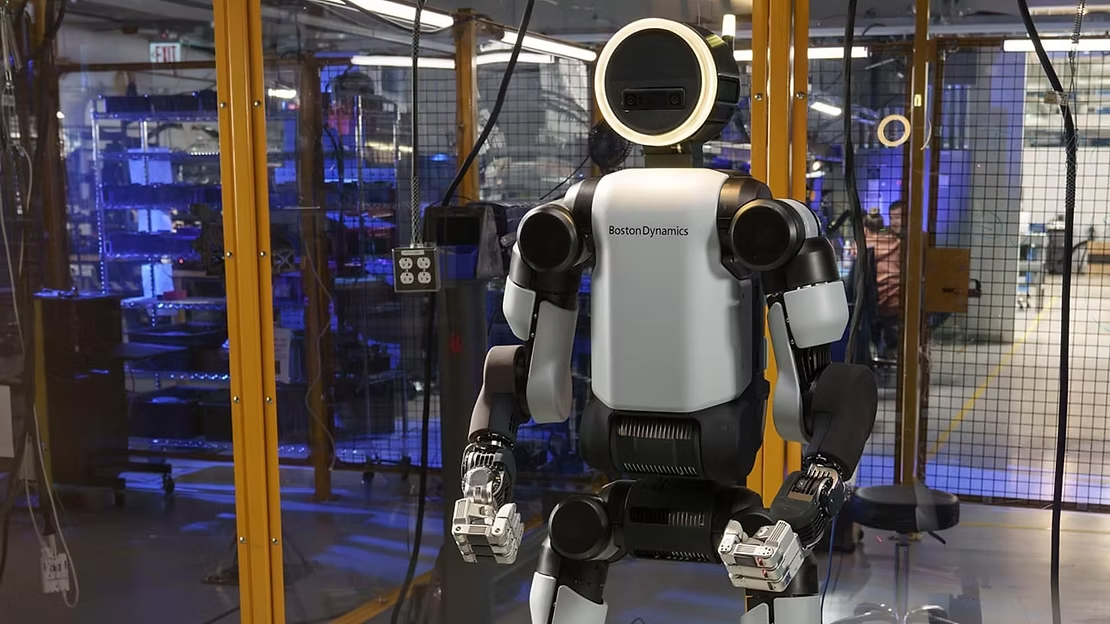
Over the last two decades, artificial intelligence (AI) and robotics have evolved from experimental technologies to integral drivers of modern industry. The convergence of machine learning, advanced sensors, and robotics engineering has catalysed a revolution in automation, transforming sectors ranging from manufacturing and logistics to healthcare and services. Companies at the forefront of AI robotics are no longer mere suppliers of machinery-they are innovators shaping the architecture of intelligent systems capable of perception, decision-making, and autonomous action.
This article examines leading AI robotics companies that are pioneering intelligent automation, highlighting their technologies and practical applications that demonstrate how AI robotics is reshaping global industries.
Understanding AI Robotics
What is AI Robotics?
AI robotics refers to the integration of artificial intelligence with robotic systems to enable machines to perceive, learn, and adapt to their environment. Unlike traditional robots that follow pre-programmed instructions, AI-enabled robots can make decisions based on real-time data, improving efficiency, flexibility, and resilience.
Key components include:
- Machine Learning Algorithms: Allow robots to learn from experience and improve performance over time.
- Computer Vision: Enables perception, object recognition, and navigation.
- Natural Language Processing: Facilitates interaction with humans via speech or text.
- Actuation and Sensor Systems: Provide the physical capability to manipulate environments or perform tasks autonomously.
How AI Robotics Works in Practice
In manufacturing, AI robots optimise production lines by predicting maintenance needs and dynamically adjusting workflows. In logistics, autonomous robots navigate warehouses, reducing operational bottlenecks. Healthcare applications include surgical robots that assist physicians with precision tasks, while service robots can engage with customers in retail or hospitality settings.
The success of these systems depends on combining robust hardware with sophisticated AI software to ensure reliability, safety, and adaptability.
Top 10 AI Robotics Companies and Their Use Cases
- Boston Dynamics
Boston Dynamics is renowned for its agile, dynamic robots, such as Spot, a quadruped capable of navigating complex terrain.
Use Cases:
- Industrial Inspection: Spot inspections of hazardous environments, such as construction sites or oil rigs, reduce human risk.
- Security Patrols: Autonomous patrolling in campuses and industrial facilities.
- Research & Development: Robotics labs use Boston Dynamics’ robots to test AI navigation and mobility algorithms.
- ABB Robotics
ABB integrates AI into industrial and collaborative robots (cobots) to drive manufacturing and production automation.
Use Cases:
- Automotive Assembly: AI-guided robots perform welding, painting, and assembly with high precision.
- Food & Beverage Packaging: Cobots handle packaging, sorting, and quality inspection tasks.
- Predictive Maintenance: AI analyses sensor data to anticipate equipment failures.
- Fanuc Corporation
Fanuc specialises in industrial automation with AI-enhanced robotic arms for manufacturing.
Use Cases:
- Electronics Manufacturing: AI-driven robotic arms perform delicate assembly and soldering.
- Automobile Production: Robots manage repetitive tasks such as painting and welding.
- Quality Assurance: AI identifies defective products in real time.
- UiPath
UiPath is a leader in robotic process automation (RPA), combining AI with software robots for enterprise workflows.
Use Cases:
- Financial Operations: Automates invoicing, transaction reconciliation, and compliance reporting.
- Customer Service: AI chatbots and automation handle repetitive client queries.
- Data Management: Automates large-scale data processing across ERP systems.
- iRobot
iRobot focuses on consumer-facing robotics with AI-enabled autonomous cleaners.
Use Cases:
- Home Automation: Robotic vacuum cleaners map homes, plan cleaning routes, and adapt to obstacles.
- Elderly Assistance: Adapted systems monitor household activities and assist with routine tasks.
- Data Collection: AI mapping improves smart home integration and spatial awareness.
- KUKA Robotics
KUKA provides AI-enhanced industrial robots for flexible automation.
Use Cases:
- Automotive Manufacturing: Cobots assist human workers on assembly lines, enhancing safety and efficiency.
- Metal Fabrication: Robots perform precision cutting, welding, and finishing.
- Research Applications: Universities and labs use KUKA robots to conduct AI motion-planning experiments.
- NVIDIA Robotics
NVIDIA provides AI computing platforms, such as the Isaac SDK, to power robotic perception and decision-making.
Use Cases:
- Autonomous Navigation: Robots and drones use NVIDIA GPUs to map the environment in real time.
- Simulation: AI-driven simulation platforms train robots in virtual environments before deployment.
- Robotic Surgery: Assists in surgical robots with image recognition and precision guidance.
- SoftBank Robotics
SoftBank develops humanoid and service robots, including Pepper.
Use Cases:
- Customer Engagement: Pepper supports retail, hospitality, and banking through human-like interaction.
- Healthcare Assistance: Provides companionship and monitoring for patients in care facilities.
- Education: Robots are deployed in classrooms to support interactive learning.
- Blue River Technology
Blue River Technology focuses on precision agriculture using AI robotics.
Use Cases:
- Targeted Herbicide Application: Robots identify individual plants to apply herbicides only where necessary.
- Crop Monitoring: AI-powered systems analyse plant health for optimal yield.
- Sustainability Initiatives: Reduce chemical usage and water waste through precise automation.
- Fetch Robotics
Fetch Robotics provides autonomous mobile robots (AMRs) for logistics and material handling.
Use Cases:
- Warehouse Automation: AMRs efficiently transport goods across large warehouses.
- Hospital Logistics: Robots deliver medicines, equipment, and supplies.
- Factory Floor Support: Automated trolleys assist human workers with material movement.
Implications of AI Robotics
Economic and Industrial Impact
AI robotics is reshaping industrial productivity, lowering operational costs, and reducing human error. For manufacturers, intelligent robots facilitate 24/7 operations, rapid prototyping, and high-quality output. In logistics, autonomous robots improve throughput, inventory accuracy, and supply chain resilience.
Workforce and Education
The integration of AI robotics introduces a paradigm shift in workforce requirements. Demand is growing for roles in robotics engineering, AI programming, and systems maintenance. Educational institutions are responding with specialised curricula to equip students with interdisciplinary skills spanning mechanical engineering, computer science, and AI ethics.
Governance and Ethical Considerations
The rise of intelligent automation brings regulatory and ethical questions, including safety standards, accountability, and transparency of AI decision-making. Policymakers must balance innovation with safeguards to prevent misuse or unintended societal consequences.
Challenges and Constraints
Despite rapid progress, AI robotics faces constraints:
- High Initial Investment: Advanced robotics systems require significant capital for acquisition, deployment, and maintenance.
- Integration Complexity: Existing industrial systems may require redesign to accommodate autonomous robotics.
- Safety and Reliability: Ensuring fail-safe operation in unpredictable environments remains a critical challenge.
- Skill Shortage: A limited talent pool can hinder the adoption and scalability of AI robotics solutions.
Overcoming these challenges requires collaboration among companies, research institutions, and regulatory bodies, as well as investment in workforce development.
The Path Forward
Meaningful progress in AI robotics relies on:
- Standardisation: Establishing interoperability standards and safety protocols for autonomous systems.
- Accessible Innovation: Developing modular, cost-effective solutions to broaden adoption across industries.
- Ethical AI Integration: Embedding transparency, fairness, and accountability into autonomous decision-making systems.
- Continuous Learning: Creating AI systems capable of lifelong learning and adaptation to evolving environments.
By addressing these factors, AI robotics can continue to drive transformative gains while mitigating risks associated with widespread automation.
The companies highlighted in this analysis represent the forefront of intelligent automation, demonstrating how AI and robotics are reshaping industries worldwide. From precision agriculture to dynamic mobility and service automation, their innovations demonstrate AI’s potential when combined with robust robotics.
As these technologies mature, they will not only increase efficiency and productivity but also redefine human roles in complex systems. The global challenge lies in integrating these advancements responsibly, ensuring intelligent automation delivers economic, social, and ethical benefits at scale.
Through careful planning, cross-sector collaboration, and continuous innovation, AI robotics will remain a defining force in the evolution of modern industry and human-machine collaboration.

Senior Reporter/Editor
Bio: Ugochukwu is a freelance journalist and Editor at AIbase.ng, with a strong professional focus on investigative reporting. He holds a degree in Mass Communication and brings extensive experience in news gathering, reporting, and editorial writing. With over a decade of active engagement across diverse news outlets, he contributes in-depth analytical, practical, and expository articles exploring artificial intelligence and its real-world impact. His seasoned newsroom experience and well-established information networks provide AIbase.ng with credible, timely, and high-quality coverage of emerging AI developments.