

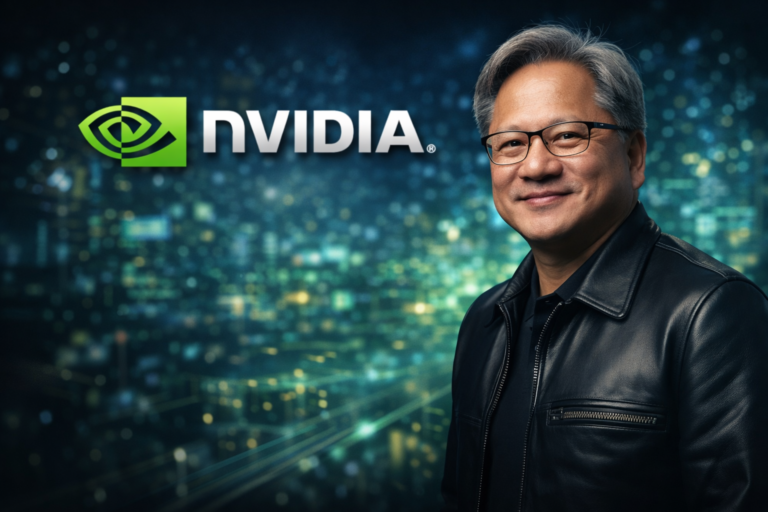
NVIDIA is not just a technology company. It is the invisible infrastructure behind modern artificial intelligence, powering everything from ChatGPT and self-driving cars to medical research, cloud data centres, and the future of robotics.
What began as a small graphics chip startup in the 1990s has become one of the most influential companies shaping how machines learn, think, and interact with the world.
For Nigeria and Africa, where AI adoption, digital transformation, fintech innovation, and cloud infrastructure are accelerating, understanding NVIDIA is essential.
This is the definitive guide to what NVIDIA is, how it works, why it dominates AI, and what its rise means for the future of computing globally and locally.
1. Origins: The Bet That Changed Computing Forever
NVIDIA was founded in April 1993 by Jensen Huang, Chris Malachowsky, and Curtis Priem, when the future of computing seemed largely settled. Intel and other CPU makers dominated the industry, and most people believed progress would come from making processors faster rather than from fundamentally different designs.
The three founders disagreed.
They believed that graphics processing—the task of rendering images, video, and visual effects—was not merely a feature for games or design software, but a new way of thinking about computation itself. Graphics required handling thousands of calculations simultaneously, something traditional CPUs were not built to do efficiently.
That belief would later reshape the entire technology industry, but in the early years, it nearly destroyed the company.
1993–1996: A Risky Beginning
NVIDIA began with a bold but unproven idea: that dedicated graphics chips could transform personal computing. At the time, most PCs relied on basic graphics handled by the CPU. Dedicated graphics hardware was rare and expensive.
In 1995, NVIDIA released its first major product, the NV1. It was ambitious, combining graphics, audio, and input processing into a single chip. Unfortunately, the market was not ready. The NV1 was incompatible with Microsoft’s emerging DirectX standard, which quickly became the industry norm.
The result was a commercial failure.
By 1996, NVIDIA was running out of cash. The company had burned through most of its venture funding, morale was low, and bankruptcy was a real possibility. Many Silicon Valley startups ended at this stage.
NVIDIA did not.
1997–1999: The Pivot That Saved the Company
Facing extinction, NVIDIA made a decisive pivot. It abandoned the NV1 architecture and focused entirely on building chips compatible with DirectX, even if it meant starting over.
In 1997, NVIDIA released the RIVA 128, a graphics chip that finally gained traction. It was not perfect, but it proved NVIDIA could compete.
Then came the breakthrough.
In 1999, NVIDIA released the GeForce 256, which it famously marketed as the world’s first GPU (Graphics Processing Unit). This was more than branding. The GeForce 256 introduced hardware-based transform and lighting, moving complex calculations off the CPU and onto the graphics chip.
This moment is widely considered NVIDIA’s first true landmark.
The GPU concept reframed graphics as a parallel computing problem and established NVIDIA as a serious force in the industry.
2000–2005: Dominating Graphics, Building Confidence
Throughout the early 2000s, NVIDIA aggressively iterated on its GPU designs. Each generation improved performance, efficiency, and programmability.
Key milestones include:
-
2001–2003: GeForce 3 and 4 series strengthen NVIDIA’s gaming dominance
-
2004: NVIDIA goes public on NASDAQ (NVDA), solidifying its financial footing
-
2005: NVIDIA becomes the clear leader in PC graphics
By this point, NVIDIA was widely known as a gaming and graphics company. But internally, something more important was happening.
Engineers and researchers began to realise that GPUs were not just good at graphics—they were good at general-purpose parallel computation.
2006: CUDA and the Quiet Revolution
In 2006, NVIDIA released CUDA (Compute Unified Device Architecture), a software platform that enabled developers to program GPUs using familiar languages such as C and C++.
At the time, CUDA attracted little mainstream attention. But in hindsight, it may be the most important product NVIDIA ever released.
CUDA transformed GPUs from fixed-function graphics chips into programmable computing engines. Researchers in physics, chemistry, finance, and eventually machine learning began using NVIDIA GPUs to accelerate workloads that would take CPUs days or weeks to complete.
This was the moment NVIDIA unknowingly laid the foundation for the AI era.
2010–2012: The AI Inflexion Point
The true turning point came around 2012, when researchers demonstrated that deep neural networks trained on GPUs dramatically outperformed traditional approaches.
One famous example was AlexNet, which used NVIDIA GPUs to win the ImageNet competition by a massive margin. This result shocked the AI research community.
Suddenly, GPUs were no longer just for graphics or scientific computing; they were essential for machine learning.
NVIDIA noticed immediately.
While many companies treated AI as a side project, NVIDIA reorganised around it.
2013–2016: Betting the Company on AI
Under Jensen Huang’s leadership, NVIDIA made a bold decision: it would reorient the entire company around accelerated computing and artificial intelligence.
Key developments during this period include:
-
Heavy investment in AI software libraries and frameworks
-
GPUs optimised specifically for deep learning
-
Partnerships with universities, cloud providers, and research labs
In 2016, NVIDIA launched the DGX-1, a purpose-built AI supercomputer. It was expensive, niche, and misunderstood by many analysts, but it signalled NVIDIA’s intent to become an AI infrastructure, not just a chip supplier.
From Survival to Strategy
Looking back, NVIDIA’s origin story is not one of instant success, but of repeated near-failure, rapid learning, and long-term conviction.
The company survived because it embraced a simple but powerful idea early:
Some problems are better solved by doing many calculations at the same time.
That idea of parallel computing became the backbone of modern artificial intelligence.
What began in the 1990s as a risky bet on graphics ultimately became the foundation for the AI revolution powering today’s data centres, startups, and digital economies, including those emerging across Nigeria and Africa.
NVIDIA did not just adapt to the future of computing.
It helped invent it.
2. The Philosophy: How NVIDIA Thinks
To understand NVIDIA, you must understand its core philosophy: accelerated computing.
Traditional CPUs are designed to do a few complex tasks very quickly. GPUs, pioneered by NVIDIA, are designed to perform many simple tasks simultaneously. This parallel approach is ideal for graphics, and later proved perfect for machine learning and artificial intelligence.
NVIDIA does not see itself as a chip company. It sees itself as a platform company. Its goal is not just to sell hardware, but to create entire ecosystems where developers, researchers, startups, and enterprises build on NVIDIA technology by default.
This long-term thinking is driven largely by founder and CEO Jensen Huang, one of Silicon Valley’s most respected leaders. His style is intense, technical, and deeply focused on the future. NVIDIA is known internally for demanding excellence, moving fast, and making bets that may take a decade to pay off.
3. The NVIDIA Technology Stack: Where the Real Power Lies
NVIDIA’s dominance comes from owning the full technology stack- from silicon to software to systems.
Hardware: The GPU Advantage
NVIDIA’s graphics processing units (GPUs) are the foundation of its power. While GPUs were originally built for gaming (GeForce), they evolved into tools for professional graphics (Quadro, now RTX) and data centres.
Today, NVIDIA’s data-centre GPUs are the gold standard for AI training and inference. They are used by:
-
Cloud providers like AWS, Microsoft Azure, and Google Cloud
-
AI labs and startups
-
Governments and research institutions
For Nigerian developers, startups, and enterprises using cloud AI services, NVIDIA GPUs are almost always working behind the scenes.
Software: CUDA, the Hidden Moat
If NVIDIA’s hardware is the engine, CUDA is the fuel-and the lock-in.
CUDA is NVIDIA’s proprietary software platform that allows developers to write programs that run efficiently on GPUs. Over the past 15+ years, CUDA has become deeply embedded in AI research, machine learning libraries, scientific computing, and enterprise software.
This is why NVIDIA is so hard to replace. Even if a competitor builds a powerful chip, developers would still need to rewrite years of software. That friction protects NVIDIA more than any patent.
Systems: From Chips to AI Factories
NVIDIA increasingly sells full systems, not just components. Products such as DGX systems and AI supercomputers enable companies to quickly deploy massive AI infrastructure.
This shift matters for emerging markets such as Nigeria, where organisations may lack deep hardware expertise but still want to deploy AI at scale via cloud providers or regional data centres.
4. NVIDIA and Artificial Intelligence: From Accident to Inevitability
Interestingly, NVIDIA did not set out to dominate AI.
In the mid-2000s, researchers discovered that GPUs- designed for graphics- were incredibly effective at training neural networks. NVIDIA noticed early and leaned in hard.
Over time, nearly every major AI breakthrough- from image recognition to large language models—ran on NVIDIA GPUs. Today:
-
Most AI model training happens on NVIDIA hardware
-
Most AI inference at scale uses NVIDIA systems
-
Most AI research frameworks are optimised for NVIDIA
This makes NVIDIA the “picks and shovels” company of the AI gold rush.
For Africa’s growing AI ecosystem spanning fintech, health tech, agritech, and education, NVIDIA’s platforms are foundational, even when accessed indirectly through the cloud.
5. Business Model: How NVIDIA Makes Money
NVIDIA’s revenue comes primarily from:
-
Data Centre -AI and cloud computing (fastest growing)
-
Gaming – Consumer GPUs
-
Professional Visualisation – Design, simulation, digital twins
-
Automotive & Robotics – Self-driving and embedded AI
The data-centre segment now dominates, driven by global demand for AI compute. NVIDIA’s margins are exceptionally high because it sells high-value infrastructure with strong software lock-in.
Unlike many tech companies, NVIDIA does not manufacture its own chips. It relies heavily on partners such as TSMC, which introduces both efficiency gains and risk.
6. Competition: Why No One Has Fully Caught Up
NVIDIA faces competition from:
-
AMD – Strong hardware, weaker software ecosystem
-
Intel – Catching up but late to AI GPUs
-
Cloud giants – Google, Amazon, and Microsoft building custom chips
However, NVIDIA’s advantage is not just performance. It is ecosystem gravity. Developers, researchers, tools, libraries, and workflows all assume NVIDIA by default.
For competitors to win, they must offer not just better chips, but a better platform. That is extremely difficult.
7. Culture and Leadership: The Jensen Huang Effect
Jensen Huang is central to NVIDIA’s identity. Known for wearing his trademark leather jacket, he is both a technologist and a strategist.
NVIDIA’s culture emphasises:
-
Long-term thinking
-
Technical depth
-
Speed and accountability
-
Obsession with customer success
This culture has allowed NVIDIA to survive multiple tech cycles and emerge stronger each time.
8. Power, Politics, and Risk
Despite its dominance, NVIDIA faces real risks:
-
Geopolitical tensions, especially the US–China export restrictions
-
Supply chain dependence on TSMC
-
AI hype cycles, which could slow investment
-
Regulatory scrutiny as AI becomes more powerful
In African markets, global politics can indirectly affect access to advanced AI infrastructure through pricing, cloud availability, and export controls.
9. NVIDIA’s Vision of the Future
NVIDIA believes the future will be built on:
-
AI factories: Data centres designed specifically for AI
-
Digital twins: Virtual simulations of real-world systems
-
Robotics and autonomous machines
-
AI-native industries, from healthcare to manufacturing
This vision aligns closely with Africa’s need to leapfrog legacy systems using smart, scalable technology.
10. The Bull Case vs the Bear Case
The Bull Case
-
AI demand continues to grow exponentially
-
NVIDIA maintains platform dominance
-
Software lock-in deepens
-
AI becomes as fundamental as electricity
The Bear Case
-
Competition accelerates
-
Governments restrict exports further
-
AI spending slows
-
New computing paradigms emerge
Reality will likely fall somewhere in between.
11. What NVIDIA Ultimately Stands For
At its core, NVIDIA stands for one idea:
Computing should adapt to human ambition—not limit it.
NVIDIA is building the infrastructure for intelligence itself. Not just faster computers, but smarter systems that can learn, reason, and act.
In Nigeria and across Africa, with immense human potential and rapidly growing digital ecosystems, NVIDIA’s technology represents both an opportunity and a dependency. Understanding NVIDIA is understanding the future of AI-powered development.
Final Take
NVIDIA is no longer just a tech company. It is a foundational layer of the modern digital world.
As artificial intelligence reshapes economies, industries, and societies, NVIDIA sits at the centre quietly powering the machines that will define the next era of human progress.
This is why NVIDIA matters. And this is why it will continue to shape the AI era for years to come.

Director
Bio: An (HND, BA, MBA, MSc) is a tech-savvy digital marketing professional, writing on artificial intelligence, digital tools, and emerging technologies. He holds an HND in Marketing, is a Chartered Marketer, earned an MBA in Marketing Management from LAUTECH, a BA in Marketing Management and Web Technologies from York St John University, and an MSc in Social Business and Marketing Management from the University of Salford, Manchester.
He has professional experience across sales, hospitality, healthcare, digital marketing, and business development, and has worked with Sheraton Hotels, A24 Group, and Kendal Nutricare. A skilled editor and web designer, He focuses on simplifying complex technologies and highlighting AI-driven opportunities for businesses and professionals.