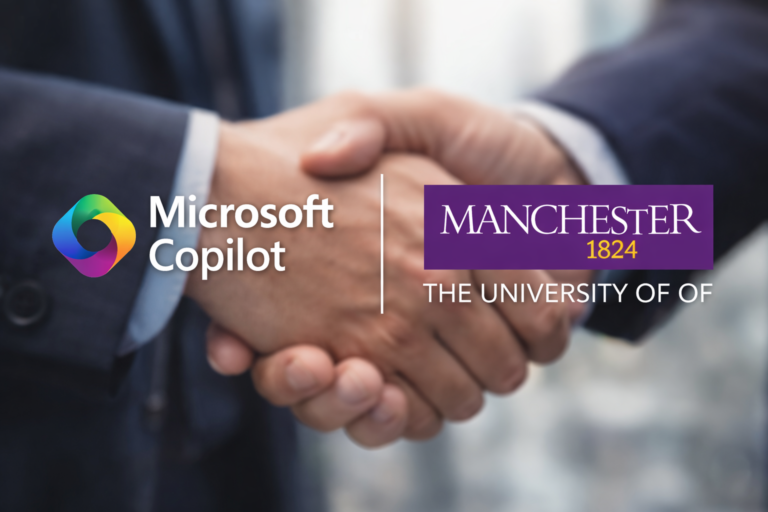
In a landmark development that highlights the growing influence of artificial intelligence in global education, technology giant Microsoft and The University of Manchester have announced a world-first artificial intelligence partnership, setting a new benchmark for how universities can integrate AI into teaching, research and administration.
The partnership, announced through official press releases published on the websites of Microsoft and The University of Manchester, will make the UK-based institution the first university globally to provide Microsoft 365 Copilot to all its students and staff, alongside comprehensive training on the responsible use of artificial intelligence.
With the initiative expected to cover more than 65,000 students and staff, the collaboration represents one of the most ambitious efforts yet to mainstream AI tools across an entire university community. Microsoft 365 Copilot is an AI-powered assistant embedded in commonly used applications such as Word, Excel, PowerPoint and Outlook, designed to support writing, data analysis, presentations, research organisation and workflow efficiency.
Announcing the partnership, the University of Manchester described it as a strategic move to prepare students and staff for a future increasingly shaped by artificial intelligence, while maintaining academic integrity and ethical standards.
“This world-first partnership ensures that every member of our university community has access to AI tools, supported by clear guidance and training on their responsible use,” the university said in its press release. “Our goal is to equip students and staff with the skills needed to thrive in an AI-enabled world.”
Microsoft, in its own statement, emphasised the role of higher education institutions in shaping how AI is adopted across society. The company noted that universities are uniquely positioned to model ethical, transparent and productive uses of artificial intelligence.
“Universities play a critical role in preparing people for the future of work,” Microsoft said. “By working with The University of Manchester, we are supporting a model of AI adoption that is inclusive, responsible and focused on real-world impact.”
Beyond access to technology, the partnership places strong emphasis on AI literacy and governance. According to details released by the university, students and staff will receive structured training on how to use AI tools effectively, understand their limitations, protect data privacy and avoid misuse, particularly in academic work.
The initiative comes at a time when universities worldwide are grappling with how to respond to the rapid rise of AI tools, amid concerns about plagiarism, misinformation, data security and ethical boundaries. Rather than restricting access, the University of Manchester has opted for a regulated, institution-wide approach that combines access with education and oversight.
Although the partnership is based in the United Kingdom, analysts say its implications extend far beyond Europe, including to Nigeria, where artificial intelligence adoption is accelerating across education, business and public services. Nigerian students and professionals rank among the most active users of AI tools globally, often relying on them for learning, research and entrepreneurship.
Education stakeholders in Nigeria have repeatedly called for clearer frameworks on AI use in universities, warning that the absence of institutional policies could lead to misuse or unequal access. Observers believe the Manchester-Microsoft model offers useful lessons for Nigerian higher institutions seeking to integrate AI in a structured and ethical manner.
A Lagos-based education technology analyst noted that, “What Manchester has done is show that AI does not have to be treated as a threat. With the right policies and training, it can become a tool that improves learning outcomes and prepares graduates for the modern workplace.”
The partnership also aligns with broader global conversations around the future of work, as employers increasingly expect graduates to possess digital and AI-related skills. By embedding AI tools into everyday academic activities, the University of Manchester aims to ensure that its graduates are not only familiar with AI, but capable of using it responsibly and productively.
Founded in 1824, The University of Manchester is widely recognised for its research excellence and history of innovation, having produced multiple Nobel laureates. Microsoft, meanwhile, remains one of the world’s leading technology companies, with significant investments in artificial intelligence, cloud computing and digital education.
As artificial intelligence continues to reshape economies and societies, the world-first partnership between Microsoft and The University of Manchester signals a shift towards planned, inclusive and responsible AI adoption in education. For countries like Nigeria, where interest in AI is high but regulatory and institutional frameworks are still evolving, the development offers a glimpse into how global best practices might be adapted to local realities.

Senior Reporter/Editor
Bio: Ugochukwu is a freelance journalist and Editor at AIbase.ng, with a strong professional focus on investigative reporting. He holds a degree in Mass Communication and brings extensive experience in news gathering, reporting, and editorial writing. With over a decade of active engagement across diverse news outlets, he contributes in-depth analytical, practical, and expository articles exploring artificial intelligence and its real-world impact. His seasoned newsroom experience and well-established information networks provide AIbase.ng with credible, timely, and high-quality coverage of emerging AI developments.