

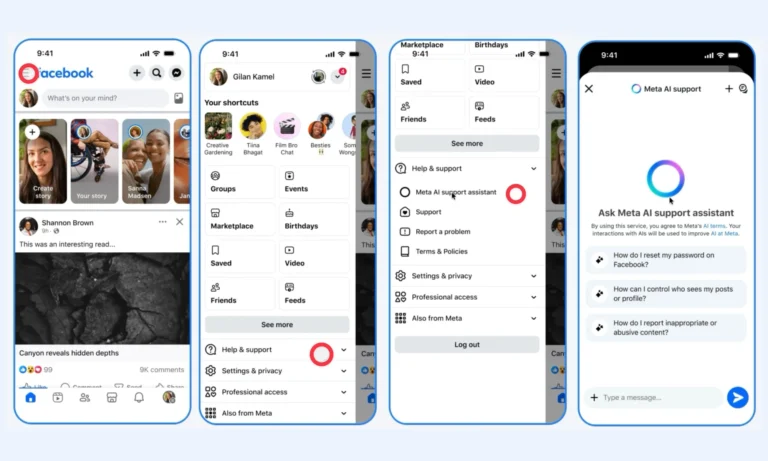
Meta has introduced an AI-powered support assistant across its flagship platforms, Facebook and Instagram, marking a significant step in the company’s push to automate user support and enhance platform efficiency at scale.
The new AI support assistant is designed to provide users with instant responses to common account and platform-related issues, reducing the need for traditional support channels and long waiting times. The rollout reflects Meta’s broader strategy to integrate artificial intelligence more deeply into its ecosystem, transforming not only user interaction but also backend operations.
The assistant operates through a chat-style interface embedded within the platforms, allowing users to interact with it in a conversational format. From account recovery and password issues to general platform guidance, the system is built to handle a wide range of routine queries without human intervention. This approach is expected to significantly improve response times, particularly given the scale of Meta’s global user base.
Meta’s move comes amid growing demand for faster, more reliable support services, as billions of users rely on Facebook and Instagram for communication, business, and content creation. Traditional support systems have often struggled to keep up with this demand, leading to delays and user frustration. By introducing AI-driven assistance, Meta aims to address these challenges while maintaining service quality.
Beyond efficiency, the introduction of the AI support assistant highlights a broader shift towards automation within the technology industry. Artificial intelligence is increasingly being deployed to handle repetitive, high-volume tasks, freeing human teams to focus on more complex and sensitive issues. In Meta’s case, this could include cases involving content moderation, policy enforcement, and user safety, where human judgment remains critical.
The development also builds on Meta’s wider investments in AI, including generative AI tools and conversational assistants integrated across its platforms. The support assistant represents a practical application of these capabilities, moving AI from experimental features to core infrastructure within the company’s operations.
However, the rollout raises important considerations around accuracy, accountability, and user trust. While AI systems can deliver speed and scalability, concerns remain about their ability to handle nuanced or sensitive cases effectively. Ensuring that users can escalate issues to human support when necessary will be essential to maintaining confidence in the system.
- Related: Mate AI for creators
For users, the change is likely to be most noticeable in the speed and accessibility of help services. Instead of navigating multiple help pages or waiting for responses, users can now receive immediate assistance through a familiar chat interface. This aligns with a broader trend across digital platforms, where conversational AI is becoming the primary interface for support and engagement.
The introduction of the AI support assistant also signals how large technology companies are rethinking their operational models. As AI continues to evolve, its role is expanding from enhancing features to underpinning entire systems, including customer support, content delivery, and platform management.
For the global tech ecosystem, Meta’s latest move reinforces the growing importance of AI as a foundational layer in digital services. For regions such as Nigeria and Africa more broadly, it underscores the need for users, businesses, and policymakers to understand how AI-driven systems are shaping everyday digital experiences.
As Meta continues to refine and expand its AI capabilities, the support assistant is likely to evolve, incorporating more advanced features and handling increasingly complex queries. What remains clear is that artificial intelligence is no longer a peripheral tool; it is becoming central to how platforms operate and how users interact with them.

Director
Bio: An (HND, BA, MBA, MSc) is a tech-savvy digital marketing professional, writing on artificial intelligence, digital tools, and emerging technologies. He holds an HND in Marketing, is a Chartered Marketer, earned an MBA in Marketing Management from LAUTECH, a BA in Marketing Management and Web Technologies from York St John University, and an MSc in Social Business and Marketing Management from the University of Salford, Manchester.
He has professional experience across sales, hospitality, healthcare, digital marketing, and business development, and has worked with Sheraton Hotels, A24 Group, and Kendal Nutricare. A skilled editor and web designer, He focuses on simplifying complex technologies and highlighting AI-driven opportunities for businesses and professionals.