

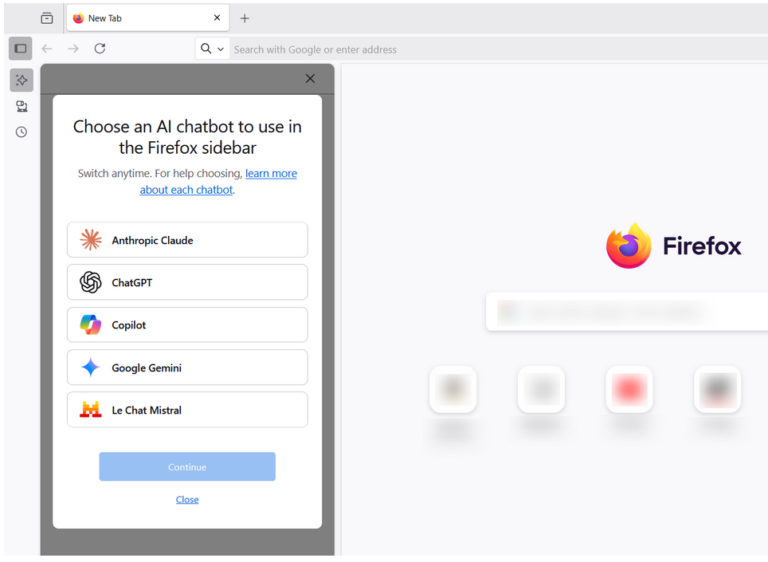
Firefox update highlights growing race to add artificial intelligence tools to web browsers while keeping user privacy and control at the centre
Mozilla has introduced new artificial intelligence chatbot controls in its Firefox browser, reflecting the growing shift towards AI-powered web browsing. The change allows users to decide how chatbots interact with the browser, signalling how web browsers are increasingly becoming platforms for built-in artificial intelligence tools rather than simple software for viewing websites.
The update to Firefox may appear minor, but it comes at a time when technology companies are competing to integrate AI features directly into everyday applications. Industry analysts say the addition of Firefox AI controls shows how internet browsing is changing, with artificial intelligence expected to play a much larger role in the future.
Browsers are becoming AI platforms
Web browsers have traditionally focused on speed, security and compatibility. However, recent developments suggest artificial intelligence will become the next major feature built into browsing software.
Mozilla’s latest update introduces settings that let users control whether AI chatbots can be used in the browser. This brings Firefox closer to rival browsers that are already experimenting with built-in AI assistants.
For example, Microsoft Edge includes AI tools linked to Microsoft’s Copilot system, while Google Chrome has been testing new features powered by Google’s artificial intelligence technology.
Technology experts say this shows browsers are evolving into digital platforms where users can search, write, summarise and interact with AI without leaving the page they are viewing.
Mozilla puts focus on privacy and user control
The organisation behind Firefox, Mozilla, has long promoted the browser as a privacy-focused alternative to products made by larger technology companies. The new Firefox AI controls follow the same approach by allowing users to decide whether chatbot features are enabled.
Some users have raised concerns about how artificial intelligence tools collect and process data, particularly when they are built directly into widely used software. By offering the option to manage or disable these tools, Mozilla appears to be reassuring users who are cautious about the spread of AI.
Analysts say this could help Firefox stand out at a time when many companies are automatically adding artificial intelligence features, with limited user control.
Why artificial intelligence is moving into browsers
Artificial intelligence chatbots have become more common over the past two years, with tools now capable of writing text, answering questions and summarising information. Because web browsers are used for most online activity, they are seen as an ideal place to integrate these features.
Adding AI directly into the browser means users can access assistance while reading articles, shopping online or working on documents, without needing to open a separate website.
However, the move also raises questions about privacy, accuracy and how much influence software companies should have over what users see online.
Developers are increasingly trying to balance convenience with transparency, particularly as AI becomes part of everyday internet use.
What Firefox AI controls suggest about the future
While the latest update does not dramatically change how Firefox works, it highlights the direction the industry is taking. Artificial intelligence is likely to become a standard part of web browsers, much like tabs, bookmarks and extensions are today.
Future browsers may be able to write emails, summarise news stories, translate languages or complete tasks automatically. At the same time, companies will face pressure to give users more control over how these tools operate.
The introduction of Firefox AI controls suggests that the future of web browsing will depend not only on new technology but also on how much choice users are given in how that technology is used.

Director
Bio: An (HND, BA, MBA, MSc) is a tech-savvy digital marketing professional, writing on artificial intelligence, digital tools, and emerging technologies. He holds an HND in Marketing, is a Chartered Marketer, earned an MBA in Marketing Management from LAUTECH, a BA in Marketing Management and Web Technologies from York St John University, and an MSc in Social Business and Marketing Management from the University of Salford, Manchester.
He has professional experience across sales, hospitality, healthcare, digital marketing, and business development, and has worked with Sheraton Hotels, A24 Group, and Kendal Nutricare. A skilled editor and web designer, He focuses on simplifying complex technologies and highlighting AI-driven opportunities for businesses and professionals.