

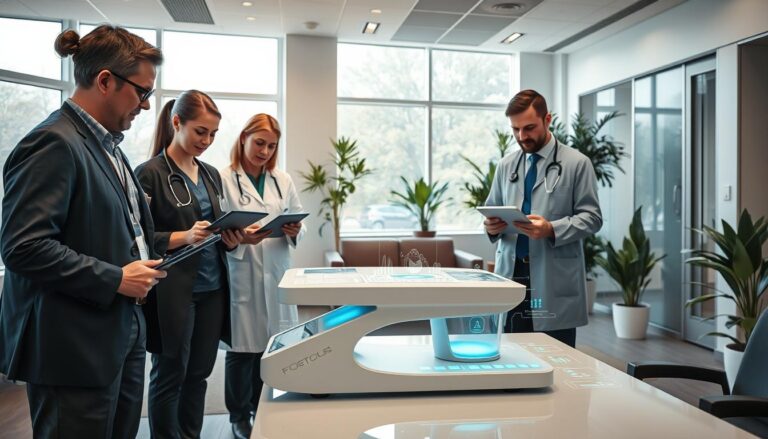
The use of Artificial Intelligence in Healthcare is changing patient care in UK doctors’ surgeries. A recent Nuffield Trust study found that nearly three in 10 GPs use AI tools like ChatGPT during patient consultations.
This quick move is changing how healthcare is given. AI helps make treatments better fit each person. But concerns about rules and data security have come up. This shows we need strict rules to protect data.
As we continue to focus on Patient Care Improvement, AI’s role in healthcare will grow. It will help make better healthcare choices and bring new ideas.
Key Takeaways
- The adoption of AI in UK doctors’ surgeries is on the rise, with nearly three in 10 GPs using AI tools.
- AI is enabling personalised medicine and treatment plans, improving patient care.
- Concerns surrounding regulation and data security have been raised.
- Robust data protection rules are necessary to address these concerns.
- The role of AI in healthcare will continue to evolve, driving innovation.
Recent AI Breakthroughs Transforming UK Primary Care
UK primary care is changing fast thanks to AI. The NHS is leading this change. They use AI to help patients and make things run more smoothly.
NHS Digital Transformation Initiative Launches New AI Tools
The NHS Digital Transformation Initiative has brought new AI tools to primary care. This is part of the NHS Plan for Change. It uses AI and keeps patient data safe.
Key Stakeholders and Technology Partners
The NHS worked with tech partners to make these AI tools. They worked with companies that make healthcare AI, NHS trusts, and groups that help patients. This teamwork ensured the AI tools met primary care needs.
Notable Early Adopters Among GP Practices
Some GP practices were quick to use AI. They shared what works and what doesn’t with AI in primary care.
Regional Distribution of AI Implementation
AI tools are not used the same everywhere in the UK. Some places got them faster because of money and setup. This shows we need a better plan for using AI.
Initial Practitioner Feedback
Doctors who started using AI tools are mostly happy. They say it helps patients and makes work easier. But they also talk about the need for clear rules for AI in healthcare. They call it the “wild west” because of the lack of regulations.
AI in UK Doctors’ Surgeries for Patient Care Improvement: Measurable Outcomes
AI is making a big difference in UK primary care. It’s thanks to AI technologies, such as Clinical Decision Support Systems. These help doctors make better decisions and improve patient care.
Clinical Decision Support Systems: Reducing Diagnostic Errors
Clinical Decision Support Systems (CDSS) are helping doctors in UK surgeries. They give doctors real-time data to help them make better choices.
Statistical Improvements in Patient Outcomes
Studies show that CDSS improve patient care. For example, AI tools cut misdiagnosis by 15% in some cases.
Cost-Effectiveness Analysis
CDSS is also cost-effective. It saves money by reducing errors and improving care. This means less money spent on wrong diagnoses.

Workflow Optimisation and Administrative Efficiency
AI is making doctors’ work easier. AI can write notes for doctors, freeing them up to see more patients. This means better care and more time with patients.
Reduction in Waiting Times and Administrative Burden
AI tools are reducing waiting times. They handle routine tasks, letting doctors focus on meaningful work.
Patient Satisfaction Metrics
Patients are happier with their care thanks to AI. They say they’re getting better service and waiting less.
Remote Monitoring and Preventive Care Advancements
AI is helping with remote monitoring in UK care. It lets doctors monitor patients’ health from afar. This means they can catch problems early.
Chronic Disease Management Improvements
AI is making a big difference for people with chronic diseases. It helps doctors catch and treat problems before they get worse.
Vulnerable Population Access Benefits
AI is also helping those who find it hard to get to the doctor. It makes healthcare more accessible for people with mobility issues or living far away.
Global Implications and Lessons for the Nigerian Healthcare System
Artificial Intelligence in Healthcare is not just for the UK. Countries like Nigeria can also learn from it. In the UK, AI has improved healthcare and sped it up. For example, AI can detect eye problems in people with diabetes very effectively.
Nigeria can improve healthcare by better leveraging technology. They need good internet and power to use AI in health. They also need rules to protect health data. This is important for using AI wisely.
By using AI effectively, Nigeria can improve healthcare. This can help patients and save money. Nigeria can learn from the UK and make healthcare better for everyone.

Director
Bio: An (HND, BA, MBA, MSc) is a tech-savvy digital marketing professional, writing on artificial intelligence, digital tools, and emerging technologies. He holds an HND in Marketing, is a Chartered Marketer, earned an MBA in Marketing Management from LAUTECH, a BA in Marketing Management and Web Technologies from York St John University, and an MSc in Social Business and Marketing Management from the University of Salford, Manchester.
He has professional experience across sales, hospitality, healthcare, digital marketing, and business development, and has worked with Sheraton Hotels, A24 Group, and Kendal Nutricare. A skilled editor and web designer, He focuses on simplifying complex technologies and highlighting AI-driven opportunities for businesses and professionals.