

Artificial intelligence (AI) has become a big part of our lives today. It has changed many areas worldwide, including Nigeria. The story of AI is one of human creativity and curiosity, with significant growth over time.
From its early beginnings to today’s applications, AI has made a significant impact. Its effects are seen in many industries.
In Nigeria, AI is making a big impact in finance, healthcare, and education. It’s helping the economy grow and improving people’s lives. As more Nigerians learn about AI, it’s important to understand its key parts and uses.
Key Takeaways
- AI involves machines simulating human intelligence.
- AI is being adopted across various sectors in Nigeria.
- The technology can drive economic growth.
- AI can improve Nigerians’ quality of life.
- Understanding AI is key for Nigerians to use its benefits.
The Origins of Artificial Intelligence
The story of artificial intelligence (AI) starts with the work of key mathematicians and computer scientists. George Boole and Alan Turing were among the first. They set the stage for today’s computing.
Alan Turing and the Imitation Game
Alan Turing’s idea of the “Turing Test” changed how we think about machine intelligence. In his 1950 paper, “Computing Machinery and Intelligence,” he proposed this test. It’s a major highlight in AI’s journey.
Early computing machines were vital for AI’s growth. Initially, they performed simple calculations. But they improved, enabling more complex tasks. This led to the AI we know today.
The efforts of these pioneers and the early tech they developed are key to AI’s current state.
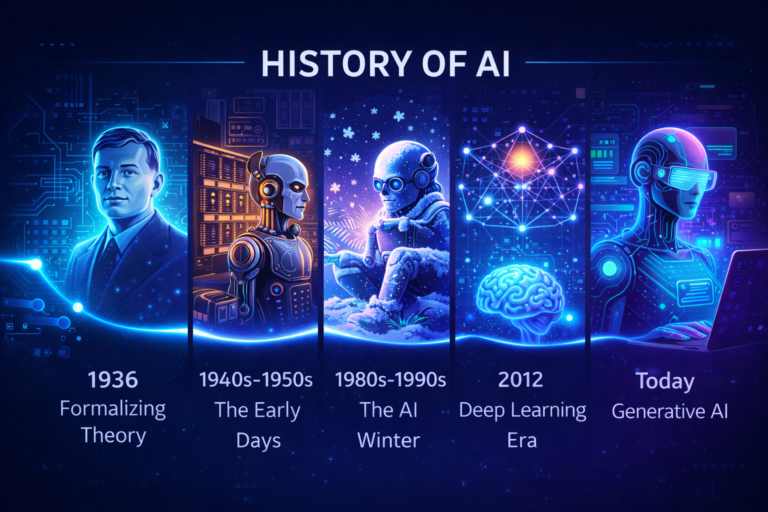
The Complete History of AI: Major Developmental Phases
AI has gone through many stages, shaping what it is today. It started with symbolic AI. This was when machines tried to think like humans using symbols and rules.
Understanding key AI terms is essential to AI’s growth. The Dartmouth Conference in 1956 was a big moment. It was there that “Artificial Intelligence” was first used.
Expert systems gained popularity in the 1980s. These systems were designed to think like a human expert in a specific area. The late 1990s and early 2000s saw a new interest in neural networks. These are a big part of deep learning.
Deep learning has been a big help for AI recently. It enables machines to learn from large datasets and improve over time. This phase has driven significant advances in big tech, including new algorithms and large datasets.
The story of AI shows our endless drive for new ideas. Knowing about AI’s history helps us see how far it’s come and what it might do next.
The Modern History of AI: From Deep Learning to Today
The story of modern AI is deeply connected to deep learning. This technology enables AI systems to better understand complex data such as images, speech, and text.
Deep learning has significantly impacted computer vision. Now, AI can spot objects, people, and patterns with great accuracy.
Recommended reading: 300 common AI terms made easy for everyone.
AI is now used in many areas, like healthcare, finance, and customer service. In healthcare, AI helps diagnose diseases and tailor treatments. In finance, it spots fraud and manages investments.
AI’s ability to adapt demonstrates significant growth and innovation potential. As AI continues to improve, it will likely further change society and the economy.
AI Development in Africa: The Continental Perspective
Africa is making big steps in AI development. The continent has many countries using AI to boost innovation and the economy.
South Africa and Kenya are leading in AI in Africa. They have invested a lot in AI research and development. This has created a great environment for new ideas.
For example, South Africa’s AI initiatives are helping different sectors grow.
Pan-African AI Initiatives
Pan-African initiatives are key in spreading AI across the continent. They work to have a common approach to AI. This helps countries share knowledge and work together.
These efforts help close the gap between different areas. They make the AI ecosystem more inclusive for everyone.
The History of AI in Nigeria
Nigeria’s journey into AI has been shaped by pioneering researchers and institutions. The country has grown significantly in this field. This growth is thanks to both individual innovators and academic institutions.
Notable Nigerian AI Researchers and Their Contributions
Nigerian researchers have made a big impact on AI worldwide. They have worked in machine learning and natural language processing. Their work has been published in top international journals.
Some have also developed AI solutions for local challenges such as healthcare and agriculture. For more on AI’s global history, check out The History of AI: From Logic to Learning.
Universities in Nigeria are key in advancing AI research. Many have established centres and programmes for AI and related technologies. These efforts not only boost innovation but also train the next AI experts.
Organisations like AIBase also support AI initiatives. This teamwork between universities and industry is set to boost AI in Nigeria. It aims to make Nigeria a leader in AI on the African continent.
Current AI Landscape and Applications in Nigeria
Nigeria is leading the way in AI adoption in Africa. It has a growing number of startups and research institutions. These businesses are using AI to tackle complex problems, leveraging technologies such as machine learning and natural language processing.
Success Stories of Nigerian AI Startups
Many Nigerian AI startups have had a significant impact, primarily in fintech and healthtech. They are using AI to make finance more accessible and to improve healthcare. Learn more about the AI era in Nigeria.
The AI ecosystem in Nigeria receives support from multiple stakeholders. The government, private investors, and international groups are all helping out. Their support is key to AI startups’ growth and success in Nigeria.
The AI scene in Nigeria is lively and full of chances for growth. As it continues to improve, it will likely play a significant role in Nigeria’s tech and economic progress.
Conclusion: The Future of AI in Nigeria
The future of AI in Nigeria looks bright. It has many uses in fields like agriculture, healthcare, finance, and education. As AI grows, Nigeria will be a key player in its use and development.
Nigerian businesses and people can use AI to innovate, improve operations, and better serve customers. But there are hurdles to overcome. These include a lack of infrastructure, data privacy concerns, and a need for skilled workers.
To make the most of AI, Nigeria needs to work on these challenges. Good communication about AI, like education and awareness, is key. This will help in adopting AI. For more on AI in Nigeria.
With the right plans, Nigeria can fully benefit from AI. This will help the economy grow. As AI Base says, Nigeria’s AI future is promising. Many projects are underway to improve life and business.

Director
Bio: An (HND, BA, MBA, MSc) is a tech-savvy digital marketing professional, writing on artificial intelligence, digital tools, and emerging technologies. He holds an HND in Marketing, is a Chartered Marketer, earned an MBA in Marketing Management from LAUTECH, a BA in Marketing Management and Web Technologies from York St John University, and an MSc in Social Business and Marketing Management from the University of Salford, Manchester.
He has professional experience across sales, hospitality, healthcare, digital marketing, and business development, and has worked with Sheraton Hotels, A24 Group, and Kendal Nutricare. A skilled editor and web designer, He focuses on simplifying complex technologies and highlighting AI-driven opportunities for businesses and professionals.