
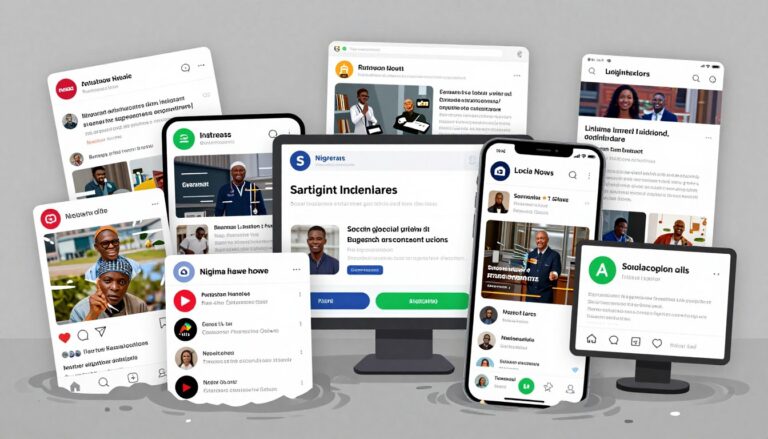
As smartphones and affordable data plans become increasingly accessible across Nigeria, the barriers to encountering—and creating-AI slop have virtually disappeared. This article examines how this phenomenon manifests in Nigeria’s digital spaces, the specific challenges it poses for Nigerian internet users, and how to preserve information integrity within one of Africa’s most vibrant online communities.
AI slop is flooding Nigerian digital spaces, creating an overwhelming volume of low-quality content that’s difficult to distinguish from legitimate information
What Is AI Slop?
Defining AI Slop in Simple Terms
AI slop refers to the massive volume of low-quality, hastily produced content generated using artificial intelligence tools. Unlike thoughtful AI-assisted content created with human oversight, AI slop is typically mass-produced with minimal human intervention, fact-checking, or quality control. This content often contains factual errors, logical inconsistencies, and cultural inaccuracies that can mislead readers or waste their time.
The term “slop,” with its connotations of messy, low-grade material, aptly describes this digital pollution that prioritises quantity over quality. While AI can be used responsibly to create valuable content, AI slop represents the opposite end of the spectrum-content created primarily to game algorithms, generate ad revenue, or create the illusion of expertise without delivering actual value.
How AI Slop Is Created
The creation of AI slop typically follows a formulaic process designed to maximise output while minimising effort. Content farms—both individuals and organisations—use generative AI tools like large language models to produce articles, social media posts, and even images at unprecedented scale. These operations often employ techniques such as prompt recycling (reusing the same AI instructions repeatedly with minor variations) and automated posting bots that distribute content across multiple platforms without human review.
In Nigeria, where entrepreneurial digital hustle is celebrated and economic pressures are significant, AI slop creation has become an attractive source of income. Some Nigerian content creators have found they can generate hundreds of articles or social media posts daily using AI tools, then monetise this content through advertising, affiliate marketing, or by selling “engagement” to brands seeking to boost their online presence.
Why AI Slop Is Spreading Faster Than Ever
Several factors have accelerated the spread of AI slop in Nigeria’s digital ecosystem. First, the dramatic reduction in data costs—with some providers offering packages as low as ₦50 for daily social media access—has removed financial barriers to constant online content consumption. Second, the proliferation of affordable smartphones has expanded internet access for millions of Nigerians, many of whom may be new to digital literacy challenges.
Platform algorithms that prioritise engagement over accuracy further compound the problem. Content that generates clicks, comments, and shares—regardless of its quality or truthfulness—gets amplified, creating a perverse incentive system that rewards sensationalism over substance. Additionally, major platforms have invested significantly less in content moderation for African markets than for Western ones, creating an environment in which AI-generated content can flourish with minimal oversight.
“Some technology analysts note that the economics of AI-generated low-quality content can be especially compelling in emerging markets like Nigeria, where modest monthly earnings from content farming can create strong incentives for volume-over-quality publishing.”
The Rise of AI Slop in Nigeria’s Digital Space
Social Media as the Main Distribution Channel
Social media platforms have become the primary vectors for AI slop in Nigeria, with Facebook and WhatsApp leading as the most significant distribution channels. On Facebook, AI-generated posts featuring sensationalist health claims, financial advice, and political commentary regularly attract thousands of shares, particularly when they align with existing beliefs or aspirations. These posts often employ AI-generated images depicting Nigerian settings or personalities to enhance perceived relevance and authenticity.
TikTok and Instagram have seen an explosion of AI-generated “educational” content targeting Nigerian youth, with videos and carousels offering oversimplified explanations of complex topics. Meanwhile, X (formerly Twitter) has become a breeding ground for AI-generated threads on Nigerian politics and business opportunities that present speculation as established fact, often garnering significant engagement before any fact-checking can occur.
Blogs, SEO Spam, and Fake News Websites
Beyond social media, Nigeria has seen a surge in AI-generated blogs and websites designed primarily to capture search traffic. These sites typically target high-value keywords related to Nigerian finance, education, immigration, and health—topics where accurate information is crucial but often difficult to verify. Using AI to generate dozens or even hundreds of articles daily, these operations can quickly dominate search results for specific queries.
A particularly concerning trend is the emergence of AI-generated “news” websites that mimic legitimate Nigerian publications. These sites often combine AI-written articles with stolen content from established sources, creating a veneer of legitimacy while spreading misinformation. Some use slight variations of trusted news brands’ names or logos to confuse readers, a practice that has prompted several Nigerian media houses to issue public warnings.
Messaging Apps and the AI Slope Problem
WhatsApp, with an estimated 100 million Nigerian users, has become a particularly problematic channel for the distribution of AI-generated content. The platform’s encryption and forwarding capabilities enable misinformation to spread rapidly through family groups, community chats, and broadcast lists, with limited oversight. AI-generated “breaking news” alerts, health advisories, and financial opportunities are regularly circulated as forwards, often gaining credibility by falsely attributing the information to trusted institutions such as universities or government agencies.
Telegram channels focused on Nigerian audiences have also become hotspots for AI slop, particularly in the cryptocurrency and investment space. These channels frequently use AI to generate “analysis” and “insider tips” that appear sophisticated but lack substantive backing. The combination of financial desperation among some users and the technical complexity of the subject matter creates fertile ground for misinformation to flourish.
Common Signs of AI Slop in Nigerian Digital Spaces:
- Content that discusses Nigerian issues but contains factual errors about local geography, culture, or governance structures
- Articles that mention “Nigerian dollars” instead of Naira or make other basic cultural mistakes
- Posts that use AI-generated images of “Nigerians” with unnatural features or inconsistent backgrounds
- Content that claims to offer “exclusive” information about Nigerian government programmes or opportunities without verifiable sources
- Health advice that combines traditional Nigerian remedies with scientifically implausible claims
How AI Slop Is Affecting Journalism in Nigeria
Erosion of Trust in Digital Media
The proliferation of AI slop is significantly undermining trust in Nigeria’s digital media landscape. As readers encounter an increasing volume of AI-generated content masquerading as legitimate journalism, many are developing a generalised scepticism toward all online information. This “trust recession” affects even established Nigerian news organisations that maintain rigorous editorial standards, as the public struggles to distinguish between credible reporting and AI-generated imitations.
A 2024 survey by the Centre for Journalism Innovation and Development found that 68% of Nigerian internet users reported difficulty determining whether online news was produced by humans or AI. This uncertainty has led to a concerning pattern in which factual reporting on important issues such as public health or electoral processes is dismissed as “fake news,” while emotionally resonant AI-generated content is accepted as truth because it aligns with existing beliefs.
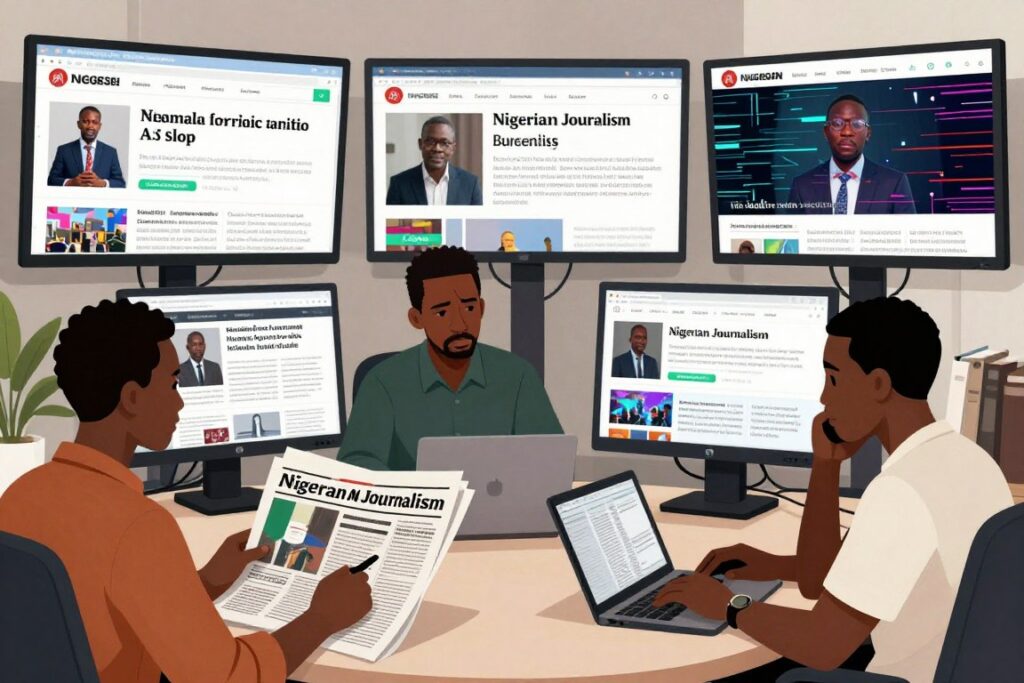
Nigerian journalists increasingly compete with AI-generated content that mimics news but lacks journalistic standards
Pressure on Newsrooms and Journalists
Nigerian newsrooms face mounting economic pressure as AI slop diverts both audience attention and advertising revenue. With AI-generated content sites producing hundreds of articles daily at minimal cost, legitimate news organisations struggle to compete for visibility in social media feeds and search results. This dynamic has accelerated the financial challenges already facing Nigerian journalism, with several local publications reducing staff or closing entirely in the past year.
Individual journalists report increasing pressure to produce more content more quickly to remain competitive, which may compromise the time available for thorough reporting and fact-checking. Some Nigerian media houses have responded by implementing their own AI tools to increase productivity, raising questions about the appropriate balance between technological assistance and journalistic judgment.
Plagiarism, Content Theft, and Ethical Concerns
AI systems trained on existing content have become vehicles for widespread plagiarism of Nigerian journalists’ work. Investigations by the Premium Times Centre for Investigative Journalism documented numerous cases where AI tools were used to rewrite published articles from Nigerian newspapers, stripping them of attribution while preserving much of the original reporting. This practice not only deprives journalists of recognition but also undermines the economic sustainability of the publications that funded the original reporting.
The ethical dimensions extend beyond plagiarism to issues of accountability and transparency. When AI-slop sites publish inaccurate information about sensitive topics such as communal conflicts or public health emergencies in Nigeria, there is typically no editor or journalist who can be held accountable for potential real-world harm. This accountability gap represents a fundamental challenge to journalistic ethics in the age of AI-generated content.
How can Nigerian readers identify AI-generated news?
Look for bylines with verifiable journalist profiles, check if the publication has a physical address and editorial team, verify claims with multiple sources, and be wary of articles that lack specific dates, locations, or named sources. Articles that contain vague statements about “experts say” without naming specific individuals or institutions often indicate AI generation.
Are there any Nigerian news organisations using AI responsibly?
Several Nigerian media organisations are implementing AI tools for tasks such as transcription, translation, and data analysis while maintaining human editorial oversight. Publications such as Business Day and TechCabal have published transparency statements outlining their use of AI while upholding journalistic standards.
What legal recourse exists for Nigerian journalists whose work is stolen by AI?
Nigeria’s copyright laws technically protect journalists’ work, but enforcement in the digital realm remains challenging. The Nigerian Union of Journalists has been advocating for updated legislation that specifically addresses AI-related content theft and establishes clearer mechanisms for takedown requests and compensation.
AI Slop and SEO in Nigeria: A Growing Crisis
How AI Slop Is Flooding Search Results
Nigeria-focused search queries are increasingly dominated by AI-generated content optimised for search engine visibility rather than accuracy or usefulness. Searches for topics like “how to start a business in Nigeria” or “best universities in Nigeria” now frequently return results from AI content farms that have mastered the technical aspects of SEO while offering little substantive value. These sites typically feature keyword-stuffed content with Nigerian place names and terms but lack genuine local insight or accurate information.
The problem is particularly acute for location-specific searches related to Nigerian cities and states. AI-generated content often contains geographical inconsistencies and outdated information, yet outranks locally produced content that relies on on-the-ground knowledge. This SEO pollution makes it increasingly difficult for Nigerians to find reliable information about their own communities and institutions online.
AI-generated content increasingly dominates search results for Nigeria-specific queries, often outranking more accurate local sources
Impact on Nigerian Publishers and Bloggers
Legitimate Nigerian content creators face an existential challenge as AI-slop sites capture search visibility and advertising revenue. Small- to medium-sized Nigerian publishers report significant declines in traffic as their carefully researched content is displaced in search rankings by AI-generated alternatives that can produce content at scale. This dynamic threatens the sustainability of authentic Nigerian digital voices, particularly in specialised niches like technology, finance, and health.
Nigerian bloggers who previously earned sustainable incomes through quality content now compete with AI content farms that can produce dozens of articles daily at minimal cost. This has forced many to either adopt AI tools themselves—potentially compromising their distinctive voice and expertise—or to abandon certain content categories entirely. The resulting homogenisation of Nigerian digital content represents a significant loss of diverse perspectives and local knowledge.
Google, Algorithms, and the Fight Against AI Slop
While search engines such as Google have implemented algorithmic updates intended to reduce low-quality AI content in search results, these efforts have demonstrated inconsistent effectiveness in the Nigerian context. Content quality evaluations often rely on signals that may not adequately account for the nuances of Nigerian English usage, cultural references, or local information needs, potentially disadvantaging legitimate Nigerian content in favour of more standardised global content.
Additionally, enforcement of content quality standards appears less rigorous for Nigeria-focused content compared to content targeting Western markets. This disparity creates an environment where AI slop targeting Nigerian audiences faces fewer algorithmic penalties, allowing it to proliferate more freely. Nigerian SEO professionals have called for more context-aware quality evaluation that better recognises authentic local content and penalises AI-generated material that lacks genuine local expertise.
Many Nigerian media leaders emphasise the need for local voices and context-aware content online. Tomiwa Aladekomo, CEO of Big Cabal Media, has highlighted the importance of Africans telling their own stories and narratives in a global digital environment rather than leaving storytelling to external platforms and technologies.
AI Slop, Scams, and Digital Fraud in Nigeria
AI-Generated Scam Content
Scammers operating in Nigeria have rapidly adopted AI tools to create more convincing fraudulent content. Where previous scam attempts might have been identifiable through poor grammar or obvious inconsistencies, AI-generated scam messages now feature polished language, localised references, and persuasive narratives. These range from fake job advertisements for non-existent positions at real Nigerian companies to investment schemes that use AI to generate realistic but fabricated testimonials from “successful” Nigerian investors.
Particularly concerning is the rise of AI-generated government impersonation scams. These use artificial intelligence to create convincing forgeries of official communications from Nigerian institutions like the Federal Inland Revenue Service, the Central Bank, or the Nigeria Immigration Service. These messages typically direct recipients to fraudulent websites that prompt them to enter personal information or make payments for non-existent services or penalties.
Deepening the Trust Deficit Online
The proliferation of AI-generated scams contributes to a generalised atmosphere of suspicion in Nigeria’s digital spaces. As users encounter more sophisticated deception, many develop a default position of distrust toward all online information, including legitimate services and opportunities. This trust deficit has tangible economic consequences, potentially hampering the adoption of genuine digital financial services, e-government initiatives, and e-commerce platforms in Nigeria.
For vulnerable populations with limited digital literacy, the increasing sophistication of AI-generated scams presents particular dangers. Elderly Nigerians, first-time internet users, and those in rural areas with limited exposure to digital security awareness are especially susceptible to AI-enhanced social engineering, which can result in financial loss or identity theft.
Why Nigeria Is a Prime Target
Several factors make Nigeria a particularly attractive target for AI slop creators focused on scams and misinformation. The country’s large, young population—with over 60% under age 25—represents a vast audience of digital consumers, many of whom are new to the internet and still developing critical evaluation skills. Economic pressures and high unemployment rates create receptivity to content promising financial opportunities or shortcuts to prosperity.
Additionally, Nigeria’s reputation as a source of internet scams (the infamous “419” or advance-fee fraud) has created a perverse dynamic where legitimate Nigerian online businesses and services face heightened scrutiny and suspicion. This environment creates opportunities for sophisticated AI-enabled scammers to exploit both local users and the global perception of Nigerian digital spaces as high-risk.
Warning Signs of AI-Generated Scams in Nigeria
Be particularly cautious of online content that:
- Promises unrealistic returns on investments or cryptocurrency schemes
- Claims to offer special access to government programmes or international opportunities
- Creates artificial urgency with limited-time offers or threats of penalties
- Uses AI-generated images of “Nigerian professionals” or offices that show subtle inconsistencies
- Directs you to websites with URLs that closely mimic but slightly differ from legitimate Nigerian institutions
Impact on Education, Research, and Learning
Students and AI Slop
Nigeria’s education system is experiencing significant disruption from both the consumption and production of AI slop. Secondary and university students increasingly rely on AI-generated content for research and assignments, often without the critical skills needed to evaluate its accuracy. Educators report a troubling trend of students submitting AI-generated essays and projects that contain plausible-sounding but factually incorrect information about Nigerian history, culture, and contemporary issues.
The problem extends beyond academic dishonesty to a fundamental shift in how students engage with knowledge. Rather than developing research skills and subject mastery, many Nigerian students are becoming adept at prompt engineering-crafting instructions for AI to generate content that appears original. This shift threatens to produce a generation with diminished critical thinking skills and an overreliance on AI systems that may perpetuate misinformation about Nigerian contexts.
Academic Research and False Sources
The academic research ecosystem in Nigeria is contaminated by AI-generated content, which creates circular citation problems. Researchers report encountering AI-generated papers that cite non-existent studies or fabricate data about Nigerian demographics, health statistics, or economic indicators. When these fabrications are subsequently cited by other researchers, they gain an unwarranted appearance of legitimacy that can be difficult to correct.
Nigerian academic journals and institutions have begun implementing AI detection tools, but these often yield inconsistent results, particularly when evaluating content that addresses Nigerian contexts or employs Nigerian English expressions. This technical limitation imposes additional burdens on Nigerian researchers and journal editors, who must devote significant time to verification processes that may be unnecessary in less AI-polluted information environments.
Who Is Responsible for AI Slop?
Tech Companies and AI Developers
The companies developing and deploying generative AI tools bear significant responsibility for the proliferation of AI slop in Nigeria. While most major AI providers include terms of service that prohibit the mass production of low-quality content, enforcement of these policies remains inconsistent, particularly for content targeting Nigerian audiences. Additionally, the fundamental design choices in these systems—prioritising fluency over accuracy and scale over precision-create inherent vulnerabilities to slop production.
Nigerian technology advocates have called for AI developers to invest more in understanding Nigerian contexts, languages, and information needs rather than simply making global tools available without localisation. This includes developing improved detection systems for Nigeria-specific misinformation and creating more accessible verification tools that operate effectively with Nigerian English and local languages such as Hausa, Yoruba, and Igbo.
Platforms and Algorithms
Social media platforms and search engines play a crucial role in amplifying or limiting the spread of AI slop through their algorithmic recommendation systems. Current engagement-based algorithms often promote content based on metrics such as clicks and shares rather than accuracy or quality, creating an environment where sensationalist AI content can thrive. Platform moderation systems also typically devote fewer resources to Nigerian content compared to Western markets, creating enforcement disparities.
Nigerian digital rights organisations have advocated for platforms to develop more contextually aware moderation systems that better understand Nigerian expressions, references, and information patterns. They also call for greater transparency into how recommendation algorithms operate and for more local control over content-moderation decisions affecting Nigerian digital spaces.
Content Creators and Publishers
Individual content creators and media organisations in Nigeria face ethical questions regarding the appropriate use of AI. While AI tools can enhance productivity and creativity when used responsibly, the line between assistance and abdication of responsibility can blur. Nigerian publishers adopting AI tools must consider their obligation to maintain editorial standards, fact-checking processes, and an authentic local perspective rather than defaulting to whatever an AI system generates.
Industry associations such as the Guild of Corporate Online Publishers (GOCOP) have begun developing ethical guidelines for the use of AI in Nigerian media contexts, emphasising the importance of human oversight, transparency about AI use, and maintaining ultimate editorial responsibility for published content, regardless of how it was produced.
Shared Responsibility Framework for Addressing AI Slop in Nigeria
- AI Developers: Improve systems to better understand Nigerian contexts and develop better detection tools for misuse
- Platforms: Adjust algorithms to reduce amplification of low-quality content and invest in Nigeria-specific moderation
- Publishers: Maintain editorial standards and transparency about AI use in content creation
- Educational Institutions: Develop digital literacy curricula that address AI content evaluation
- Government: Create appropriate regulatory frameworks that balance innovation with protection from harm
- Individual Users: Develop critical evaluation skills and avoid sharing unverified information
How Nigeria Can Combat AI Slop
Strengthening Digital Literacy
Enhancing digital literacy is one of the most effective long-term strategies for combating AI-related misinformation in Nigeria. Educational initiatives that teach students and the broader public how to identify AI-generated content, verify information from multiple sources, and critically evaluate online claims can create a more resilient information ecosystem. Several Nigerian civil society organisations have begun developing curricula specifically addressing the evaluation of AI content for both formal education and community workshops.
Media literacy programmes tailored to the Nigerian context are particularly important, as generic approaches may not adequately address the specific manifestations of AI slop in Nigerian digital spaces. These programmes should incorporate examples relevant to Nigerian users’ everyday experiences and provide practical strategies for navigating information challenges unique to Nigerian online environments.
Ethical AI Use in Media and Business
Nigerian media organisations and businesses can lead by example by establishing and adhering to clear editorial standards for the use of AI. This includes transparency about when and how AI tools are employed in content creation, maintaining human oversight of AI-generated material, and prioritising accuracy and local relevance over production volume. Some Nigerian publications have begun including disclosure statements when AI tools are used in content production, setting an important precedent for transparency.
Industry-specific guidelines for ethical AI use in Nigerian contexts are emerging, with organisations like the Nigeria Union of Journalists and various business associations developing frameworks that address the unique considerations of deploying AI in a diverse, multilingual society with distinct information needs. These guidelines emphasise the importance of preserving authentic Nigerian perspectives rather than defaulting to AI-generated content that may reflect Western biases or lack local nuance.
Policy, Regulation, and Industry Standards
Nigeria’s regulatory environment for AI remains in its early stages, with existing frameworks like the Nigerian Data Protection Regulation (NDPR) providing some guardrails but not specifically addressing AI-generated content. The National Information Technology Development Agency (NITDA) has begun developing AI governance frameworks that could eventually include provisions addressing AI slop and its impacts on Nigerian digital spaces.
Effective regulation must balance protecting Nigerians from harmful AI-generated content while avoiding restrictions that might hamper innovation or legitimate AI applications. Industry self-regulation through standards bodies and professional associations offers a complementary approach, potentially enabling more agile responses to rapidly evolving AI capabilities and challenges.
Can AI Be Used Without Creating Slop?
Responsible AI Content Creation
Responsible AI use in content creation requires treating AI as a collaborative tool rather than a replacement for human judgment and expertise. Nigerian creators who successfully integrate AI into their workflows typically maintain clear boundaries—using AI for tasks like research assistance, outlining, or translation while reserving substantive decisions about content, framing, and factual claims for human judgment informed by genuine local knowledge and expertise.
Fact-checking processes are particularly important when using AI tools. Nigerian creators using AI responsibly implement verification steps for any factual claims, statistics, or references generated by AI systems, recognising that these tools can confidently present inaccurate information about Nigerian contexts. This verification often involves consulting primary sources, local experts, or official data rather than relying solely on AI-generated content.
Best Practices for Nigerian Creators and Brands
Nigerian creators and brands can adopt specific practices to ensure that their use of AI enhances rather than degrades information quality. Prioritising depth and accuracy over production volume represents a fundamental shift away from a slop mentality, potentially sacrificing short-term metrics, such as post frequency, for longer-term benefits, such as audience trust and content longevity. This approach recognises that while AI can accelerate content production, quality still requires time, expertise, and care.
Transparency about AI use builds trust among Nigerian audiences, who are increasingly concerned about the authenticity of content. Some Nigerian creators have adopted disclosure practices—either explicitly stating when AI tools were used in content creation or explaining their overall AI policy to their audience. This transparency helps establish clear expectations and demonstrates a commitment to ethical content practices in an increasingly AI-influenced landscape.
Signs of Responsible AI Use
- Clear disclosure of how AI tools are used in content creation
- Human review and fact-checking of all AI-generated material
- Preservation of the authentic Nigerian voice and perspective
- Verification of AI-generated claims against reliable sources
- Thoughtful integration of AI capabilities with human expertise
Signs of AI Slop Production
- Mass production of content with minimal human oversight
- Generic information lacking a specific Nigerian context
- Factual errors about Nigerian geography, culture, or institutions
- Inconsistent voice or perspective within the same content
- Overreliance on AI-generated images with visual inconsistencies
Conclusion
AI slop in Nigeria represents a significant but often unrecognised threat to the country’s information ecosystem. As one of Africa’s most digitally connected nations, Nigeria faces particular vulnerability to this flood of low-quality, AI-generated content that prioritises quantity over quality and engagement over accuracy. The impacts extend beyond mere annoyance to fundamental challenges for journalism, education, cultural representation, and social discourse.
Addressing this challenge requires a multifaceted approach involving technology companies, platforms, content creators, educational institutions, and individual users. By strengthening digital literacy, establishing ethical guidelines for AI use, and creating appropriate regulatory frameworks, Nigeria can work toward an information environment in which AI serves as a tool for empowerment rather than a vehicle for pollution.
The stakes are significant. Left unchecked, AI slop threatens to drown authentic Nigerian voices, distort cultural narratives, and further erode trust in digital information. However, with thoughtful intervention and a commitment to information integrity, Nigeria can navigate this challenge while harnessing the genuine benefits of AI technology. The future of Nigeria’s digital landscape will be shaped not by whether AI is used, but by how it is used—either as a tool that amplifies Nigerian creativity and knowledge or as a mechanism that displaces local expertise with generic, low-quality content.

Director
Bio: An (HND, BA, MBA, MSc) is a tech-savvy digital marketing professional, writing on artificial intelligence, digital tools, and emerging technologies. He holds an HND in Marketing, is a Chartered Marketer, earned an MBA in Marketing Management from LAUTECH, a BA in Marketing Management and Web Technologies from York St John University, and an MSc in Social Business and Marketing Management from the University of Salford, Manchester.
He has professional experience across sales, hospitality, healthcare, digital marketing, and business development, and has worked with Sheraton Hotels, A24 Group, and Kendal Nutricare. A skilled editor and web designer, He focuses on simplifying complex technologies and highlighting AI-driven opportunities for businesses and professionals.
The Social and Cultural Cost of AI Slop in Nigeria
Normalising Low Standards of Information
The ubiquity of AI slop in Nigerian digital spaces risks normalising lower standards for information quality and accuracy. As users become accustomed to consuming content that prioritises engagement over accuracy, the social expectation for factual rigour and intellectual integrity may gradually erode. This shift has implications beyond individual content consumption, extending to broader social discourse on important issues facing Nigerian society.
Political and civic discussions are particularly vulnerable to this degradation, as AI-generated content can amplify divisive narratives or oversimplify complex policy issues. The nuance necessary for productive dialogue about Nigeria’s diverse society and challenging governance questions is often lost in AI-slop that reduces multifaceted issues to simplistic talking points or inflammatory claims designed to maximise engagement rather than understanding.
Language, Local Context, and Cultural Distortion
AI systems trained predominantly on Western content struggle to accurately represent Nigerian linguistic patterns, cultural nuances, and social contexts. This limitation results in AI slop that subtly but persistently misrepresents Nigerian realities, often reinforcing stereotypes or overlooking important cultural distinctions between Nigeria’s diverse ethnic and regional communities.
The problem is particularly evident in AI-generated content about Nigerian traditions, celebrations, or social practices, which frequently contains factual errors or inappropriate conflations of distinct cultural elements. This misrepresentation contributes to a digital environment in which authentic Nigerian cultural knowledge is drowned out by more voluminous but less accurate AI-generated alternatives, potentially affecting how younger Nigerians understand their cultural heritage.
How AI Slop Misrepresents Nigerian Culture
Impact on Nigerian Digital Identity