


Have you noticed a small blue circle appearing across your favourite social media apps lately? That’s Meta AI, and it’s quietly revolutionising how billions of people interact with technology every single day. As artificial intelligence becomes increasingly woven into the fabric of our digital lives, understanding these tools is no longer optional—it’s essential.
Meta AI represents one of the most ambitious integrations of artificial intelligence into everyday applications. With over 500 million monthly active users and counting, this AI assistant has become an invisible companion to people scrolling through Facebook, chatting on WhatsApp, or browsing Instagram. But what exactly is Meta AI, and why should you care?
This comprehensive guide will walk you through everything you need to know about Meta AI. You’ll discover how this intelligent assistant works, where you can access it, what makes it different from other AI tools, and how both individuals and businesses are leveraging its capabilities. Whether you’re a casual user curious about that blue icon or a business owner wondering how AI can streamline your operations, you’ll find practical insights here.
What Is Meta AI? Understanding the Basics
Meta AI is an artificial intelligence assistant developed by Meta Platforms, the parent company behind Facebook, Instagram, WhatsApp, and Messenger. Think of it as your digital companion—always ready to answer questions, help create content, generate images, and assist with everyday tasks, all without leaving the apps you already use daily.
Unlike basic chatbots that simply follow pre-programmed scripts, Meta AI employs advanced machine learning algorithms that enable it to understand context, learn from interactions, and provide increasingly personalised responses over time. The more you engage with it, the better it becomes at understanding your needs and preferences.
At its core, Meta AI is powered by Llama (Large Language Model Meta AI), Meta’s proprietary language model. The latest iteration, Llama 3, represents a significant leap forward in natural language processing capabilities. This technology allows Meta AI to comprehend complex queries, maintain context across conversations, and generate human-like responses that feel natural and helpful.
What sets Meta AI apart from standalone AI tools is its seamless integration across Meta’s ecosystem. You don’t need to download a separate app or visit a different website. The assistant is embedded directly into the platforms where you already spend time, making AI assistance as simple as starting a conversation. For users in Nigeria and across Africa, this accessibility represents a significant advantage, as it removes barriers to AI adoption.
The technology behind Meta AI extends beyond simple text responses. It can understand images, generate visual content, provide real-time information, and even assist with complex problem-solving tasks. This multi-modal capability makes it a versatile tool for various applications, from casual conversation to professional content creation.
The Evolution of Meta AI: From Concept to Reality
Meta’s journey into artificial intelligence began long before the launch of Meta AI as we know it today. Understanding this evolution helps contextualise the technology’s current capabilities and future potential.
The Early Days: Facebook AI Research
Meta’s AI ambitions took formal shape in 2013 with the establishment of Facebook AI Research (FAIR). This research division focused on advancing the fundamental understanding of machine learning, computer vision, and natural language processing. During these early years, AI technology was primarily used behind the scenes to improve photo recognition, content recommendations, and advertising targeting across Facebook’s platforms.
The company invested heavily in understanding how machines could learn to see, comprehend language, and make decisions. These foundational years laid the groundwork for what would eventually become consumer-facing AI products.
The Rebrand and Renewed Focus
When Facebook rebranded as Meta in 2021, it signalled a broader vision that extended beyond social networking. The company emphasised its commitment to building immersive technologies, including the metaverse, and positioned AI as central to this future. This strategic shift accelerated AI development and brought it to the forefront of Meta’s product roadmap.
The Llama Revolution
The release of LLaMA (Large Language Model Meta AI) in February 2023 marked a turning point. Unlike some competitors who kept their models proprietary, Meta took a more open approach, releasing LLaMA for research purposes. This decision fostered innovation and collaboration within the AI community whilst simultaneously advancing Meta’s own capabilities.
The evolution continued rapidly with subsequent versions. Llama 2, released in mid-2023, brought improved reasoning and conversation abilities. Llama 3, launched in 2024, represented a quantum leap in performance, offering better understanding, more accurate responses, and enhanced multi-modal capabilities including image understanding and generation.
Key Milestones
- 2013: Facebook AI Research (FAIR) established
- 2021: Facebook rebrands to Meta, emphasising AI focus
- 2023: LLaMA model released for research
- 2023: Llama 2 launched with commercial licensing
- 2024: Llama 3 powers Meta AI across platforms
- 2024: Meta AI reaches 500 million monthly users
Recent Developments
- Llama 3.1 introduced with 405 billion parameters
- Llama 3.2 added vision capabilities
- Llama 3.3 optimised for speed and efficiency
- Llama 4 Scout designed for rapid responses
- Integration with Ray-Ban Meta smart glasses
- Expansion to over 200 countries and territories
The Present and Beyond
Today, Meta AI represents the culmination of over a decade of research and development. The assistant is available across Meta’s family of apps, reaching billions of users worldwide. With ongoing development of models like Llama 4 Maverick and the planned Mango and Avocado models, Meta continues pushing the boundaries of what AI assistants can achieve.
This evolution reflects a broader trend in technology: AI moving from specialised tools used by experts to accessible assistants integrated into everyday applications. For users, this means increasingly sophisticated help without increasing complexity.
How Does Meta AI Work? The Technology Behind the Assistant
Understanding how Meta AI works demystifies the technology and helps users leverage its capabilities more effectively. At its foundation lies a sophisticated combination of artificial intelligence techniques that work together seamlessly.
The Meta-Learning Approach
Meta AI employs a concept called meta-learning, which is essentially “learning how to learn.” Rather than being trained for one specific task, the system learns patterns and strategies that it can apply to new situations it hasn’t encountered before. This approach makes Meta AI remarkably versatile and adaptable.
When you ask Meta AI a question, it doesn’t simply retrieve a pre-written answer from a database. Instead, it analyses the context of your query, draws upon its training across vast amounts of data, and generates a response tailored to your specific situation. This dynamic approach means every interaction is unique whilst maintaining consistency and accuracy.
Neural Architecture and Optimisation
Behind the scenes, Meta AI uses neural architecture search (NAS) to optimise its performance continually. This process allows the system to adjust its computational structure based on the task at hand. When you’re asking about restaurant recommendations, it allocates resources differently than when you’re requesting image generation or complex problem-solving assistance.
The Llama models that power Meta AI consist of billions of parameters—essentially, adjustable weights that determine how the system processes information. Llama 3.1, for instance, contains up to 405 billion parameters, enabling nuanced understanding and generation of human language. These parameters are continuously refined through training on diverse datasets, improving the model’s ability to understand context, cultural references, and specialised knowledge.
Multi-Modal Understanding
One of Meta AI’s most impressive capabilities is its multi-modal understanding—the ability to work with different types of content simultaneously. Recent versions can process and generate both text and images, understanding the relationship between visual and linguistic information.
When you upload an image and ask Meta AI to describe it or answer questions about it, sophisticated computer vision algorithms analyse the visual content whilst language models interpret your question and generate an appropriate response. This integration of capabilities creates a more natural and versatile interaction model.
Continuous Learning and Adaptation
Meta AI doesn’t remain static after its initial training. The system continuously learns from interactions, though it’s important to note that this happens at a system level rather than remembering individual conversations (which protects privacy). Patterns in how users interact, what types of questions are asked, and which responses prove most helpful inform ongoing improvements to the model.
This continuous refinement process means Meta AI becomes progressively better at understanding regional dialects, cultural contexts, and emerging trends. For users in Nigeria, this translates to an assistant that increasingly understands local context, references, and communication styles.
Real-Time Information Integration
Unlike some AI systems that rely solely on training data with a knowledge cut-off date, Meta AI can access current information through web search integration. When you ask about recent events, current weather, or up-to-date business information, the system retrieves real-time data and synthesises it with its understanding to provide accurate, timely responses.
This combination of vast training knowledge and real-time information access makes Meta AI particularly useful for staying informed about current events, making time-sensitive decisions, and accessing the latest information on rapidly evolving topics.
Key Features of Meta AI
Meta AI offers an impressive array of features designed to enhance productivity, creativity, and everyday convenience. Understanding these capabilities helps users extract maximum value from the assistant.
Conversational Intelligence
Meta AI excels at natural conversations, maintaining context across multiple exchanges. You can ask follow-up questions, change topics, and return to previous discussions, all whilst the assistant keeps track of the conversation flow. This makes interactions feel more human and less robotic.
Content Creation Assistance
Whether you need help writing social media captions, drafting emails, brainstorming ideas, or creating longer content pieces, Meta AI serves as a creative partner. It can suggest different angles, provide structure to your thoughts, and help overcome writer’s block.
Image Generation
Using advanced image generation technology, Meta AI can create unique images from text descriptions. Simply describe what you want to see, and the assistant generates visual content that matches your prompt. This feature proves invaluable for social media content, presentations, or creative projects.
Cross-Platform Integration
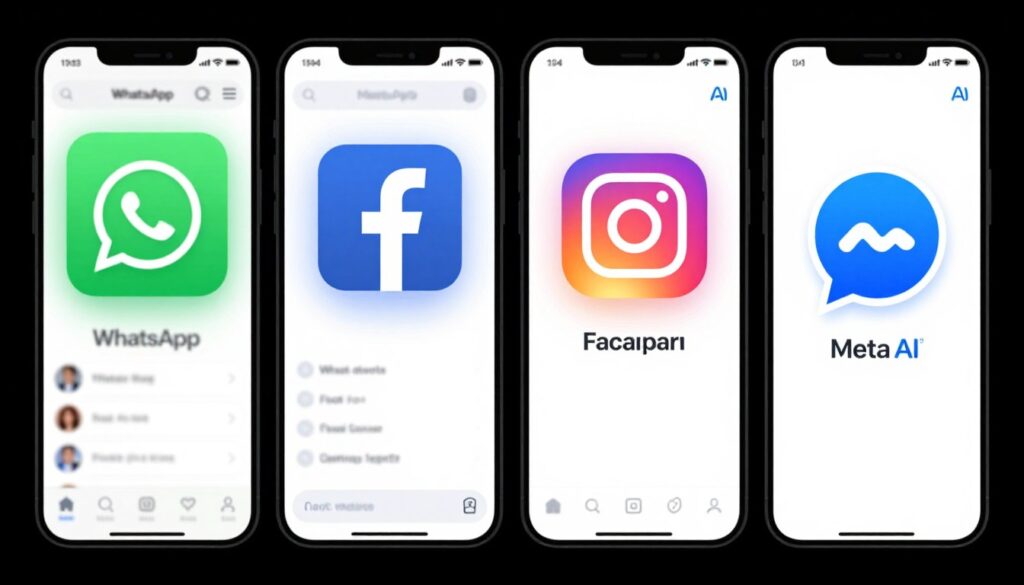
One of Meta AI’s most practical features is its seamless availability across Meta’s family of apps. The same assistant that helps you on Facebook is available in WhatsApp, Instagram, and Messenger, maintaining consistency whilst adapting to each platform’s unique context.
This integration means you can start a conversation on one platform and continue it on another, or use Meta AI in different contexts without learning new interfaces or behaviours. The assistant understands the platform context and adjusts its responses accordingly.
Personalisation and Adaptation
Meta AI learns your preferences over time, tailoring its responses to match your communication style and information needs. If you consistently prefer concise answers, it adapts to provide briefer responses. If you frequently ask about specific topics, it recognises these patterns and provides more relevant suggestions.
This personalisation happens whilst respecting privacy boundaries. The system doesn’t store personal conversations but learns from aggregated patterns to improve general performance and relevance.
Multilingual Capabilities
Meta AI supports conversations in multiple languages, making it accessible to diverse user bases. For Nigerian users, this means the ability to interact in English whilst the system understands local context and expressions. The assistant can also help with translation tasks, bridging language barriers in communication.
Time-Saving Automation
Beyond answering questions, Meta AI helps automate routine tasks. It can summarise lengthy articles, extract key information from documents, help schedule activities, and provide quick answers that would otherwise require extensive searching. These capabilities free up mental energy for more important work.
Accessibility and Ease of Use
Perhaps Meta AI’s most important feature is its accessibility. There’s no steep learning curve, no technical jargon to master, and no complex setup process. Users simply interact with the assistant in natural language, asking questions as they would to a helpful friend. This simplicity makes AI assistance available to everyone, regardless of technical expertise.
Accessing Meta AI Across Meta Platforms
Meta AI’s integration across multiple platforms ensures users can access intelligent assistance wherever they are within Meta’s ecosystem. Here’s how to find and use Meta AI on each major platform.
Meta AI on Facebook
Facebook makes Meta AI readily accessible through its search functionality. When you open Facebook on your mobile device or through a web browser, you’ll find the search icon (magnifying glass) prominently displayed. Tapping or clicking this icon reveals the Meta AI interface embedded within the search bar.
This placement is strategic—it positions the AI assistant at the point where users naturally seek information. Instead of simply searching for posts or profiles, you can now ask conversational questions and receive intelligent responses. The assistant can help you discover trending topics, understand complex issues, or simply chat about your interests.
On desktop browsers, the experience is similarly intuitive. The search bar at the top of the Facebook interface provides access to Meta AI, allowing seamless transitions between traditional search and AI assistance.
Meta AI on WhatsApp
WhatsApp’s integration of Meta AI places the assistant directly within your chat list, making it as accessible as messaging any contact. When you open WhatsApp, look towards the top-right corner of your chat list screen. You’ll spot the distinctive Meta AI icon—a small blue circle with a gradient design.
Tapping this icon opens a dedicated chat interface with Meta AI. From here, you can ask questions, request information, generate images, or simply have a conversation. The chat format feels natural to WhatsApp users, as you interact with the AI assistant just as you would with a human contact.
This integration proves particularly useful for quick information retrieval during conversations. If you’re chatting with friends about restaurant recommendations or need to verify information before sharing it in a group chat, Meta AI is immediately available without leaving the app.
Meta AI on Instagram
Instagram’s visual focus doesn’t diminish Meta AI’s usefulness; rather, it enhances it. To access Meta AI on Instagram, navigate to your Direct Messages by tapping the messenger icon in the upper-right corner of the app. When you select the option to start a new message (typically a pencil or plus icon), you’ll see Meta AI suggested in the list.
Selecting Meta AI opens a conversation thread where you can interact with the assistant. This proves especially valuable for content creators seeking caption ideas, hashtag suggestions, or creative inspiration. The AI can help brainstorm content themes, suggest optimal posting times, or provide feedback on content strategies.
For businesses using Instagram, Meta AI serves as an on-demand consultant, offering insights into engagement strategies, content trends, and audience interaction techniques—all within the familiar Instagram interface.
Meta AI on Messenger
Messenger provides multiple access points for Meta AI. The most prominent is through the search bar at the top of the app, where tapping reveals the Meta AI option. Alternatively, scrolling down through your chat list reveals a menu at the bottom of the screen where Meta AI appears as a persistent option.
Messenger’s integration makes Meta AI particularly useful for group conversations. You can add the AI assistant to group chats, allowing multiple participants to interact with it simultaneously. This feature facilitates group planning, collective brainstorming, or simply adds an informative element to social conversations.
Desktop Web Access
For users who prefer desktop interaction, Meta AI maintains a dedicated web interface. Visiting the official Meta AI website provides a standalone experience similar to other AI chatbots. After logging in with your Meta or Instagram account credentials, you access a clean interface focused solely on your conversation with the assistant.
The desktop experience offers advantages for tasks requiring longer, more detailed interactions or when you need to reference the conversation whilst working on other desktop applications. The larger screen real estate makes it easier to review extended conversations and work with generated content.
Availability Considerations
Whilst Meta AI continues expanding globally, availability varies by region and platform. Currently, the assistant operates in over 200 countries and territories, including Nigeria. However, some features may roll out gradually, and specific capabilities might vary based on your location and platform version.
Keeping your Meta apps updated ensures you have access to the latest features and improvements. Regular updates bring new capabilities, enhanced performance, and broader language support, making it worthwhile to maintain current versions of all Meta platforms.
How Businesses Can Leverage Meta AI
Meta AI transcends casual conversation, offering substantial value for businesses of all sizes. Understanding these applications helps organisations integrate AI into their operations strategically and effectively.
Content Strategy and Creation
Content creation represents one of Meta AI’s most immediately valuable business applications. Marketing teams can use the assistant to brainstorm campaign ideas, develop content calendars, and generate social media posts. The AI doesn’t replace human creativity but amplifies it, providing starting points, alternative perspectives, and rapid iteration capabilities.
For small businesses in Nigeria without dedicated marketing departments, Meta AI levels the playing field. A sole proprietor can access sophisticated content planning assistance that would otherwise require hiring external consultants or agencies. The assistant can suggest content themes aligned with your business goals, recommend optimal posting schedules, and even help craft compelling copy.
When developing longer-form content like blog posts or email newsletters, Meta AI serves as a collaborative partner. It can outline structure, suggest subheadings, provide research starting points, and help maintain consistent tone across your content portfolio.
Visual Content Generation
Meta AI’s image generation capabilities solve a common business challenge: creating professional visual content without extensive design resources. Businesses can generate images for social media posts, blog headers, presentation slides, or promotional materials by simply describing what they need.
This proves particularly valuable for maintaining consistent social media presence. Rather than searching through stock photo libraries or commissioning custom graphics for every post, businesses can generate unique, on-brand visuals tailored to specific messages. The images created are original, avoiding copyright concerns associated with unauthorised image use.
For businesses operating in Nigeria’s competitive digital marketplace, this capability enables more frequent, visually appealing content publication without proportionally increasing costs or time investment.
Customer Engagement Applications
- Automated initial response to customer enquiries
- FAQ answering during off-hours
- Product information provision
- Order status updates and tracking
- Appointment scheduling assistance
- Customer feedback collection
Internal Business Operations
- Meeting summary generation
- Document drafting and editing
- Email composition assistance
- Research and information gathering
- Training material development
- Process documentation creation
Customer Service Enhancement
Customer service represents another area where Meta AI delivers tangible business value. Businesses can implement the assistant to handle routine customer enquiries on Instagram and WhatsApp, platforms increasingly preferred for customer communication in Nigeria.
Meta AI can provide instant responses to common questions about business hours, product availability, pricing, delivery options, and return policies. This immediacy improves customer satisfaction whilst freeing human staff to handle more complex enquiries requiring personal attention or decision-making authority.
The key to successful customer service implementation lies in setting appropriate expectations. Businesses should clearly indicate when customers are interacting with an AI assistant and provide easy escalation paths to human representatives for issues requiring personalised attention.
Market Research and Competitive Intelligence
Meta AI assists with market research by helping businesses gather and synthesise information about industry trends, competitor activities, and customer preferences. Whilst it shouldn’t replace comprehensive market research, it provides a valuable starting point for understanding market dynamics.
Business owners can ask Meta AI about emerging trends in their industry, typical customer concerns, best practices for specific business challenges, or general market conditions. The assistant aggregates information from its training data and real-time web searches, providing overviews that inform strategic planning.
Productivity and Administrative Tasks
Beyond customer-facing applications, Meta AI streamlines internal business operations. It can help draft emails, create meeting agendas, summarise long documents, extract key points from reports, and generate templates for routine communications.
These applications save significant time on administrative tasks, allowing business owners and employees to focus on activities requiring human judgment, creativity, and relationship-building. In resource-constrained environments common among Nigerian small businesses, these efficiency gains translate directly to improved productivity and profitability.
Training and Knowledge Management
Businesses can use Meta AI to support employee training and knowledge management. The assistant can help create training materials, answer employee questions about company policies or procedures, and provide just-in-time learning support.
For businesses without formal training programmes, Meta AI offers an accessible way to provide consistent information to staff. Employees can ask questions and receive immediate answers, reducing the burden on managers and senior staff who would otherwise field these enquiries.
Real-World Applications Across Industries
Meta AI’s versatility extends across virtually every industry sector. Understanding specific applications helps identify opportunities relevant to your context.
Healthcare and Wellness
Healthcare providers use Meta AI to improve patient communication and administrative efficiency. The assistant can help schedule appointments, provide general health information, send medication reminders, and answer common questions about services offered.
For patients, Meta AI offers accessible health information, helping them understand medical terminology, prepare for appointments, and manage wellness goals. Whilst it should never replace professional medical advice, it serves as a useful educational resource.
Education and Learning
Educational institutions and individual educators leverage Meta AI for various purposes. Teachers use it to create lesson plans, generate quiz questions, explain complex concepts in simpler terms, and develop engaging learning activities.
Students benefit from having an always-available study companion. Meta AI can explain difficult concepts, provide additional examples, help with research, and offer study strategies. It supplements traditional learning methods rather than replacing them.
Retail and E-commerce
Retailers use Meta AI to enhance customer experience throughout the purchasing journey. The assistant can help customers find products, compare options, understand specifications, and make informed decisions.
On the business side, retailers use Meta AI for inventory management insights, pricing strategy development, promotional campaign planning, and customer feedback analysis. These applications help retailers compete more effectively in increasingly digital marketplaces.
Financial Services
Financial institutions and fintech companies integrate AI assistants to improve customer service and financial literacy. Meta AI can help customers understand financial products, explain basic financial concepts, guide them through application processes, and provide account information.
For Nigerian businesses operating in financial services, AI assistance helps scale operations without proportionally increasing staff, particularly important for reaching underserved populations in remote areas.
Hospitality and Tourism
Hotels, restaurants, and tourism operators use Meta AI to manage bookings, answer guest questions, provide local recommendations, and handle routine enquiries. This improves guest experience whilst reducing operational burden on staff.
Tourism businesses particularly benefit from Meta AI’s ability to provide information in multiple languages and answer questions about local attractions, cultural practices, and travel logistics.
Professional Services
Law firms, accounting practices, consulting firms, and other professional service providers use Meta AI for document drafting, research assistance, client communication, and administrative task automation.
These businesses leverage the assistant to improve efficiency in routine tasks, allowing professionals to focus on complex work requiring specialised expertise and judgment.
Manufacturing and Supply Chain
Manufacturing operations use Meta AI for coordination between teams, documentation creation, training support, and process optimisation insights. The assistant helps bridge communication gaps in complex operations involving multiple stakeholders.
Supply chain managers use it for information gathering, scenario planning, documentation, and coordination with partners. These applications improve operational efficiency and responsiveness to changing conditions.
Media and Entertainment
Content creators, media companies, and entertainment businesses use Meta AI for content ideation, scriptwriting assistance, audience research, and engagement strategy development. The assistant helps maintain consistent content output whilst supporting creative processes.
For Nigerian creative professionals, Meta AI provides tools previously accessible only to large production companies, democratising access to sophisticated content development support.
Benefits of Using Meta AI
Understanding the concrete benefits Meta AI offers helps users and businesses make informed decisions about integration and usage.
Accessibility
Meta AI requires no separate downloads, installations, or account creations beyond existing Meta platform accounts. This removes barriers that often prevent AI adoption, making sophisticated technology accessible to everyone with a smartphone and internet connection.
Time Efficiency
The assistant provides immediate responses to queries that might otherwise require extensive searching, reading, and information synthesis. This time saving accumulates significantly across daily interactions, freeing mental energy for more important tasks.
Cost Effectiveness
Meta AI offers powerful capabilities without subscription fees or usage charges. For businesses and individuals in Nigeria, this free access to advanced AI technology represents substantial value, particularly compared to paid alternatives.
Enhanced Creativity and Productivity
Meta AI serves as a creative catalyst, helping overcome blank page syndrome and generating ideas you might not have considered independently. This creative assistance doesn’t replace human creativity but amplifies it, leading to better outcomes in less time.
The productivity gains extend beyond content creation to information processing, task organisation, and communication. Users consistently report completing tasks faster and with less mental fatigue when using AI assistance.
Learning and Skill Development
Interacting with Meta AI serves an educational function. Users learn new information, discover different perspectives, and develop better questioning skills. The assistant can explain complex topics in accessible language, supporting continuous learning.
For professionals seeking to develop new skills, Meta AI provides on-demand tutoring and resource recommendations. This personalised learning support helps individuals advance their capabilities without formal training programmes.
Consistency and Reliability
Unlike human assistants who experience fatigue, mood variations, or availability constraints, Meta AI provides consistent service twenty-four hours daily. This reliability proves particularly valuable for businesses operating across time zones or serving customers outside traditional business hours.
The assistant maintains consistent quality in responses, following established patterns whilst adapting to specific contexts. This consistency helps businesses maintain service standards even as they scale operations.
Personalisation Without Privacy Concerns
Meta AI adapts to user preferences and communication styles whilst respecting privacy boundaries. The system learns from interaction patterns without storing personal conversations, providing personalisation benefits without associated privacy risks.
This approach addresses growing concerns about data privacy whilst still delivering relevant, contextual assistance. Users receive tailored experiences without sacrificing control over personal information.
Understanding Meta AI’s Limitations
Whilst Meta AI offers impressive capabilities, understanding its limitations ensures appropriate usage and realistic expectations.
Accuracy and Verification
Meta AI occasionally produces inaccurate information or “hallucinations”—confident-sounding responses that contain factual errors. This limitation affects all current AI language models and requires users to verify important information, particularly for critical decisions or professional use.
The assistant performs best when users understand this limitation and treat responses as starting points rather than definitive answers. Cross-referencing important information with authoritative sources remains essential for accuracy.
Context and Cultural Nuances
Whilst Meta AI demonstrates impressive language understanding, it sometimes misses subtle cultural references, local context, or implicit meanings specific to Nigerian or African contexts. The model’s training data, whilst extensive, may not fully represent all cultural perspectives and regional variations.
Users should remain aware of this limitation and provide additional context when discussing culturally specific topics. The assistant improves with clearer, more explicit prompts that don’t rely on implicit cultural knowledge.
Advantages
- No separate app download required
- Free access to advanced AI capabilities
- Seamless integration across Meta platforms
- Continuous learning and improvement
- Multi-modal capabilities (text and images)
- Available in over 200 countries
- No technical expertise required
- Helps with diverse tasks
Disadvantages
- Occasional factual inaccuracies
- May miss cultural nuances
- Generic responses for some queries
- Limited availability in some regions
- Requires Meta platform accounts
- Cannot replace human judgment
- Privacy considerations with Meta
- Inconsistent feature availability
Creativity Constraints
Meta AI generates content based on patterns in its training data, which means responses can sometimes feel generic or similar to existing content. Original, groundbreaking creative work still requires human insight, experience, and innovation.
The assistant works best as a collaborative tool that helps develop and refine ideas rather than generating entirely original concepts. Users achieve the best results when they bring their unique perspectives and use Meta AI to explore and expand upon them.
Regional Feature Availability
Not all Meta AI features are available in all locations simultaneously. New capabilities often roll out gradually across regions, meaning Nigerian users might experience delayed access to certain functions compared to users in other markets.
Additionally, some features may work differently or have reduced functionality depending on local factors like language settings, platform versions, or regional regulations. Staying informed about feature availability helps set appropriate expectations.
Decision-Making Boundaries
Meta AI should inform decisions rather than make them. The assistant lacks the contextual understanding, ethical reasoning, and accountability necessary for important personal or business decisions. Human judgment remains essential, particularly for decisions with significant consequences.
Users should view Meta AI as one input among many in decision-making processes, not as a substitute for careful consideration, professional advice, or personal responsibility.
Meta AI Compared to Other AI Assistants
Understanding how Meta AI compares to alternatives helps users choose the right tools for specific needs. Learn more about different AI tools and their applications at AIBase Nigeria.
| Feature | Meta AI | ChatGPT | Google Gemini |
| Platform Integration | Built into WhatsApp, Facebook, Instagram, Messenger | Standalone website and app | Integrated with Google services |
| Access Method | No additional download needed | Separate app or website visit required | Through Google apps and website |
| Cost | Free for all users | Free tier plus paid subscription | Free and paid tiers |
| Best For | Social media content, quick queries, casual use | Detailed writing, coding, problem-solving | Research, Google workspace integration |
| Response Style | Concise, social-friendly, conversational | Detailed, structured, comprehensive | Factual, formal, research-oriented |
| Image Generation | Yes, integrated directly | Yes, through DALL-E (paid tier) | Limited image capabilities |
When to Use Meta AI
Meta AI excels in scenarios where convenience and integration matter most. If you’re already using Meta platforms for communication and social networking, the assistant provides seamless access to AI capabilities without context switching.
The tool works particularly well for quick information lookups, social media content creation, casual conversations, and tasks that benefit from immediate accessibility within your existing digital workflow.
When to Consider Alternatives
For specialised tasks requiring deep technical knowledge, extensive code generation, or highly detailed analytical work, alternatives like ChatGPT might better serve your needs. Similarly, users heavily invested in Google’s ecosystem might find Gemini’s integration with Google Workspace more convenient.
The ideal approach often involves using multiple AI tools, each for its strengths. Meta AI handles quick queries and social content, ChatGPT supports detailed writing projects, and Gemini assists with research and Google-based workflows.
Getting Started with Meta AI: Practical Tips
Maximising Meta AI’s value requires understanding how to interact effectively with the assistant. These practical tips help users extract better results from their interactions.
Crafting Effective Prompts
The quality of Meta AI’s responses directly correlates with the clarity and specificity of your prompts. Vague questions yield generic answers, whilst detailed, specific prompts produce targeted, useful responses.
Instead of asking “Tell me about marketing,” try “Suggest three social media content ideas for a Lagos-based fashion boutique targeting young professionals.” The specific context enables Meta AI to provide relevant, actionable suggestions.
Iterative Refinement
Don’t expect perfect results from initial prompts. Effective AI interaction often involves iterative refinement—starting with a general query, reviewing the response, then asking follow-up questions that narrow focus or request different approaches.
This conversational approach leverages Meta AI’s ability to maintain context across multiple exchanges. Each refinement helps the assistant better understand your needs and deliver increasingly relevant responses.
Effective Prompt Strategies
- Be specific about context and requirements
- Include relevant details about your situation
- Specify desired output format or length
- Ask for multiple options or alternatives
- Request explanations when needed
- Use follow-up questions to refine results
Common Usage Mistakes
- Asking overly broad, vague questions
- Accepting first response without refinement
- Not providing sufficient context
- Expecting perfect accuracy without verification
- Using it for inappropriate decision-making
- Not exploring different phrasing approaches
Leveraging Context
Meta AI performs better when you provide relevant context. Instead of assuming the assistant understands your situation, explicitly state important details about your location, industry, target audience, or specific constraints.
For Nigerian users, mentioning local context helps Meta AI provide more relevant responses. References to local business practices, cultural considerations, or regional specifics enable better-tailored assistance.
Experimenting with Different Approaches
Don’t hesitate to rephrase questions or approach problems from different angles. Meta AI might provide substantially different responses to similar questions phrased differently. This variation can actually prove beneficial, offering multiple perspectives on the same issue.
Experimentation helps you learn what types of prompts work best for different tasks, improving your efficiency over time. Consider it a learning process where both you and the assistant improve through practice.
Combining AI with Human Judgment
Use Meta AI as one tool among many in your decision-making and creative processes. The assistant works best when combined with your expertise, experience, and judgment rather than replacing these human elements.
Review AI-generated content critically, verify important facts, add your personal perspective, and refine outputs to match your voice and requirements. This hybrid approach produces better results than relying solely on AI or avoiding it entirely.
Privacy and Security Considerations
Understanding how Meta AI handles data helps users make informed decisions about what information to share and how to use the assistant safely.
Data Collection and Usage
Meta AI interactions are subject to Meta’s broader privacy policies. The company collects data about how users interact with the assistant to improve its performance and understand usage patterns. This data collection follows the same frameworks that govern other Meta platform activities.
Users should avoid sharing sensitive personal information, financial details, passwords, or confidential business information with Meta AI. Whilst the assistant doesn’t publicly share your conversations, treating it as you would any online service—with appropriate caution about sensitive data—remains prudent.
Conversation Privacy
Individual conversations with Meta AI aren’t stored in ways that allow the company to retrieve and review specific user exchanges for purposes beyond aggregated analysis and improvement. However, the assistant uses interaction patterns to refine its responses over time.
This approach balances personalisation benefits with privacy protection, but users should remain aware that complete privacy cannot be guaranteed with any internet-connected service.
Security Best Practices
Follow standard security practices when using Meta AI. Don’t share account credentials, financial information, or other sensitive data. Be cautious about acting on advice without verification, particularly for important decisions.
Use the assistant to gather information and explore options, but verify critical details through authoritative sources before making significant decisions based on AI responses.
Business Data Considerations
Businesses should establish clear policies about what information employees can share with AI assistants. Proprietary information, customer data, strategic plans, and other confidential details should not be inputted into Meta AI or any similar service.
Creating guidelines about appropriate AI usage helps protect business interests whilst still allowing employees to benefit from productivity and efficiency gains the technology offers.
The Future of Meta AI
Meta continues investing heavily in AI development, with several trends indicating where the technology is heading.
Enhanced Capabilities
Upcoming Llama models promise improved understanding, reasoning, and generation capabilities. Models like Llama 4 Behemoth, designed for highly complex tasks, and planned releases like Mango and Avocado aim to enhance text, image, and video understanding.
These improvements will make Meta AI increasingly capable of handling sophisticated queries, understanding nuanced context, and providing more accurate, relevant responses across diverse topics.
Expanded Integration
Meta is expanding AI integration beyond smartphones and computers. Ray-Ban Meta smart glasses already incorporate the assistant, allowing voice-based interaction in real-world contexts. This trend towards ambient AI—technology that’s accessible anywhere without devices—will likely accelerate.
Future integrations might include virtual reality environments through Meta Quest headsets, deeper integration with business tools, and connections with Internet of Things devices.
Improved Personalisation
As machine learning techniques advance, Meta AI will likely become better at understanding individual user preferences, communication styles, and needs whilst respecting privacy boundaries. This improved personalisation will make interactions feel more natural and responses more relevant.
Business Tools and Features
Meta is developing specialised tools for businesses, including enhanced automation capabilities, advanced analytics, and improved customer service features. These developments will make Meta AI an increasingly valuable business resource.
For Nigerian businesses, these advances promise more accessible, affordable tools for competing in digital marketplaces and reaching customers effectively.
Regional Improvements
As Meta AI expands globally, regional adaptations will improve. Better understanding of local languages, cultural contexts, and regional needs will make the assistant more useful for users outside Western markets.
Nigerian users can expect gradual improvements in how well Meta AI understands local context, incorporates African perspectives, and addresses region-specific needs.
Understanding What Is Meta AI: Final Thoughts
Meta AI represents a significant step in making artificial intelligence accessible, practical, and useful for everyday tasks. By integrating sophisticated AI capabilities directly into platforms billions already use, Meta has removed traditional barriers to AI adoption whilst providing genuine value to both casual users and businesses.
The assistant excels at quick information retrieval, content creation support, casual conversation, and task automation. Its seamless availability across Meta platforms makes it convenient for users in Nigeria and worldwide who rely on these apps for communication and connection.
Understanding what is Meta AI and how it works empowers you to leverage its capabilities effectively. Whether you’re creating social media content, seeking information, planning tasks, or running a business, Meta AI offers tools that enhance productivity and creativity without requiring technical expertise or financial investment.
As AI technology continues evolving, staying informed about capabilities, limitations, and best practices ensures you extract maximum value whilst using these tools responsibly. Meta AI isn’t a replacement for human judgment, creativity, or expertise—it’s a powerful complement that amplifies human capabilities when used thoughtfully.
The technology will continue improving, with enhanced understanding, broader capabilities, and better regional adaptation. For now, exploring Meta AI’s current features and learning how it fits into your personal or professional workflows offers immediate benefits whilst preparing you for the increasingly AI-integrated future.

AI Writer
Bio: Joseph Michael is an MBA graduate in Marketing from Ladoke Akintola University of Technology and a passionate tech enthusiast. As a professional writer and author at AIbase.ng, he simplifies complex AI concepts, explores digital innovation, and creates practical guides for Nigerian learners and businesses. With a background in marketing and brand communication, Joseph brings clarity, insight, and real-world relevance to every article he writes.