

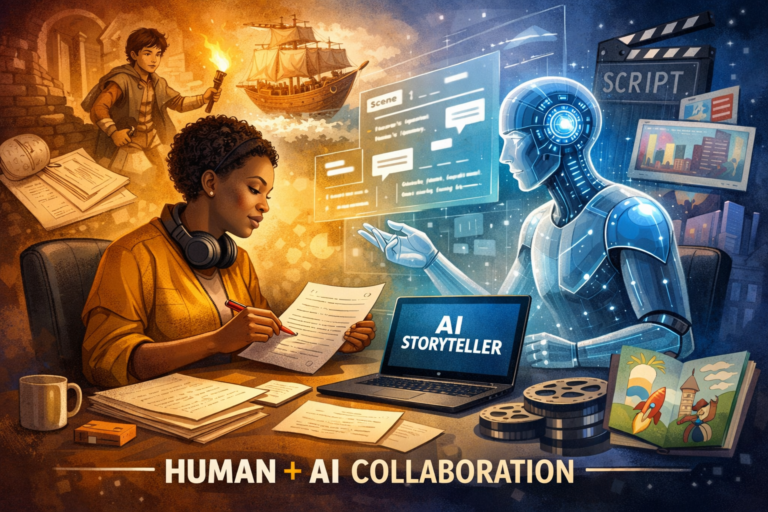
Storytelling has always connected societies and preserved culture, from African oral traditions to modern digital media. Today, AI is transforming this practice, with AI storytellers already in use across publishing, marketing, education, gaming, and media.
These systems go beyond simple writing aids, combining language modelling, narrative logic, and human guidance to produce coherent stories at scale, boosting creativity and efficiency while reducing content production costs.
What is AI Storyteller
An artificial intelligence storyteller is a digital system that creates or enhances narratives using machine learning models trained on large text datasets. It can generate fiction, scripts, marketing copy, educational content, and interactive stories.
These systems analyse language patterns, understand context, and predict coherent text sequences using statistical modelling, without actual understanding or consciousness. They range from simple automated story generators to advanced narrative engines used in games, film production, and brand communications.
Practical Applications
To understand the system properly, it is useful to examine its operational layers.
Input and Prompt Design
The storytelling process begins with user input—theme, genre, audience, tone, or existing text. Clear, precise instructions yield focused, engaging narratives, while vague instructions lead to generic results. The system converts these inputs into structured data that guides the story’s development.
Language Modelling and Context Processing
The core intelligence layer uses large language models, such as those from OpenAI, trained on extensive text to recognise grammar, narrative patterns, and style. When generating a story, the model analyses the prompt, applies context, and predicts text sequences to maintain consistent characters, coherent plotlines, and a stable tone.
Narrative Structuring
Advanced AI storytellers go beyond word prediction by applying narrative structuring, recognising arcs like introduction, rising action, climax, and resolution. They manage dialogue, character development, and pacing, producing coherent stories rather than random text. This structured approach sets them apart from early template-based generators.
Style Adaptation and Emotional Tone
AI storytellers can modify style and tone, from formal prose to conversational or culturally specific language, and emphasise emotions like suspense, humour, or empathy. This flexibility lets the same story be tailored for different audiences, whether for corporate training or children’s narratives.
Output and Human Refinement
The final output can be a short story, a script, a marketing narrative, or an interactive story. Human oversight remains crucial, with editors refining structure, ensuring accuracy, and adjusting tone. Effective AI storytelling is collaborative, not fully autonomous.
Top AI Storytelling Platforms, Use Cases and Best Functionalities
- OpenAI
- Use Case: Creative writing, script drafting, educational content, conversational agents
- Best Functionality: Advanced natural language understanding and scalable content generation across multiple formats
- Sudowrite
- Use Case: Fiction writing for novelists and creative authors
- Best Functionality: Character expansion, scene rewriting, and sensory description enhancement
- Jasper
- Use Case: Marketing and branded storytelling, long-form promotional content
- Best Functionality: Campaign narrative generation, brand voice adaptation, and consistent content production at scale
- ShortlyAI
- Use Case: Long-form writing and extended narrative development
- Best Functionality: Story continuation and expansion from brief prompts
All platforms share core AI storytelling principles but differ in their interfaces, target audiences, and specialised narrative tools.
Impact on Economy, Education and Employment
Economic impact:
AI storytelling lowers production costs, helping smaller creators compete while enabling faster, more efficient content development across marketing and publishing.
Educational impact:
AI-driven storytelling enhances learning through engaging, scenario-based content and realistic simulations across professional training fields.
Employment impact:
While some writing roles change, new opportunities emerge in AI management and editorial oversight, shifting skills rather than eliminating jobs.
Sustaining the innovation
Meaningful progress depends on three interlinked developments.
Firstly, investment in digital infrastructure must expand beyond urban centres to ensure equitable access.
Secondly, educational institutions should integrate AI literacy into media, communication and creative arts curricula.
Thirdly, regulatory clarity must continue to evolve, balancing innovation with accountability.
Local dataset development is particularly important. Partnerships between technology firms, Universities and creative industries could help build culturally relevant narrative resources that reflect linguistic diversity, especially in the Nigerian context.
Ethical Regulations
Responsible deployment requires transparency. Users should understand when content is generated by AI. Intellectual property considerations must be respected. Bias mitigation is essential, particularly in multicultural societies.
Organisations adopting AI storytelling tools should establish internal review processes. Editorial oversight remains necessary to ensure accuracy, fairness and cultural sensitivity.
A Measured Outlook
The artificial intelligence storyteller reshapes how stories are created and shared, amplifying human creativity rather than replacing it when used with clear intent and understanding.
For organisations, success lies in informed adoption. With strong governance, adequate infrastructure and cultural awareness, AI storytelling can drive creative growth, enrich education and support economic development.

Senior Reporter/Editor
Bio: Ugochukwu is a freelance journalist and Editor at AIbase.ng, with a strong professional focus on investigative reporting. He holds a degree in Mass Communication and brings extensive experience in news gathering, reporting, and editorial writing. With over a decade of active engagement across diverse news outlets, he contributes in-depth analytical, practical, and expository articles exploring artificial intelligence and its real-world impact. His seasoned newsroom experience and well-established information networks provide AIbase.ng with credible, timely, and high-quality coverage of emerging AI developments.