

Visual storytelling has long shaped how ideas travel, from editorial cartoons and illustrated books to animation and digital campaigns. Today’s digital revolution is accelerating that tradition. AI cartoon makers can now generate characters, scenes, and illustrated visuals in minutes, not weeks. What once required specialist skills and expensive software has become faster, more scalable, and far more accessible.
For AI adopters across sectors, understanding these tools is no longer optional. AI cartoon makers are influencing education, advertising, entertainment, journalism, and public communication. This article offers a clear, evidence-based explanation of how they work, the leading platforms driving adoption globally, and what their growing use means for creative practice and the digital economy.
Concept and Definition
An AI cartoon maker is software that uses artificial intelligence to generate cartoon-style visuals such as characters, portraits, scenes, and short animations. Unlike traditional illustration tools that depend on manual design, these systems automate much of the creative process.
They combine machine learning, computer vision, and generative models trained on large collections of images and artistic styles. By analysing features like line work, colour, and facial structure, the software can turn a photo or text prompt into a stylised cartoon. Crucially, AI cartoon makers go beyond simple filters, interpreting form and expression to produce visuals that closely resemble hand-drawn or digitally illustrated artwork.
Practical Functionality
AI cartoon makers generally operate through one or more of three approaches.
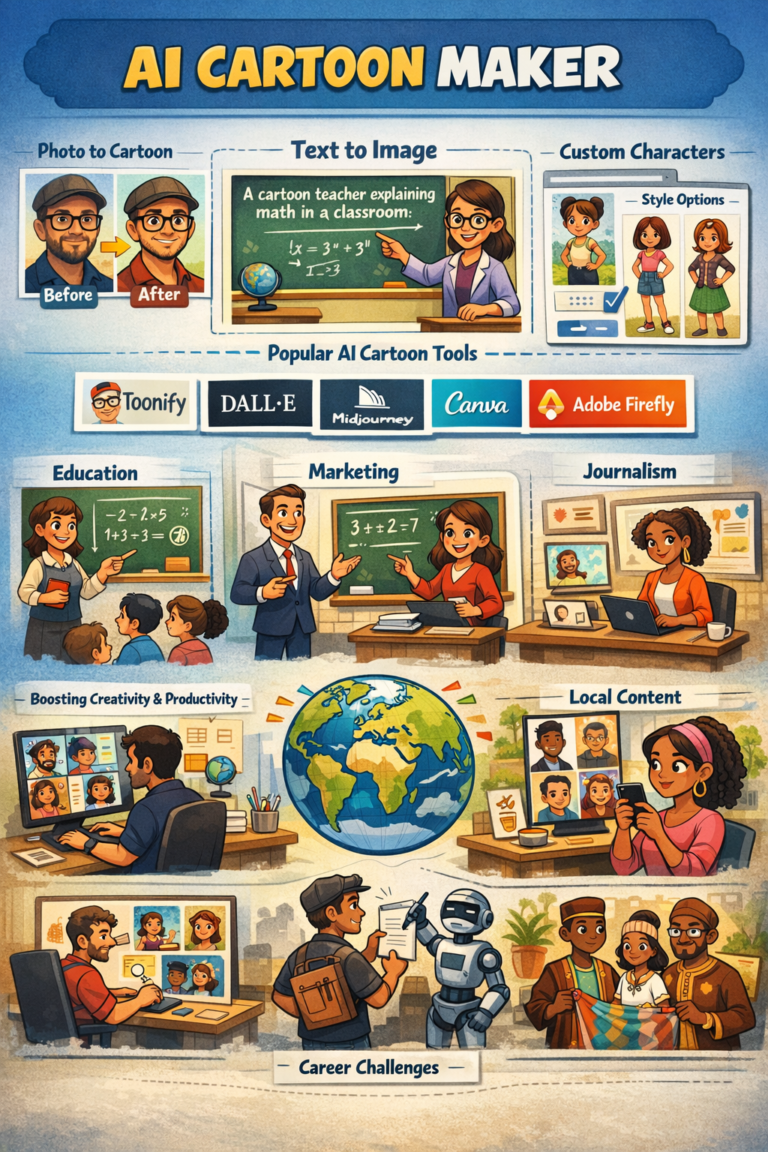
The first is the image-to-cartoon transformation. Here, a user uploads a photograph, and the system converts it into a cartoon-style image. Facial landmarks, outlines, and textures are detected and stylised to resemble animation or illustration.
The second approach is text-to-image generation. In this case, users describe a scene or character in natural language, such as a cartoon teacher explaining mathematics in a classroom. The AI model generates an image from that prompt, drawing on its training on visual and textual data.
The third approach combines templates with generative intelligence. Users select a style, character type, or scene layout, then customise elements such as expressions, clothing, and background. The AI fills in details and ensures visual consistency.
Behind the scenes, most modern tools rely on deep learning architectures, particularly diffusion models and transformer-based systems. These models refine images iteratively, improving detail and coherence at each step. The result is a cartoon image that often appears polished, expressive, and suitable for publication or presentation.
Key AI Cartoon Maker Tools and Platforms
Several platforms have emerged as leaders in this space, each with distinct strengths and target audiences.
Toonify is widely recognised for its ability to transform real photographs into cartoon-like portraits. It gained early attention for producing Pixar-style facial renderings and remains popular for profile images, avatars, and informal creative use.
Midjourney is known for its high-quality artistic outputs. While not limited to cartoons, it is frequently used to generate illustrated and animated-style visuals through carefully crafted prompts. Designers and storytellers value its flexibility and aesthetic depth.
DALL·E offers text-to-image generation with strong control over style and composition. It is often used for editorial cartoons, educational illustrations, and concept art where clarity and relevance matter more than exaggerated style.
Canva has integrated AI cartoon and illustration features into its broader design ecosystem. This makes it particularly accessible to non-designers, educators, and small businesses that need quick visual assets without specialist training.
Adobe Firefly represents a more professional-grade approach, embedded within Adobe’s creative software environment. Its emphasis on commercial safety and integration with established design workflows appeals to agencies and corporate users.
Each of these tools reflects a different balance between automation, control, and artistic expression. Together, they illustrate how AI cartoon makers are evolving from novelty applications into serious creative infrastructure.
Use Cases Across Sectors
AI cartoon makers are not confined to entertainment. Their adoption spans multiple sectors with practical, measurable benefits.
In education, illustrated content improves comprehension and retention, especially for younger learners. Teachers use AI cartoon tools to create visual explanations, story-based lessons, and culturally relevant characters that resonate with students. This is particularly valuable in contexts where resources for professionally illustrated textbooks are limited.
In marketing and advertising, cartoons simplify complex messages and attract attention in crowded digital spaces. Brands use AI-generated characters for social media campaigns, explainer visuals, and product storytelling. The speed of generation allows rapid iteration and localisation.
In media and journalism, cartoon visuals support opinion pieces, editorial commentary, and social awareness campaigns. AI tools reduce production time while maintaining a consistent visual identity.
In personal branding and communication, individuals create avatars, presentation visuals, and profile images that balance professionalism with approachability.
These use cases highlight a common theme: AI cartoon makers lower the cost and skill barriers to visual communication.
Global Perception
Globally, AI cartoon makers are shaped by differing cultural, legal, and market conditions. In North America and Europe, the focus is often on intellectual property protection, ethical training data, and commercial licensing. Platforms emphasise transparency about how models are trained and how outputs can be used in professional settings.
In parts of Asia, particularly in countries with strong animation and gaming industries, AI cartoon tools are increasingly integrated into production pipelines. They are used for concept development, background generation, and character prototyping rather than final outputs.
Emerging markets, including many African countries, approach AI cartoon makers from a different angle. Here, the emphasis is on accessibility, affordability, and relevance. Tools that function well on low bandwidth, support mobile devices, or allow local cultural expression gain traction more quickly.
These global differences influence how AI cartoon makers are designed and adopted, reminding users that the technology is not culturally neutral.
How It Affects the Economy, Education, and Jobs
AI cartoon makers carry real economic weight. They boost productivity and open the creative economy to a wider pool of contributors, allowing people without formal art training to produce compelling visual content and generate new income opportunities.
At the same time, automation is reshaping creative work. Entry-level illustration roles may come under pressure, but the deeper shift is toward new skill sets. Value increasingly lies in creative judgement, cultural understanding, and confident use of AI tools, not manual production alone.
In education, these tools strengthen inclusive learning by making complex ideas visual and adaptable to local languages and contexts, supporting digital literacy and equity. In governance and public communication, cartoon-style visuals cut through complexity, helping public health messages and civic information reach broader audiences with clarity and impact.
Path to Progress
For AI cartoon makers to deliver lasting value, several conditions must be met.
First, access must improve. Affordable pricing models, local partnerships, and offline-friendly features would broaden adoption.
Secondly, governance frameworks should evolve to address creative ownership, fair use, and accountability. Clear guidance protects both creators and users.
Thirdly, education and capacity building are essential. Integrating AI-assisted creativity into design, media, and education programmes ensures that users understand both the possibilities and limitations of the technology.
Finally, local content matters. Encouraging datasets, styles, and prompts that reflect lived experiences helps ensure relevance and cultural integrity.
In Closing
AI cartoon makers mark a decisive shift in how visual content is produced and distributed. They fuse advanced technology with everyday accessibility, unlocking faster, broader, and more flexible creative expression. Their real value lies not in novelty but in how effectively they are embedded into real-world practice.
For AI adopters, the goal is not mere usage but informed application. With clarity, responsibility, and cultural awareness, AI cartoon makers can expand creative ecosystems, elevate local storytelling, and enhance communication rather than erode professional craft.

Senior Reporter/Editor
Bio: Ugochukwu is a freelance journalist and Editor at AIbase.ng, with a strong professional focus on investigative reporting. He holds a degree in Mass Communication and brings extensive experience in news gathering, reporting, and editorial writing. With over a decade of active engagement across diverse news outlets, he contributes in-depth analytical, practical, and expository articles exploring artificial intelligence and its real-world impact. His seasoned newsroom experience and well-established information networks provide AIbase.ng with credible, timely, and high-quality coverage of emerging AI developments.