

AI agents are software systems that act on your behalf. They complete tasks, make decisions, and learn from data with little human input.
AI agents are artificial intelligence tools that sense information, decide what to do, and take action to reach a clear goal. They power chat support, automate routine work, and personalise services across many industries.
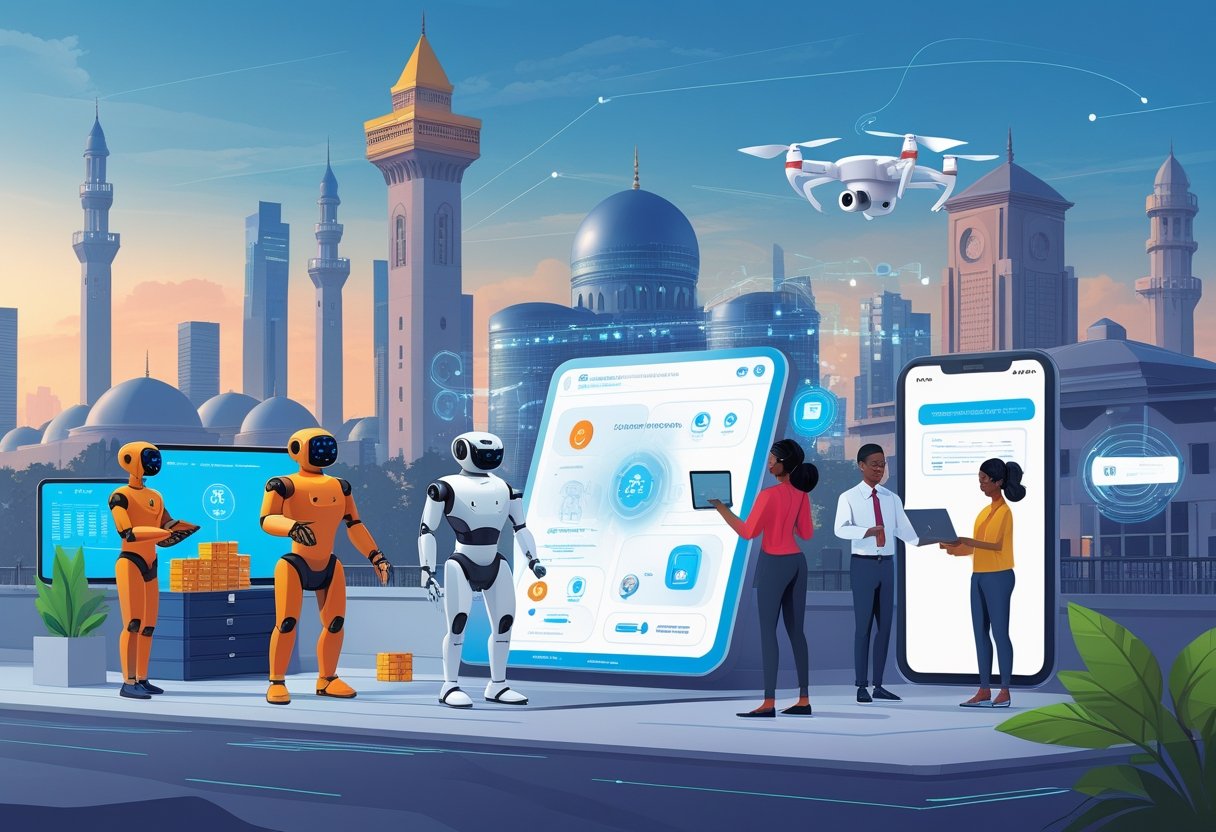
In Nigeria, you already meet AI agents in banking apps and online support chats. They also show up in marketing tools and fraud checks.
Businesses use different types, from simple rule-based agents to learning agents that improve over time. These tools help teams save time, cut costs, and serve customers better, even when resources feel limited.
- AI agents act, decide, and learn using artificial intelligence
- Different agent types solve different business problems
- Nigerian use cases focus on efficiency, service, and growth
Defining AI Agents and Their Core Principles
You need a clear idea of what an AI agent is before diving into types and use cases. Let’s break down what they are, how they’re different from bots or assistants, and what makes them useful in the real world.
What Is an AI Agent?
An AI agent is a software system that uses artificial intelligence to act on your behalf. You give it a goal, and it figures out how to reach that goal using data, rules, or learning.
The agent observes its environment, like user input, sensor data, or system states. Then it chooses actions and carries them out—no need for you to steer it every step of the way.
You see AI agents in tasks such as route planning, fraud checks, and customer support. In Nigeria, businesses rely on them to manage payments, monitor networks, and handle significant data flows.
At a basic level, an AI agent follows a loop:
- Observe what is happening
- Decide what action to take
- Act using available tools
This cycle repeats as conditions change.
The Difference Between AI Agents, Bots, and Assistants
People often mix up AI agents, bots, and AI assistants. They’re not the same, though. Here’s a table to make it more straightforward:
| System | Main purpose | Decision-making | Level of autonomy |
|---|---|---|---|
| Bot | Follow fixed commands | Very limited | Low |
| AI assistant | Help users directly | Moderate | Medium |
| AI agent | Achieve set goals | Advanced | High |
A bot follows simple rules, like replying to keywords. It doesn’t plan or adapt.
An AI assistant helps you with tasks like writing or reminders. It responds well, but you still guide most actions.
An AI agent works with less input. You set the goal, and it handles the steps, choices, and timing on its own.
Key Features of Modern AI Agents
Modern AI agents have several core features that set them apart.
Autonomy means the agent acts without your guiding every move. This matters in fast systems like finance or logistics.
Goal-driven behaviour keeps actions focused. The agent checks if each action actually moves it closer to the goal.
Reasoning and planning help it compare options. It can pick a better path, not just the first one it sees.
Memory or state tracking lets the agent use past information. It makes smarter decisions over time.
Learning ability, when present, helps the agent adapt. It tweaks its behaviour based on results, which is handy in ever-changing places like Nigerian markets or traffic.
Fundamental Architectures and Components of AI Agents
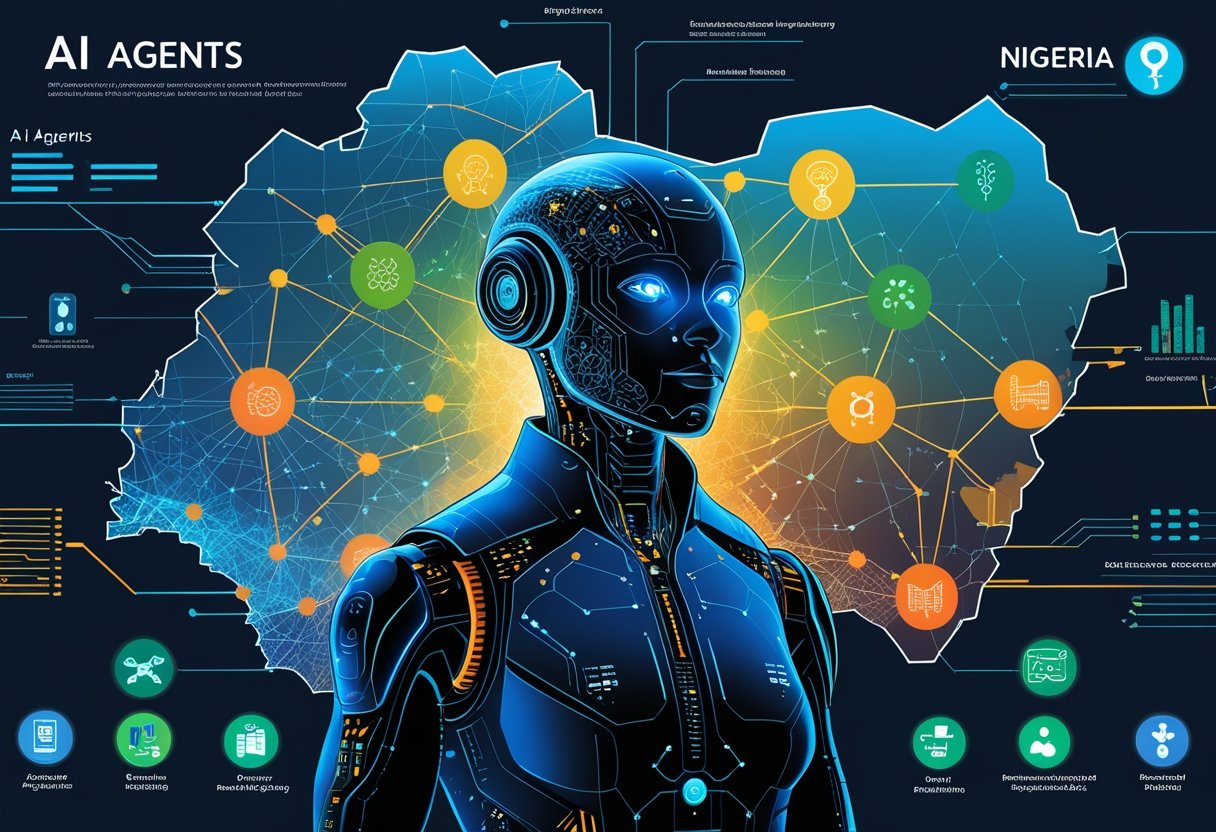
AI agents follow clear structures that guide how they sense data, make decisions, and act. Knowing these building blocks helps you see how agents work in real systems, whether in business or public services in Nigeria.
Core Elements: Perception, Reasoning, and Action
Every AI agent relies on three core elements: perception, reasoning, and action execution.
The perception module gathers input from text, databases, sensors, or user messages. It turns raw data into something the agent can process.
Reasoning lets the agent decide what to do next. It often uses planning algorithms to compare options and pick steps that support a goal.
Some agents also keep a world model, which stores facts about the environment and current state.
Action execution connects decisions to real outcomes. The agent might call an API, update a record, send a message, or trigger a workflow.
In many systems, a human-in-the-loop reviews or approves key actions.
Agent Architectures and Modules
Agent architecture is about how components connect and work together. You might see single-agent architectures for simple tasks, like document sorting.
More complex systems use multi-agent architectures, in which agents share tasks such as planning, checking, and execution.
Most modern agent architectures use modular design. Each module handles one role, such as perception, planning, or tool use.
This approach gives you better control and safety.
- Input and perception module
- Reasoning and planning module
- Action execution layer
- Control and safety rules
This setup helps you scale systems and manage risk. It’s essential in finance, logistics, and government services.
The Role of Memory and Learning in Agents
Memory lets agents stay consistent and improve over time. Short-term memory stores current tasks and recent messages.
Long-term memory stores past actions, user preferences, or results across sessions.
Learning agents use feedback to adjust behaviour. They track what worked and what failed, then update future decisions.
Memory also supports accountability. You can review decisions, trace actions, and involve a human in the loop when needed.
In regulated sectors, this control matters as much as performance.
Types of AI Agents
AI agents differ in how they sense data, make decisions, and act on tasks. Some react to simple inputs, while others plan, weigh options, or learn from past results.
These differences shape how you can use them in real work across Nigeria.
Simple Reflex Agents
Simple reflex agents act on direct rules. You set a condition, and the agent responds when it detects it.
These reactive agents don’t store memory or analyse past events.
You often see simple reflex agents in basic automation. Think spam filters, auto-replies, or rule-based alerts.
If an input matches a rule, the agent triggers an action.
Key traits
- No memory or learning
- Fast and predictable behaviour
- Works best in stable settings
In Nigeria, businesses use simple reflex agents for email sorting, SMS responses, and basic customer support. They’re cheap to run but break down when things get complicated.
Model-Based Agents
Model-based agents keep track of what happens over time. They maintain an internal model of the environment, which helps them act even when information is missing.
These agents build on simple reflex agents by adding context. A model-based reflex agent can remember prior inputs and adjust its responses accordingly.
What makes them useful
- Handles missing or delayed data
- Maintains short-term state
- Responds with better accuracy
You’ll find model-based agents in navigation apps, chat systems, and inventory tools. In Nigeria, logistics firms use them to track deliveries and update routes when traffic or weather changes.
Goal-Based Agents
Goal-based agents pick actions that move you closer to a defined outcome. You set a goal, and the agent plans steps to reach it.
These active agents look ahead at possible results before acting. They don’t rely solely on fixed rules and can change course when things shift.
Common uses
- Appointment scheduling
- Task planning
- Process automation
For example, a goal-based agent in a Nigerian recruitment platform can screen applicants, book interviews, and send updates. It focuses on completing the hiring task, not just reacting to messages.
Utility-Based Agents
Utility-based agents go beyond goals. They compare multiple actions and pick the one with the highest value using a utility function.
You decide what matters most—maybe speed, cost, or quality. The agent scores each option and picks the best one.
| Factor | Example use |
|---|---|
| Cost | Cheaper delivery route |
| Time | Faster customer response |
| Value | Higher-quality lead |
Banks and e-commerce firms in Nigeria use utility-based agents for risk checks, lead scoring, and service prioritisation. These agents shine when there’s more than one good choice.
Learning Agents
Learning agents get better with experience. They tweak behaviour based on feedback, stored data, or performance results.
Most learning agents use fixed models but refine outcomes with new data or rules. They don’t learn as people do, but they adapt within set limits.
Where they help
- Fraud detection
- Sales coaching
- Customer insights
In Nigeria, fintech firms use learning agents to spot unusual transactions. Over time, the agent learns better patterns and reduces false alerts, which builds trust and boosts efficiency.
Multi-Agent Systems
Multi-agent systems bring together several agents working as a team. Each agent takes on a part of the job and shares what they find with the others.
Things move faster and on a bigger scale since agents run in parallel. Each one sticks to its own rules but still has to coordinate with the rest.
Typical structure
- One agent collects data
- Another analysis result
- A third triggers actions
Telecoms, innovative grid projects, and big platforms in Nigeria rely on multi-agent systems. They’re a good fit for complicated setups where no single agent can handle every decision.
Advanced and Collaborative AI Agent Models
Advanced AI agents have gone way past fixed rules and simple routines. These days, you see systems that learn from data, act with a bit of independence, and team up to tackle bigger problems in Nigerian businesses, services, and public systems.
Learning and Autonomous Agents
Learning agents improve over time by using feedback and new data. They’re common in autonomous AI setups that don’t require someone to monitor them constantly.
You’ll spot them in fast-changing fields like fintech, logistics, and online services in Nigeria. If you break it down, learning agents have four main parts: decision logic, learning logic, feedback, and exploration.
This mix lets the agent try out new things and keep whatever works best.
Typical uses in Nigeria include:
- Fraud detection that adapts to new scam patterns
- Customer support chatbots that learn from past chats
- Demand forecasting for retail and agriculture
Autonomous agents handle uncertainty better than single-agent systems. But honestly, they still need clear boundaries to avoid mistakes or biased results.
Multi-Agent Systems and Collaboration
Multi-agent systems consist of multiple agents with distinct roles. This model makes sense when one agent can’t do it all.
These systems support multi-agent collaboration through shared goals and data. In practice, maybe one agent grabs the data, another plans what to do, and a third checks how things went.
This setup works well for complex Nigerian scenarios such as traffic control, supply chains, and energy management.
| Agent Role | Example Task |
|---|---|
| Data agent | Collects sensor or user data |
| Planning agent | Chooses next actions |
| Monitoring agent | Flags risks or failures |
You’ll notice better speed and reliability than with just one agent.
Emerging Agent Frameworks and Tools
There’s a growing set of tools that make building and running AI agents much simpler. Agent frameworks give you structure, memory, and task control—no need to write everything from scratch.
Some popular names are LangChain, AutoGPT, CrewAI, and Agent Studio. These tools usually hook agents up to a vector database, which stores info in a way that makes searching and recalling facts super fast.
This helps agents keep context, even on long or messy tasks.
You can use these frameworks to:
- Chain tasks across multiple agents
- Share memory between agents
- Connect agents to local data sources
For Nigerian teams, these tools reduce build time and enable local solutions without the need for massive infrastructure.
Key Use Cases of AI Agents in Nigeria
AI agents already power daily business and public services across Nigeria. They reduce fraud, improve access to care, automate tedious tasks, and help companies make quick decisions with limited resources.
AI Agents in Financial Services and Fraud Detection
Banks and fintechs use AI agents to monitor transactions in real time. These agents spot anomalous patterns, flag risky payments, and block fraud before it escalates.
That’s a big deal in Nigeria, where mobile payments and transfers keep climbing. AI agents also help with credit scoring and lending by checking payment history, phone data, and spending habits to judge risk.
This opens doors for people without much credit history. Common uses include:
- Fraud detection on cards, wallets, and transfers
- Automated compliance checks for KYC and AML
- Lead scoring for loans and savings products
These tools reduce manual reviews and speed up decision-making.
Healthcare, HR, and Employee Onboarding
In healthcare, AI agents help clinics that lack sufficient staff. They track patient data from basic devices and alert doctors if something’s off.
Telemedicine platforms use AI assistants to schedule visits and send cases to the right specialist. In HR, companies use AI-powered automation to handle hiring and onboarding.
Agents screen CVs, answer staff questions, and guide new hires through policies and training. This takes a load off admin teams and helps companies grow faster.
Key applications include:
- Remote patient monitoring and alerts
- Employee onboarding workflows
- HR chatbots for leave, payroll, and benefits
You get faster service and fewer mistakes.
Customer Engagement: Chatbots and Virtual Assistants
Many Nigerian businesses rely on chatbots and virtual assistants to keep up with customer demand. These AI agents answer on WhatsApp, web chat, and social media at any time of day.
They handle questions, process orders, and fix simple issues—no human needed. Some agents use recommendation engines to suggest products or plans based on what you’ve done before.
Sales teams lean on AI assistants for lead scoring, follow-ups, and reminders.
Typical use cases include:
- Customer support chatbots
- Sales and marketing automation
- Personalised product suggestions
This means quicker responses and happier customers.
Optimising Delivery, Dynamic Pricing, and Resource Allocation
Logistics and service companies use AI agents to plan routes and manage fleets. These systems look at traffic, fuel costs, and demand to optimise delivery times.
That’s especially handy in cities with heavy traffic and rising transport costs. AI agents also power dynamic pricing by tweaking prices based on demand, location, and supply.
Energy, transport, and e-commerce firms already test these ideas. Resource planning gets a boost, too:
- Smart inventory management
- Workforce scheduling
- Energy and fuel usage control
You waste less and get more out of what you have.
Opportunities, Challenges, and the Future of AI Agents in Nigeria
AI agents already handle real jobs in Nigeria, from customer service to crunching data. There’s a lot of room to grow, but honestly, skills, privacy, and infrastructure still put a cap on how fast things can move.
AI Adoption: Opportunities for Nigerian Industries
You can use AI agents to boost speed, cut costs, and expand services in essential sectors. Banks roll out LLM-powered agents for support chats, fraud spotting, and loan guidance.
Health providers are experimenting with generative AI for triage, records, and patient follow‑ups. Farmers benefit from agents that analyse weather, soil, and pricing.
Education platforms use large language models to personalise lessons and spot learning gaps.
Common opportunities include:
- 24/7 customer support using GPT-style chat agents
- Decision support with RAG systems that use local data
- Process automation in finance, logistics, and government
These tools work best when grounded in Nigerian data and real business needs.
Overcoming Barriers: Skills, Privacy, and Infrastructure
There are still roadblocks that slow down AI agent adoption. Skilled AI talent is in short supply, especially for building and keeping up LLMs and RAG pipelines.
Many teams depend on foreign tools, which can drive up costs and limit control. Privacy and data protection matter more than ever as agents handle sensitive information.
You have to follow Nigeria’s Data Protection Act and keep tabs on where data lives, how models train, and who gets to see the results. Infrastructure isn’t always up to the task either.
Unreliable power, pricey cloud services, and spotty networks all affect performance. Key barriers include:
- Shortage of local AI engineers and prompt designers
- Poor data quality and scattered records
- Not enough guidance on safe AI use in regulated sectors
Fixing these problems will take better policies, more training, and private investment—no easy answers, but it’s doable.
The Future Outlook for AI Talent and Innovation
AI agents are set to grow steadily as skills and tools continue to improve. Universities, bootcamps, and private labs have started training developers in LLMs, RAG, and applied AI.
This shift helps build local capacity, so people don’t have to rely entirely on imported models. It’s a welcome change, honestly.
Startups now zero in on narrow, high-impact agents instead of chasing broad general AI. You’ll spot plenty of solutions tailored to Nigerian languages, regulations, and workflows.
That sort of focus? It boosts trust and makes adoption much more likely.
The future of AI agents in Nigeria really hinges on a few things:
- Practical training that matches up with what industries actually need
- Responsible use, protecting privacy and data rights, isn’t optional
- Local innovation, built on top of global models, rather than just swapping them out

AI Writer
Bio: Joseph Michael is an MBA graduate in Marketing from Ladoke Akintola University of Technology and a passionate tech enthusiast. As a professional writer and author at AIbase.ng, he simplifies complex AI concepts, explores digital innovation, and creates practical guides for Nigerian learners and businesses. With a background in marketing and brand communication, Joseph brings clarity, insight, and real-world relevance to every article he writes.