

From the early days of ELIZA in the 1960s to today’s sophisticated conversational agents, chatbots have undergone profound transformations. Initially, chatbots were simple programs designed to mimic conversation with predefined scripts.
Their interactions were often limited, mechanical, and confined to narrow domains. Over the past two decades, however, advances in natural language processing, machine learning, and computational power have enabled chatbots to engage users with increasing sophistication, handling complex queries and understanding nuanced contexts.
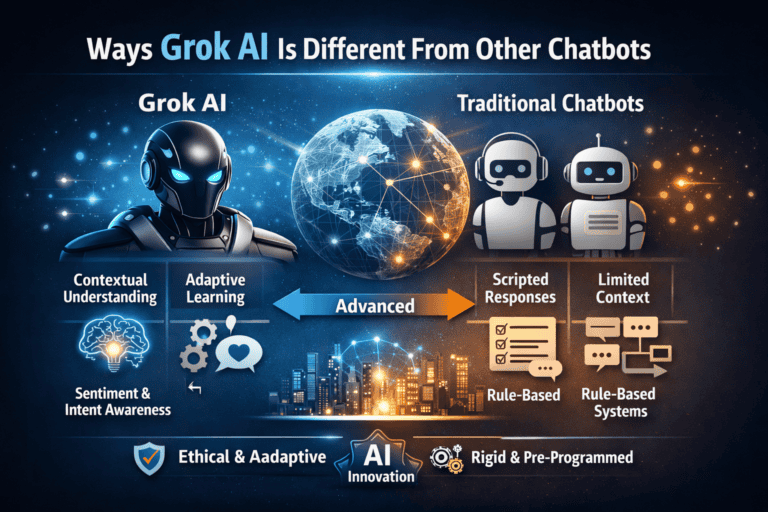
Within this landscape, Grok AI has emerged as a notable player. Unlike many conventional chatbots, which often operate within rigid boundaries, Grok AI integrates cutting-edge language comprehension, context retention, and adaptive interaction capabilities.
What Is Grok AI?
Grok AI is an advanced conversational artificial intelligence platform developed to facilitate nuanced human-computer interaction. The term “Grok” originated in science fiction literature and implies a deep, intuitive understanding. In practical terms, Grok AI is designed not only to process language but also to understand context, intent, and user sentiment. This contrasts sharply with traditional chatbots, which often rely on keyword matching or rigid rule-based systems.
Conventional Chatbots
Most traditional chatbots fall into two broad categories:
- Rule-Based Chatbots: These rely on pre-programmed scripts. They are effective for structured tasks such as FAQs or simple customer service queries, but lack flexibility and fail when users deviate from anticipated inputs.
- Machine Learning Chatbots: These use statistical models to improve responses over time. While more flexible than rule-based bots, they often struggle with context retention and nuanced understanding, especially in multi-turn conversations.
How Grok AI Works
Contextual Awareness
A defining feature of Grok AI is its ability to retain long-term context. Unlike many chatbots that treat each query in isolation, Grok AI remembers prior interactions, enabling coherent, contextually informed responses over extended conversations. This is particularly relevant in sectors such as customer service, where understanding historical interactions enhances user satisfaction.
Sentiment and Intent Analysis
Grok AI integrates sentiment analysis, allowing it to interpret the emotional tone of user inputs. Combined with advanced intent recognition, this enables the AI to respond not only with factual accuracy but with empathy and nuance. For example, in mental health or counselling applications, this capability ensures more sensitive, human-like engagement.
Adaptive Learning
While conventional chatbots may improve responses via training on large datasets, Grok AI incorporates continuous, adaptive learning mechanisms. It can adjust its conversational strategies in real time based on feedback, enhancing accuracy and relevance without requiring frequent manual retraining. This makes it suitable for dynamic environments such as financial services or evolving regulatory frameworks.
Global Comparisons: How Grok AI Stands Out
Across the world, several AI platforms have sought to revolutionise conversational interaction. Microsoft’s Azure AI, Google’s Bard, and OpenAI’s ChatGPT, for instance, have popularised generative language models capable of producing human-like text. However, Grok AI distinguishes itself in several respects:
- Localised Knowledge Integration: Grok AI is designed to efficiently incorporate domain-specific knowledge, enabling more accurate responses in specialised fields such as law, medicine, and education.
- Ethical Alignment: The platform integrates ethical constraints and bias-mitigation frameworks, reducing the likelihood of harmful or inappropriate outputs.
- Scalable Deployment: Unlike some global platforms constrained by server or licensing limitations, Grok AI can be deployed across enterprise-level infrastructure, supporting high-volume, real-time interactions.
Implications Across Sectors
Economy and Business
For businesses, Grok AI’s contextual and adaptive capabilities translate into improved customer engagement, reduced operational costs, and streamlined workflows. Companies can automate complex interactions, freeing human employees for higher-value tasks while maintaining high service quality.
Education
In education, Grok AI can provide personalised tutoring, adaptive learning experiences, and responsive feedback mechanisms. By retaining contextual knowledge of a student’s progress, the AI can tailor exercises and explanations to address individual learning gaps effectively.
Governance and Public Services
Governments and public institutions can leverage Grok AI to improve citizen engagement. From handling policy enquiries to providing real-time updates on public services, Grok AI’s sophisticated dialogue management enhances transparency and responsiveness. In the Nigerian context, for example, such tools could improve accessibility of information across multiple languages and dialects.
Critical Conditions for Maximising Benefits
To fully harness Grok AI’s potential, several conditions are necessary:
- Robust Regulatory Frameworks: Clear policies on data privacy, AI ethics, and operational accountability are essential.
- Infrastructure Investment: Reliable internet connectivity and computing resources are fundamental to the scalable deployment of AI.
- Human-AI Collaboration: Training programmes to equip professionals with AI literacy can ensure that Grok AI complements human expertise rather than replacing it.
- Localisation of AI Models: Incorporating local languages, idioms, and cultural contexts enhances usability and relevance.
Closing Analysis
Grok AI represents a significant evolution in the chatbot landscape, combining deep contextual understanding, adaptive learning, and ethical design. Its distinguishing features make it well-suited to complex real-world applications in business, education, and governance. While challenges remain-particularly in infrastructure, regulation, and cultural adaptation-its potential to transform human-computer interaction is undeniable.
By bridging the gap between rigid, rule-based systems and truly adaptive, human-like conversation, Grok AI offers a model for the next generation of intelligent digital assistants, shaping the future of how individuals and institutions communicate, learn and operate in a rapidly digitalising world.

Bio: An (HND, BA, MBA, MSc) is a tech-savvy digital marketing professional, writing on artificial intelligence, digital tools, and emerging technologies. He holds an HND in Marketing, is a Chartered Marketer, earned an MBA in Marketing Management from LAUTECH, a BA in Marketing Management and Web Technologies from York St John University, and an MSc in Social Business and Marketing Management from the University of Salford, Manchester.
He has professional experience across sales, hospitality, healthcare, digital marketing, and business development, and has worked with Sheraton Hotels, A24 Group, and Kendal Nutricare. A skilled editor and web designer, He focuses on simplifying complex technologies and highlighting AI-driven opportunities for businesses and professionals.
LinkedIn