

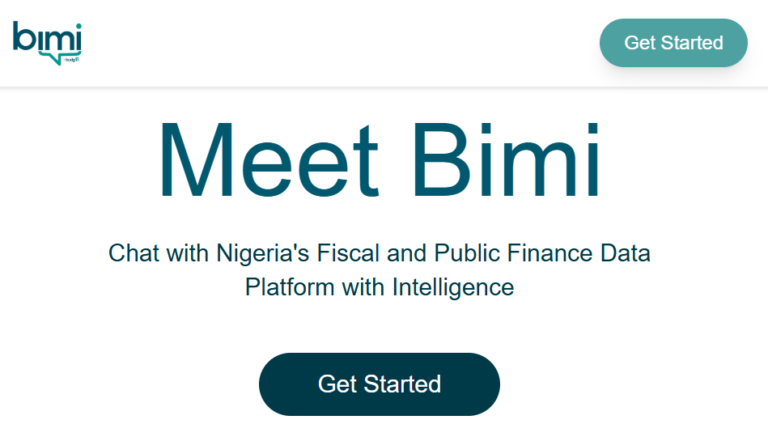
In 2025, BudgIT, the Nigerian civic-tech organisation known for promoting transparency and citizen engagement, launched an artificial intelligence-driven chatbot named Bimi to make fiscal and public finance data more accessible to everyday users. The tool represents a significant step in leveraging advanced technology to bridge the knowledge gap between complex government financial records and citizen understanding.
Democratizing Access to Fiscal Data
Bimi — a name derived from the Yoruba phrase meaning “ask me” — is a web-based AI assistant designed to help Nigerians of all backgrounds obtain precise, accurate, and real-time insights into Nigeria’s public finance landscape. Rather than navigating dense spreadsheets or government portals, users can interact with Bimi using natural language queries, such as requests for budget figures, public spending breakdowns, or information on government revenue trends.
Accessible through bimi.budgit.org, the chatbot consolidates fiscal indicators, audited financial reports, macroeconomic data, and budget implementation statistics into conversational responses. It also offers downloadable datasets and explanatory content, providing users with context and numbers.
- AI challenges in Nigeria
- AI in the Nigerian retail sector
- Artificial Intelligence adoption in Nigeria
- Viable AI Startup Business Ideas for Nigerians
- AI is creating new job roles in Nigeria
- AI regulations in Nigeria
Empowering Citizens and Stakeholders
BudgIT’s leadership has framed Bimi not simply as a technical tool, but as a civic empowerment platform. During its launch at the Lagos Open Data Day 2025 and through subsequent statements, BudgIT executives underscored the chatbot’s potential to improve government transparency and accountability by equipping citizens with the information necessary to make informed decisions and demand better governance.
Global Director Oluseun Onigbinde said that by simplifying complex fiscal datasets, Bimi offers “a user-friendly gateway to otherwise opaque government data,” enabling journalists, researchers, policymakers, and everyday Nigerians to engage with financial information previously accessible only to specialists.
Features and Functional Capabilities
Bimi’s design focuses on several core capabilities:
-
Natural language interaction: Users pose questions as they would in regular conversation, and the chatbot interprets and answers them using structured public finance data.
-
Real-time data access: It pulls from audited financial reports and related datasets to deliver near-instant insights on budgets, allocations, expenditure, and fiscal performance.
-
Educational content: Beyond raw figures, Bimi provides context on fiscal concepts and governance issues to help users understand why certain numbers matter.
-
Expandability: The platform is structured to accommodate additional modules, including courses on public financial management and civic technologies.
According to BudgIT, the chatbot is intended for a broad audience — citizens, researchers, civil society organisations, the media, academia, and policymakers alike — reducing barriers that traditionally limited data access to specialists and technocrats.
AI and Civic Participation
The introduction of Bimi also signals a broader shift toward AI-enabled civic participation in Nigeria. Experts associated with the BudgIT project have pointed out that the convergence of open data and artificial intelligence can significantly enhance citizen engagement by making technical information actionable and understandable.
However, the adoption of such technology also raises questions around ethical AI practices, data governance, and ensuring inclusive access for users across different regions and literacy levels — issues that civic technologists and policymakers are monitoring as the tool evolves.
The Road Ahead
While still relatively new, Bimi reflects BudgIT’s long-standing mission to democratise public financial information and strengthen democratic accountability. By making fiscal data more accessible through intuitive interaction and AI analytics, the chatbot is helping Nigerians better understand government budgets, address civic questions with data, and engage with decision-makers from an informed perspective.
As technology continues to reshape how citizens interact with public data, tools like Bimi offer a practical example of how AI can deepen transparency and civic participation in emerging economies.

Senior Reporter/Editor
Bio: Ugochukwu is a freelance journalist and Editor at AIbase.ng, with a strong professional focus on investigative reporting. He holds a degree in Mass Communication and brings extensive experience in news gathering, reporting, and editorial writing. With over a decade of active engagement across diverse news sources, he contributes in-depth analytical, practical, and expository articles that explore artificial intelligence and its real-world impact. His seasoned newsroom experience and well-established information networks provide AIbase.ng with credible, timely, and high-quality coverage of emerging AI developments.