
Artificial intelligence is reshaping the early stages of visual creation, allowing ideas that once began as pencil sketches to emerge from text prompts, photographed doodles, or rough outlines. AI sketch generators now sit at the intersection of imagination and computation, serving as practical tools for designers, artists, educators, and everyday creators by accelerating ideas and supporting visual thinking.
This article offers a concise, fact-based overview of the leading AI sketch generators, explaining how they work, where they excel, and what their adoption means for creativity, work, and skills development.
Understanding AI sketch generators
AI sketch generators are software systems that convert simple visual inputs or written descriptions into refined sketches, illustrations, or stylised drawings. Unlike general image generators, their focus is on line work, form, and structure rather than full photorealistic rendering.
Most modern tools rely on deep learning models trained on millions of images and drawings. These models learn visual patterns, including outlines, shading, perspective, and artistic style. When a user provides a prompt or a rough sketch, the system predicts how a more complete or aesthetically coherent drawing should look.
In practical terms, there are three common modes of operation. Some tools transform text into sketch-like images. Others refine hand-drawn inputs by cleaning lines or adding detail. A third group interprets rough shapes and converts them into recognisable objects or scenes. The best platforms combine two or more of these capabilities.
How AI sketch generators work in practice
At the core of these tools are neural networks designed for image generation and transformation. Many are based on diffusion models or generative adversarial networks. The technical detail matters less to users than the workflow.
A typical workflow begins with an idea expressed as a phrase, a scribble, or a simple diagram. The AI analyses this input, matches it against learned visual patterns, and generates a sketch that aligns with the intent. Users then iterate, adjusting prompts, refining lines, or selecting alternative outputs. This iterative loop mirrors traditional sketching but compresses time dramatically.
Importantly, these systems do not think or imagine. They recombine learned visual knowledge. The creative direction still comes from the human user. This distinction is central to understanding both the power and the limitations of AI sketch generation.
Leading AI sketch generators and what they do best
- Midjourney
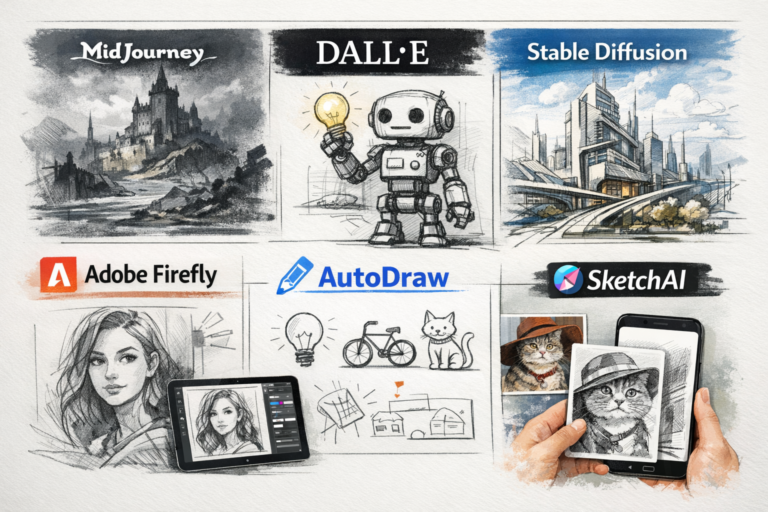
Midjourney is widely regarded as one of the most visually sophisticated AI image generators, particularly strong at producing expressive, stylised sketches. While not exclusively a sketch tool, its ability to generate line-based, concept art-style visuals from text prompts makes it highly popular among illustrators and designers.
Its best functionality lies in aesthetic interpretation. Users can specify artistic styles, levels of abstraction, and mood. This makes it valuable for early-stage ideation in fields such as concept art, fashion design, and editorial illustration. However, it is less suited to technical sketching or precise structural work.
- DALL·E
DALL·E focuses on translating textual descriptions into images with a strong emphasis on clarity and recognisable forms. Its sketch-like outputs are clean and accessible, making it useful for rapid visualisation of ideas rather than expressive artistry.
In practice, DALL·E excels at producing illustrative sketches for presentations, educational materials, and early product concepts. Its interface is straightforward, which lowers the barrier for non-designers. The trade-off is less stylistic control compared with more artist-oriented platforms.
- Stable Diffusion
Stable Diffusion occupies a unique position because it is open source and highly customisable. With the right configuration, it can function as a powerful sketch generator, particularly when paired with control mechanisms that guide line work and structure.
Its best use cases include professional workflows where users want control over style, training data, and output resolution. Architects, game designers, and digital artists often favour Stable Diffusion because it can be adapted to specific visual languages. The downside is complexity. It demands technical knowledge that casual users may lack.
- Adobe Firefly
Adobe Firefly is integrated into the broader Adobe Creative ecosystem, making it especially relevant for professionals who already use tools such as Photoshop and Illustrator. Its sketch-related features focus on enhancing hand-drawn inputs and generating clean, editable line art.
Firefly’s strongest functionality lies in workflow integration and commercial safety. Adobe has emphasised training on licensed and owned content, which matters for commercial users concerned about copyright. For designers working in advertising, branding, or publishing, this reliability is a significant advantage.
- AutoDraw
AutoDraw takes a simpler approach. It uses machine learning to recognise rough doodles and suggest clean, polished icons or drawings. While it lacks the depth of more advanced generators, its simplicity is its strength.
AutoDraw is particularly effective in educational settings, for quick diagrams, and for informal communication. It demonstrates how AI sketch generation can support everyday creativity, not just professional art production.
- SketchAI
SketchAI focuses on mobile-first sketch generation, converting photos or rough drawings into stylised sketches. Its accessibility makes it appealing to social media creators and hobbyists.
The tool’s best functionality is speed and ease of use. It allows users to generate visually appealing sketches without advanced technical knowledge. Its outputs are less customisable, but for casual creative expression, this is often sufficient.
Implications for creativity, jobs, and education
AI sketch generators do not eliminate the need for human creativity. Instead, they shift where effort is applied. Less time is spent on repetitive drafting and more on concept development, refinement, and decision-making.
For jobs, this creates both pressure and opportunity. Entry-level roles focused solely on basic drafting may decline. At the same time, demand is growing for creatives who can direct AI tools effectively and integrate their outputs into coherent design narratives.
In education, these tools can democratise learning. Students can experiment visually without fear of technical failure. The challenge is ensuring that foundational skills, such as observation and critical thinking, are not neglected.
Challenges and constraints
Several challenges cut across markets. Quality control remains an issue. AI sketches can look convincing while containing structural errors. Over-reliance can weaken manual skills. There are also unresolved legal questions around training data and ownership.
In Nigeria specifically, policy frameworks have not yet caught up with generative AI. Clear guidelines on commercial use, attribution, and rights would support more confident adoption. Capacity building is equally important, ensuring that creators understand both the power and the limits of these tools.
Striving towards meaningful progress
Meaningful progress requires balance. Creators need access to tools, but also education on ethical and professional use. Institutions, from art schools to regulatory bodies, need to engage with generative technologies rather than react belatedly.
Local communities can play a role by sharing best practices and developing regionally relevant styles and datasets. This would help ensure that AI-assisted creativity reflects diverse cultural perspectives rather than reproducing a narrow global aesthetic.
Final reflections
AI sketch generators are neither a threat nor a miracle. They are instruments. Used thoughtfully, they expand creative possibilities, lower barriers to entry, and support experimentation. Used carelessly, they risk flattening originality and obscuring authorship.
For creators, the task is not to compete with algorithms, but to learn how to guide them. In that collaboration lies the real transformation of creativity in the digital age.
Senior Reporter/Editor
Bio: Ugochukwu is a freelance journalist and Editor at AIbase.ng, with a strong professional focus on investigative reporting. He holds a degree in Mass Communication and brings extensive experience in news gathering, reporting, and editorial writing. With over a decade of active engagement across diverse news outlets, he contributes in-depth analytical, practical, and expository articles exploring artificial intelligence and its real-world impact. His seasoned newsroom experience and well-established information networks provide AIbase.ng with credible, timely, and high-quality coverage of emerging AI developments.