

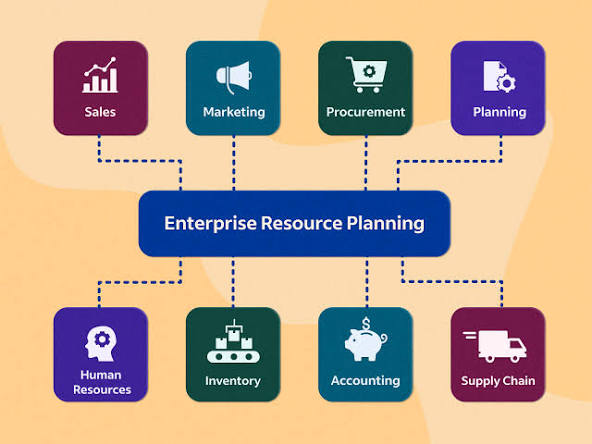
Artificial intelligence in ERP is delivered through specific platforms rather than a single generic system. These platforms embed distinct AI tools across finance, operations, human resources, and supply chains, with each reflecting unique design priorities, technical strengths, and sectoral focus. Understanding these differences is essential for organisations aiming to gain meaningful value rather than superficial automation. The leading AI-enabled ERP tools vary in names, use cases, core functionalities, and sectoral applications.
SAP AI-Enabled ERP Platform
SAP operates one of the most mature and deeply integrated AI-enabled ERP ecosystems globally. Its artificial intelligence capabilities are embedded directly into core ERP processes rather than deployed as optional add‑ons.
Use Cases
SAP’s AI is widely used for demand forecasting, intelligent procurement, predictive maintenance, financial risk detection, and supply chain optimisation. In finance, it automates reconciliations, flags anomalous transactions, and supports continuous auditing. In operations, it predicts material shortages and recommends production adjustments based on real‑time data.
Best Functionality
SAP’s strongest AI functionality lies in large‑scale predictive analytics and process optimisation across complex, multi‑entity environments. Its models perform particularly well where transaction volumes are high, historical data sets are extensive, and supplier or production networks are intricate.
Sectoral Application
SAP’s AI‑enabled ERP is most dominant in manufacturing, oil and gas, utilities, telecommunications, pharmaceuticals, and large public sector institutions. In Nigeria, it is commonly deployed by multinational corporations, large banks, and government‑linked enterprises where regulatory compliance and operational scale are critical.
Oracle AI‑Powered ERP
Oracle positions artificial intelligence as a decision‑automation layer across finance, human capital management, and customer operations within its ERP environment.
Use Cases
Oracle’s AI is extensively applied in financial forecasting, anomaly detection, expense management, workforce planning, and revenue optimisation. In human resources, it supports talent matching, attrition risk analysis, and performance insights. In finance, it identifies irregular transactions and predicts cash flow gaps before they materialise.
Best Functionality
Oracle’s strongest functionality is autonomous financial operations. Its AI models excel at reducing manual intervention in routine finance processes while maintaining strong controls. The system’s ability to surface risks and recommendations proactively is a defining strength.
Sectoral Application
Oracle’s AI‑enabled ERP is widely used in banking, insurance, professional services, higher education, healthcare, and government agencies. In Nigeria, it is often selected by financial institutions and large service‑based organisations seeking tighter financial governance and automation.
Microsoft AI‑Integrated ERP Platform
Microsoft integrates artificial intelligence into its ERP offerings with a strong emphasis on accessibility, analytics, and integration with everyday business tools.
Use Cases
Microsoft’s AI within ERP systems is used for financial insights, demand planning, sales forecasting, customer behaviour analysis, and operational reporting. Conversational AI allows users to query ERP data using natural language, while embedded analytics support scenario modelling and performance tracking.
Best Functionality
Microsoft’s strongest functionality is user‑centric intelligence. Its AI excels at transforming ERP data into easily interpretable insights through dashboards, visual analytics, and conversational interfaces. This significantly lowers the barrier to adoption for non‑technical users.
Sectoral Application
Microsoft’s AI‑enabled ERP is commonly adopted by mid‑sized enterprises, diversified groups, retail organisations, logistics firms, and professional services companies. In Nigeria, it is particularly attractive to growing businesses seeking intelligent ERP functionality without the complexity of heavyweight enterprise systems.
Workday AI‑Driven ERP for Finance and HR
Workday applies artificial intelligence with a clear focus on people, finance, and continuous planning rather than broad operational coverage.
Use Cases
Workday’s AI is used for workforce analytics, skills intelligence, recruitment optimisation, attrition prediction, and financial planning. It helps organisations understand workforce capability gaps, predict turnover risks, and align talent strategy with business objectives.
Best Functionality
Workday’s strongest AI functionality is human capital intelligence. Its models are particularly effective at analysing workforce data to support strategic planning, rather than relying solely on transactional automation.
Sectoral Application
Workday’s AI‑enabled ERP is widely used in education, healthcare, technology, consulting, and multinational service organisations. In Nigeria, it is most relevant to organisations with large professional workforces and a strong emphasis on talent management and planning.
Broader Observations on Sectoral Use
Across sectors, AI‑enabled ERP tools deliver the greatest value where data quality is strong and processes are clearly defined. Manufacturing and logistics benefit most from predictive and optimisation‑focused AI. Financial services derive significant value from anomaly detection, forecasting, and compliance automation. Public sector institutions benefit from improved transparency, auditability, and planning when governance frameworks are properly enforced.
Closing Perspective
Artificial intelligence in ERP is best understood through the tools that deliver it. Each platform brings distinct strengths, sectoral alignment, and implementation realities. Organisations that approach AI‑enabled ERP with clarity around use cases, functional priorities, and sector needs are far more likely to achieve sustainable value. The technology itself is mature. The true differentiator lies in informed selection, disciplined implementation, and responsible use.

Senior Reporter/Editor
Bio: Ugochukwu is a freelance journalist and Editor at AIbase.ng, with a strong professional focus on investigative reporting. He holds a degree in Mass Communication and brings extensive experience in news gathering, reporting, and editorial writing. With over a decade of active engagement across diverse news outlets, he contributes in-depth analytical, practical, and expository articles exploring artificial intelligence and its real-world impact. His seasoned newsroom experience and well-established information networks provide AIbase.ng with credible, timely, and high-quality coverage of emerging AI developments.