

The global push to build dependable and sovereign AI infrastructure has reached a critical stage, as organisations move from testing to real-world deployment. In this context, Koyeb‘s partnership with Mistral AI goes beyond a typical partnership, underscoring the growing strategic importance of infrastructure alongside AI models.
The collaboration reflects a wider shift away from reliance on hyperscale and closed cloud ecosystems towards more open, high-performance, and regionally controlled AI systems. For AI adopters globally, including in Nigeria, this evolution raises key considerations around affordability, access, digital sovereignty, and long-term resilience.
What Koyeb Brings to AI Infrastructure
Koyeb has positioned itself as a modern cloud platform designed for developers building distributed, performance-sensitive applications. Unlike traditional cloud services that require extensive configuration and operational oversight, Koyeb focuses on a serverless, globally distributed architecture. This allows applications to run closer to end users while abstracting away much of the underlying complexity.
For AI workloads, this approach offers several advantages. Machine learning inference, real-time data processing, and API driven AI services all benefit from low latency and elastic scaling. Koyeb’s infrastructure is optimised for containerised workloads and GPU-enabled deployments, making it suitable for hosting AI models and related services without the heavy operational burden typically associated with bespoke infrastructure.
Mistral AI and the Push for Open, High-Performance Models
Mistral AI has rapidly become a central figure in Europe’s AI ecosystem. Known for developing high-performance large language models with an emphasis on openness and efficiency, the company has challenged the assumption that cutting-edge AI must remain proprietary or concentrated within a handful of global technology firms.
Mistral’s models are designed to be deployable across different environments, including on-premises and private cloud settings. This flexibility aligns closely with the needs of governments, regulated industries, and organisations seeking greater control over their data and AI capabilities. By focusing on efficiency, Mistral also lowers the computational barrier to adoption, a critical factor for emerging markets.
Diving Deeper into This Integration
Infrastructure as a Strategic Layer
Artificial intelligence is no longer just about algorithms. The infrastructure layer has become a strategic asset, influencing cost structures, performance, compliance, and even geopolitical alignment. By aligning Koyeb’s cloud native platform with Mistral AI’s models, the two companies are effectively offering a vertically integrated alternative to dominant AI stacks controlled by US-based hyperscalers.
This matters because infrastructure choices shape who can build, deploy, and benefit from AI. A more modular and open approach allows organisations to avoid vendor lock-in while tailoring deployments to local regulatory and operational realities.
Practical Benefits for Developers and Enterprises
In practical terms, the collaboration simplifies the path from model development to production deployment. Developers can access Mistral’s models within an environment optimised for modern application delivery. Enterprises gain the ability to deploy AI services with predictable performance and governance controls, without the need to assemble and manage complex infrastructure stacks.
For startups and small to medium-sized businesses, this lowers entry barriers. The combination of efficient models and streamlined infrastructure reduces upfront costs and operational risk, enabling faster experimentation and iteration.
How the Koyeb–Mistral Stack Works in Practice
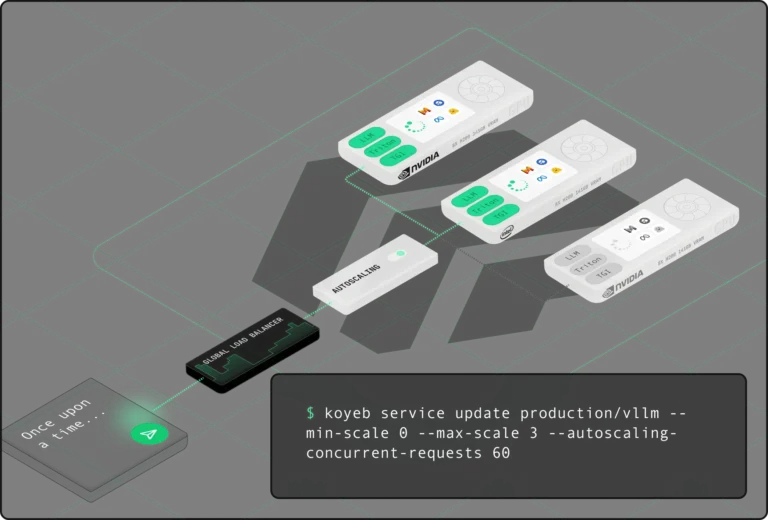
At a technical level, the integration leverages container-based deployments and serverless orchestration. Mistral’s models can be packaged as scalable services, while Koyeb handles traffic routing, autoscaling, and geographic distribution. This architecture is particularly well-suited to inference workloads, where responsiveness and reliability are critical.
Data governance is another key consideration. Organisations can deploy models in regions that align with their regulatory requirements, ensuring compliance with data protection laws. This is especially relevant in jurisdictions that restrict cross-border data flows.
Global Perspectives on Sovereign AI Infrastructure
Europe’s Strategic Motivation
Europe’s push for AI sovereignty has been shaped by concerns over dependency, data protection, and industrial competitiveness. Initiatives such as the EU’s digital strategy and AI Act reflect a desire to balance innovation with accountability. The Koyeb and Mistral alignment fits squarely within this framework, offering a European anchored alternative that does not compromise on performance.
Implications for Emerging Markets
For countries outside Europe and North America, the significance lies in choice. Access to diverse AI infrastructure options reduces reliance on a narrow set of providers and allows local ecosystems to develop on their own terms. This is particularly important in regions where cost sensitivity, connectivity constraints, and regulatory uncertainty can limit adoption.
Infrastructure and Cost Constraints
High-performance computing resources are expensive and often located outside the country. This creates latency issues and raises concerns about data sovereignty. Platforms that offer efficient models and flexible deployment options can help mitigate these challenges. While Koyeb does not operate local data centres in Nigeria, its distributed architecture and focus on efficiency may still offer performance advantages compared to more rigid setups.
Regulatory and Institutional Context
Nigeria’s regulatory landscape around data protection is shaped by frameworks such as the Nigeria Data Protection Act. Organisations deploying AI systems must navigate compliance while managing costs. Infrastructure solutions that provide greater control over data location and processing can support compliance with these regulations.
Academic institutions and research centres also stand to benefit. Access to deployable, high-quality models without prohibitive infrastructure requirements can accelerate research and skills development.
Broader Implications for Economy, Jobs, and Society
Economic Competitiveness
AI infrastructure is becoming a foundational layer of economic competitiveness. Countries and companies that can deploy AI efficiently are better positioned to innovate and scale. By lowering technical and financial barriers, integrated platforms such as Koyeb and Mistral Stack can contribute to more inclusive growth.
Skills and Workforce Development
As AI adoption expands, demand for skills in model deployment, data engineering, and AI governance will grow. Exposure to open, flexible infrastructure encourages learning and experimentation, both essential to building local expertise. For Nigeria, this aligns with broader efforts to develop a digital workforce capable of competing globally.
Governance and Trust
Trust in AI systems depends not only on model behaviour but also on how and where systems are deployed. Infrastructure that supports transparency, auditability, and compliance strengthens public confidence. This is particularly relevant in sectors such as finance and public services.
Challenges and Constraints in the Nigerian Context
Despite the potential benefits, challenges remain. Connectivity reliability, power supply issues, and limited access to advanced hardware can constrain deployment. There is also a need for clearer policy guidance on AI-specific governance to complement existing data protection laws.
Furthermore, awareness and understanding of infrastructure choices among decision makers is uneven. Without informed procurement and policy decisions, organisations may default to familiar but suboptimal solutions.
Working towards Sustainability
For AI infrastructure innovation to translate into tangible benefits, several conditions must be met. Investment in digital infrastructure remains essential, including connectivity and power. Policy frameworks should evolve to address AI-specific risks while encouraging innovation. Collaboration between government, academia, and industry can help align incentives and build capacity.
International partnerships also play a role. Engagement with global platforms that respect local needs and constraints can accelerate progress without undermining sovereignty.
Looking Ahead
The integration of Koyeb with Mistral AI reflects a broader shift in how AI infrastructure is conceived and delivered. It underscores the importance of openness, efficiency, and strategic control in an era where AI capabilities are increasingly central to economic and social development.
For AI adopters worldwide, including in Nigeria, this development expands the range of viable options. It challenges the notion that cutting-edge AI must be tethered to a handful of dominant providers and points towards a more pluralistic future. As AI continues to reshape industries and societies, the infrastructure choices made today will shape who benefits tomorrow.

Senior Reporter/Editor
Bio: Ugochukwu is a freelance journalist and Editor at AIbase.ng, with a strong professional focus on investigative reporting. He holds a degree in Mass Communication and brings extensive experience in news gathering, reporting, and editorial writing. With over a decade of active engagement across diverse news outlets, he contributes in-depth analytical, practical, and expository articles exploring artificial intelligence and its real-world impact. His seasoned newsroom experience and well-established information networks provide AIbase.ng with credible, timely, and high-quality coverage of emerging AI developments.