

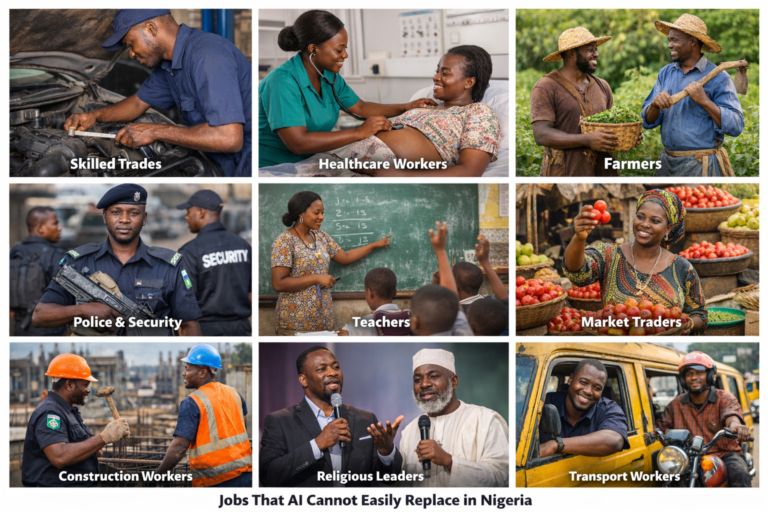
Nigeria’s labour market sits at a critical crossroads. With a population exceeding 220 million people and a median age of about 18 years, Nigeria has one of the largest and youngest workforces in the world. According to data from the National Bureau of Statistics (NBS), over 70 percent of Nigeria’s employed population works in the informal sector, relying on hands-on, service-oriented, and people-driven jobs rather than highly automated systems. At the same time, unemployment and underemployment have remained persistently high in recent years, hovering around one-third of the working-age population when combined—making job security a national concern.
Globally, artificial intelligence and automation are projected to disrupt millions of jobs, especially in structured, repetitive, and office-based roles. However, Nigeria’s labour market is fundamentally different from those of advanced economies where automation thrives. Limited industrial automation, inconsistent electricity supply, low robot penetration, and the dominance of small and medium-scale enterprises significantly slow down AI-driven job replacement. More importantly, many Nigerian jobs depend on physical presence, human judgment, local knowledge, trust, empathy, and cultural legitimacy—qualities that AI cannot independently replicate.
Sectors such as skilled trades, healthcare, agriculture, transportation, security, education, and community-based services collectively employ tens of millions of Nigerians. For example, agriculture alone accounts for over 30 percent of total employment, while construction, trade, transport, and personal services form the backbone of urban and rural livelihoods. These roles often involve unpredictable environments, direct human interaction, and real-world problem-solving—conditions under which AI systems struggle to operate effectively.
This article examines categories of jobs in Nigeria that are not easily replaceable by AI automation. By grounding the analysis in Nigeria’s economic structure, labour realities, and social context, it highlights why human labour will remain indispensable to the country’s economy for decades to come, even as digital technologies continue to evolve.
1. Skilled Trades & Manual Work (High Local Demand)
Skilled trades remain some of the most AI-resistant jobs in Nigeria because they require hands-on physical labor, on-the-spot decision-making, improvisation, and deep understanding of local conditions. Nigeria’s infrastructure challenges, informal housing, inconsistent standards, and limited automation make human skill indispensable.
- Electricians
Electricians in Nigeria work in highly unpredictable environments. Many buildings—especially in residential areas—are wired without standard plans, and faults differ from one location to another.
Why AI Cannot Easily Replace Electricians in Nigeria:
- Electrical systems are often non-standard and undocumented
- Power supply is unstable, requiring human judgment to manage generators, inverters, and solar systems
- Fault detection often involves physical inspection, smell, sound, and experience
- Safety decisions must be made instantly in dangerous conditions
AI may assist with diagnostics, but only a human electrician can physically repair, adapt, and ensure safety in Nigeria’s complex electrical landscape.
- Plumbers
Plumbing systems in Nigeria vary widely due to old buildings, poor water pressure, and improvised installations.
Why Plumbers Are AI-Resistant:
- Underground and concealed pipes require manual detection and excavation
- Repairs often demand creative improvisation using locally available materials
- Many plumbing issues occur in emergencies, such as flooding or burst pipes
- Hygiene and sanitation issues require human judgment and physical effort
AI cannot crawl into ceilings, dig trenches, or make instant repair decisions on site.
- Welders & Fabricators
Welders and fabricators are essential in Nigeria for gates, doors, tanks, machines, and construction supports.
Why AI Cannot Replace Welders Easily:
- Most fabrication workshops are small-scale and informal
- Projects are often custom-made, not mass-produced
- Welding requires manual precision, hand control, and experience
- Power fluctuations and material quality vary widely
Robotic welding is expensive and impractical for most Nigerian workshops.
- Auto Mechanics
Nigerian mechanics deal with used vehicles (tokunbo), mixed parts, and mechanical improvisation daily.
Why Auto Mechanics Are Not Easily Automated:
- Vehicles often lack service history or manuals
- Faults are diagnosed using experience, sound, vibration, and observation
- Spare parts are frequently adapted rather than replaced
- Road conditions create unique wear and tear issues
AI diagnostics tools exist, but human mechanics remain irreplaceable in Nigerian auto repairs.
- Motorcycle (Okada) Mechanics
Okada mechanics operate in one of Nigeria’s most informal and high-demand sectors.
Why Okada Mechanics Are AI-Proof:
- Motorcycles are used intensively on rough roads
- Repairs are frequent and urgent
- Workshops are mobile and roadside-based
- Mechanics rely on experience, speed, and adaptability
Automation cannot function in roadside, low-infrastructure environments.
- Panel Beaters
Panel beaters repair accident-damaged vehicles, a common need in Nigeria due to traffic congestion and road conditions.
Why AI Cannot Replace Panel Beaters:
- Accident damage is never identical
- Repairs require manual reshaping, hammering, and alignment
- Visual judgment is critical for aesthetics and structure
- Most workshops lack standardized tools for automation
This work demands human creativity and physical skill.
- Bricklayers & Masons
Bricklayers are central to Nigeria’s housing and construction industry, especially in rural and semi-urban areas.
Why Bricklayers Are AI-Resistant:
- Construction sites differ widely in soil, design, and materials
- Blocks are often locally made with inconsistent quality
- Building adjustments are made on the spot
- Work depends heavily on physical endurance and teamwork
Robots cannot navigate Nigeria’s uneven, informal building sites.
- Carpenters & Furniture Makers
Nigerian carpenters create custom furniture, doors, roofing frames, and fittings.
Why AI Cannot Replace Them:
- Furniture is often customized to space and budget
- Materials vary in quality and size
- Hand finishing and artistic judgment are crucial
- Clients prefer human interaction and negotiation
Automation works for mass production, not Nigeria’s bespoke carpentry market.
- Tilers & Painters
These professionals handle the finishing stage of buildings, where visual precision matters most.
Why Tilers & Painters Are AI-Proof:
- Surfaces are often uneven and require correction
- Color mixing and pattern alignment require human judgment
- Work is affected by weather, humidity, and material quality
- Clients often change designs mid-project
No AI can match human adaptability in finishing work.
- Borehole Drilling Technicians
Access to water is critical in Nigeria, making borehole technicians indispensable.
Why AI Cannot Replace Borehole Technicians:
- Geological conditions vary from street to street
- Water tables are unpredictable
- Drilling requires physical operation of heavy equipment
- On-site decisions determine success or failure
AI can assist with mapping, but human expertise is essential on the ground.
- Healthcare & Caregiving Roles (High Human & Ethical Dependence)
- Doctors (especially general practitioners & surgeons)
Doctors in Nigeria work in environments where diagnostic equipment may be limited and patient conditions are often complex. General practitioners regularly treat multiple illnesses simultaneously, relying on clinical experience and patient interaction rather than advanced technology.
Why AI Cannot Easily Replace Doctors in Nigeria:
- Medical decisions often require ethical judgment and accountability
- Many diagnoses depend on physical examination and observation
- Surgeons rely on manual precision and instant response during operations
- Treatment plans must adapt to resource limitations and patient affordability
AI can assist with analysis, but only human doctors can take responsibility for life-critical decisions in Nigeria’s healthcare system.
- Nurses & Midwives
Nurses and midwives provide continuous hands-on care in Nigerian hospitals, clinics, and maternity centers. Their roles involve patient monitoring, emergency response, emotional reassurance, and physical assistance.
Why Nurses & Midwives Are AI-Resistant:
- Patient care requires physical touch and emotional support
- Childbirth is unpredictable and demands instant human decision-making
- Monitoring patients involves constant human presence
- Cultural sensitivity is essential when dealing with families and mothers
AI cannot comfort patients, manage labor, or respond emotionally during emergencies
- Community Health Workers
Community health workers operate at the grassroots level, especially in rural and underserved Nigerian communities, where access to hospitals is limited.
Why Community Health Workers Cannot Be Replaced by AI:
- Their effectiveness depends on trust and personal relationships
- They communicate in local languages and cultural contexts
- Health education requires human persuasion and empathy
- Many communities have limited digital access
AI lacks the social connection needed to influence health behavior in Nigerian communities.
- Traditional Birth Attendants
Traditional birth attendants remain important in many Nigerian communities due to cultural acceptance and limited access to modern healthcare facilities.
Why AI Cannot Replace Traditional Birth Attendants:
- Their authority comes from cultural trust and tradition
- Childbirth assistance requires physical presence and experience
- Care is deeply rooted in local customs and beliefs
- Many births occur outside formal medical facilities
AI has no cultural legitimacy or physical ability to assist childbirth in such settings.
- Caregivers for Elderly & Disabled
Caregivers in Nigeria support elderly people and individuals living with disabilities through daily physical and emotional assistance.
Why Caregiving Is AI-Proof in Nigeria:
- Tasks require human touch and physical support
- Emotional companionship is a key part of care
- Nigerian culture values family-based and personal caregiving
- Each individual’s needs are unique and unpredictable
Machines cannot replace empathy, patience, or emotional bonding.
- Pharmacists (patient interaction & judgment)
Pharmacists in Nigeria often serve as the first point of healthcare contact, especially where hospitals are overcrowded.
Why Pharmacists Are Not Easily Automated:
- They provide professional judgment beyond prescriptions
- Patients rely on human explanation and reassurance
- Medication misuse requires ethical intervention
- Many decisions depend on patient history and context
AI can provide drug data, but human pharmacists ensure safe and responsible medication use.
3. Education & Training (Human-Centered Knowledge Transfer
1. Pimary & Secondary School Teachers
Primary and secondary school teachers in Nigeria handle classrooms with varied learning abilities, behavioral challenges, and cultural backgrounds. They are responsible not only for teaching academics but also for discipline, moral instruction, and character development.
Why AI Cannot Easily Replace School Teachers in Nigeria:
Teaching requires classroom control and discipline
Students need emotional support and motivation
Learning speeds vary widely and need human adaptation
Moral instruction and value shaping are culturally rooted
AI cannot manage classrooms, discipline students, or mentor children effectively.
- University Lecturers
University lecturers in Nigeria do more than deliver lectures; they mentor students, supervise research, and adapt teaching to local realities.
Why University Lecturers Are AI-Resistant:
Research supervision requires critical thinking and guidance
Lecturers adapt content to local academic and social contexts
Academic assessment requires human judgment
Student mentorship depends on experience and interaction
AI can provide information, but it cannot mentor or evaluate academic growth effectively.
- Vocational Instructors (Technical Colleges)
Vocational instructors train students in hands-on skills such as welding, electrical work, mechanics, and carpentry.
Why Vocational Instructors Cannot Be Automated:
Training involves physical demonstration and correction
Safety supervision requires human oversight
Skills depend on practice, feedback, and repetition
Workshops are informal and resource-limited
AI cannot physically demonstrate or correct technical skills in real time.
- Qur’anic / Islamic Teachers (Alaramma)
Islamic teachers play an important role in religious and moral education across Nigeria.
Why AI Cannot Replace Religious Teachers:
Teaching is rooted in spiritual authority and trust
Moral guidance requires human interpretation
Instruction involves personal mentorship
Religious learning is culturally sensitive
AI lacks spiritual legitimacy and moral authority.
- Special Education Teachers
Special education teachers work with children who have learning difficulties, disabilities, or behavioral challenges.
Why Special Education Is AI-Proof:
Teaching requires patience and emotional intelligence
Learning methods must be highly individualized
Progress depends on human encouragement
Physical assistance is often required
AI cannot replace compassion or personalized care.
- Private Tutors
Private tutors support students preparing for WAEC, NECO, JAMB, and other exams.
Why Private Tutors Remain Relevant:
Tutors adapt teaching to individual student weaknesses
Parents value human accountability
Motivation and confidence building are essential
Learning environments are flexible and informal
AI tools may assist learning, but human tutors remain trusted and effective.
Summary (Nigeria Context)
Education and training roles in Nigeria remain resistant to AI automation because:
Learning is socially driven
Emotional intelligence is essential
Discipline and mentorship matter
Cultural and moral instruction is human-based
Physical demonstration is often required
- Agriculture & Food Production (Environment-Dependent & Hands-On Work)
- Small-Scale Farmers
Small-scale farmers form the backbone of Nigeria’s food supply, especially in rural areas where farming methods are traditional and land holdings are fragmented.
Why AI Cannot Easily Replace Small-Scale Farmers in Nigeria:
Farming decisions depend on local soil and weather knowledge
Activities require physical labor and presence
Crops are affected by unpredictable climate conditions
Most farms lack access to advanced machinery
AI tools may assist planning, but farming itself requires human effort and judgment.
- Livestock Herders
Livestock herders manage cattle, goats, sheep, and other animals across diverse terrains in Nigeria.
Why Livestock Herding Is AI-Resistant:
Animals require constant human supervision
Grazing routes depend on local geography and security conditions
Disease detection relies on human observation
Conflict management requires human negotiation
AI cannot manage animals or respond to real-world environmental risks.
- Poultry Farmers
Poultry farming is widespread in Nigeria, ranging from backyard operations to medium-scale farms.
Why Poultry Farming Cannot Be Fully Automated:
Birds require daily human care and monitoring
Disease outbreaks need quick human response
Feed management depends on experience and adjustment
Infrastructure limitations restrict automation
Human oversight remains critical for poultry survival and productivity.
- Fishermen
Fishing is an important livelihood in coastal and riverine areas of Nigeria.
Why Fishermen Are Not Easily Replaced by AI:
Fishing depends on environmental awareness
Equipment handling requires physical skill
Water conditions change unpredictably
Operations are mostly small-scale and manual
Automation is impractical in Nigeria’s traditional fishing environments.
- Palm Oil Processors
Palm oil processing is a major agricultural activity, especially in southern Nigeria.
Why Palm Oil Processing Is AI-Resistant:
Processing involves manual harvesting and handling
Equipment is mostly locally fabricated
Quality control depends on human judgment
Operations are community-based and informal
AI cannot replace hands-on processing in rural settings.
- Farm Supervisors
Farm supervisors oversee daily farm operations and labor management.
Why Farm Supervisors Cannot Be Automated:
Supervision requires human leadership
Workers need direct instruction and motivation
Decisions depend on real-time farm conditions
Conflict resolution requires human judgment
AI cannot manage people effectively in informal farm settings.
- Agricultural Extension Workers
Agricultural extension workers connect farmers with modern farming practices and government programs.
Why Extension Work Is AI-Proof in Nigeria:
Education relies on human communication
Farmers trust personal relationships
Training involves field demonstrations
Many farmers lack digital literacy
AI lacks the trust and physical presence needed for extension services.
Summary (Nigeria Context)
Agriculture and food production in Nigeria remain largely immune to AI automation because:
Farming environments are unpredictable
Physical labor is essential
Local knowledge drives success
Operations are small-scale and informal
Human supervision and adaptation are criticalS
5. Security, Safety & Enforcement (High Human Judgment & Physical Presence)
1. Police Officers
Police officers in Nigeria are responsible for law enforcement, crime prevention, and maintaining public order in complex social environments.
Why AI Cannot Easily Replace Police Officers in Nigeria:
Law enforcement requires human discretion and judgment
Situations are unpredictable and emotionally charged
Physical presence is essential for authority
Conflict resolution requires human communication
AI cannot interpret social dynamics or manage volatile situations on the ground.
- Civil Defense Officers
Civil defense officers protect critical infrastructure and respond to emergencies such as disasters and accidents.
Why Civil Defense Work Is AI-Resistant:
Emergency response requires physical intervention
Situational assessment changes rapidly
Public coordination requires human leadership
Many environments lack automation infrastructure
AI cannot operate effectively during real-world emergencies.
- Immigration Officers
Immigration officers manage border control and traveler screening across Nigeria’s land, sea, and air borders.
Why Immigration Officers Cannot Be Automated:
Identity verification requires human observation
Border conditions are complex and dynamic
Cultural and language understanding is essential
Fraud detection depends on experience
AI systems support checks but cannot replace human judgment.
- Customs Officers
Customs officers regulate imports and exports, enforce trade laws, and inspect goods.
Why Customs Enforcement Is AI-Proof:
Cargo inspection requires physical examination
Smuggling techniques constantly evolve
Negotiation and enforcement require human authority
Port environments are unpredictable
AI cannot adapt to evolving smuggling tactics independently.
- Prison Wardens
Prison wardens manage inmates and maintain order within correctional facilities.
Why Prison Wardens Are Not Easily Replaced by AI:
Inmate management requires human control and judgment
Conflict prevention relies on experience
Physical intervention is often necessary
Ethical and legal responsibility is human-based
AI lacks authority and physical capability in prisons.
- Private Security Guards
Private security guards protect homes, offices, banks, and businesses across Nigeria
Why Private Security Is AI-Resistant:
Security threats require real-time human response
Guards deter crime through physical presence
Decision-making depends on situational awareness
Local knowledge is critical
Automation cannot replace deterrence provided by human guards.
- Vigilante Group Members (Local Security)
Vigilante groups operate at community level to provide local security.
Why Vigilante Security Cannot Be Automated:
Effectiveness depends on community trust
Local intelligence is human-based
Conflict resolution requires cultural understanding
Physical patrols are essential
AI cannot build community trust or local intelligence networks.
6. Construction & Infrastructure (Site-Based & Environment-Specific Work)C
1. Construction Site Supervisors
Construction site supervisors coordinate workers, materials, and timelines across active building sites.
Why Construction Site Supervisors Are AI-Resistant in Nigeria:
Supervision requires human leadership and authority
Work conditions change daily on site
Labor management depends on human interaction
Safety enforcement requires physical presence
AI cannot manage people or enforce safety on dynamic sites.
- Road Construction Workers
Road construction workers build and maintain Nigeria’s road networks under challenging conditions.
Why Road Construction Work Cannot Be Automated:
Tasks require physical labor
Terrain varies widely across regions
Equipment operation needs human control
On-site decisions must be made instantly
Automation struggles in Nigeria’s variable road environments.
- Heavy Equipment Operators
Operators control bulldozers, excavators, graders, and other machines on construction sites.
Why Heavy Equipment Operators Are AI-Proof:
Machine operation requires human judgment
Terrain and obstacles change constantly
Safety risks require instant human response
Equipment maintenance needs experience
Fully autonomous operation is impractical in Nigeria.
- Surveyors
Surveyors measure land boundaries and construction layouts across diverse terrains.
Why Surveying Is AI-Resistant in Nigeria:
Measurements depend on physical site assessment
Land disputes require human interpretation
Terrain conditions affect accuracy
Fieldwork requires human presence
AI tools assist, but surveyors remain essential.
- Structural Engineers (On-Site Roles)
Structural engineers ensure building stability and safety during construction.
Why On-Site Engineers Cannot Be Replaced by AI:
Structural assessment requires visual inspection
Design adjustments are made on site
Safety decisions carry legal responsibility
Construction quality varies widely
AI cannot take responsibility for structural safety.
7. Religious & Community Leadership (Cultural & Moral Authority)
1. Pastors
Pastors play a central role in Nigerian society, providing spiritual guidance, counseling, and community leadership.
Why AI Cannot Replace Pastors in Nigeria:
Spiritual leadership requires moral authority
Counseling depends on empathy and human connection
Religious interpretation is value-based
Congregational trust is built over time
AI lacks spiritual legitimacy and emotional depth.
- Imams
Imams lead Islamic worship, teach religious principles, and guide communities.
Why Imams Are AI-Resistant:
Religious authority is rooted in faith and trust
Teaching involves moral interpretation
Community leadership requires human example
Cultural sensitivity is essential
AI cannot serve as a religious role model.
- Traditional Priests
Traditional priests preserve indigenous beliefs and practices in many Nigerian communities.
Why Traditional Priests Cannot Be Automated:
Authority is based on ancestral and cultural legitimacy
Rituals require physical presence
Knowledge is passed orally and experientially
Community belief systems are deeply personal
AI cannot participate in or validate traditional spirituality.
- Religious Counselors
Religious counselors provide guidance on personal, family, and moral issues.
Why Religious Counseling Is AI-Proof:
Counseling requires emotional intelligence
Advice is guided by faith values
Trust is central to effectiveness
Situations are highly personal
AI cannot replace faith-based human counseling.
- Community Leaders
Community leaders coordinate development efforts and resolve disputes at local levels.
Why Community Leadership Is AI-Resistant:
Leadership depends on local trust
Conflict resolution requires human judgment
Cultural norms guide decisions
Authority is socially recognized
AI cannot lead or negotiate community matters.
- Village Chiefs & Elders
Chiefs and elders uphold tradition, settle disputes, and represent community interests.
Why Traditional Leadership Cannot Be Replaced by AI:
Authority is derived from culture and lineage
Decision-making involves customary law
Mediation requires human wisdom
Respect is culturally enforced
AI lacks cultural legitimacy and authority.
8. Creative & Cultural Professions (Human Expression & Cultural Identity)
1. Musicians & Live Performers
Musicians and live performers play a major role in Nigeria’s entertainment industry and cultural expression.
Why AI Cannot Easily Replace Musicians in Nigeria:
Music reflects human emotion and lived experience
Live performances require audience interaction
Cultural rhythm and expression are context-driven
Improvisation is a human skill
AI can generate sounds but cannot replicate human performance energy.
- Nollywood Actors & Directors
Actors and directors in Nollywood tell stories that reflect Nigerian realities, culture, and social issues.
Why Nollywood Professionals Are AI-Resistant:
Acting requires emotional depth and realism
Storytelling is shaped by cultural context
On-set decisions require human creativity
Audience connection depends on authenticity
AI lacks emotional presence and cultural understanding.
- Traditional Dancers & Drummers
Traditional dancers and drummers preserve Nigeria’s cultural heritage through performance.
Why Traditional Performers Cannot Be Automated:
Performances are tied to cultural rituals
Rhythm and movement require human coordination
Training is experiential and communal
Cultural authenticity is essential
AI cannot embody tradition or ritual meaning.
- Fashion Designers (Local Tailoring)
Fashion designers and tailors create custom clothing across Nigeria.
Why Local Fashion Is AI-Proof:
Designs are custom-fitted
Client interaction shapes outcomes
Cultural styles influence creativity
Hand finishing is essential
Automation suits mass production, not bespoke tailoring.
- Makeup Artists
Makeup artists work in events, film, and fashion industries.
Why Makeup Artistry Is AI-Resistant:
Work requires artistic judgment
Skin tones and features vary widely
Client preferences change in real time
Physical application is essential
AI cannot replace artistic human touch.
- Event Planners
Event planners organize weddings, ceremonies, and corporate events.
Why Event Planning Cannot Be Automated:
Planning involves human coordination
Cultural expectations guide decisions
Problem-solving is real-time
Client emotions must be managed
AI cannot manage dynamic social events.
- MCs (Masters of Ceremony)
MCs host events and manage audience engagement.
Why MC Roles Are AI-Proof:
Hosting requires charisma and improvisation
Audience reading is human-based
Cultural humor is context-driven
Live response is essential
AI cannot replicate human stage presence.
9. Entrepreneurship & Informal Economy (Relationship-Driven & Adaptive Work)
1. Market Traders
Market traders form the backbone of Nigeria’s informal economy, selling food items, clothing, and household goods.
Why Market Trading Is AI-Resistant in Nigeria:
Trading depends on human negotiation
Prices change based on relationships
Customer trust is personal
Markets are informal and dynamic
AI cannot bargain or build personal trading relationships.
- Shop Owners
Shop owners manage small retail outlets across Nigerian communities.
Why Small Shop Ownership Cannot Be Automated:
Inventory decisions depend on local demand
Credit sales rely on personal trust
Customer relationships drive loyalty
Daily operations require human presence
Automation cannot manage informal trust-based trade.
- Street Vendors
Street vendors sell food and goods in public spaces.
Why Street Vending Is AI-Proof:
Operations require physical mobility
Sales depend on human interaction
Location decisions are real-time
Informal settings lack automation support
AI cannot function in unstructured street environments.
- Transport Union Leaders
Transport union leaders organize drivers and manage routes.
Why Transport Union Leadership Is AI-Resistant:
Leadership requires human authority
Conflict resolution is people-centered
Decisions depend on local dynamics
Negotiations require human presence
AI cannot lead unions or resolve disputes.
- Business Negotiators
Business negotiators handle deals and partnerships.
Why Negotiation Cannot Be Automated:
Negotiation depends on human judgment
Trust and persuasion are key
Cultural cues guide outcomes
Situations are unpredictable
AI lacks persuasive ability and emotional intelligence.
- Import/Export Traders
Importers and exporters manage goods across borders.
Why Import/Export Trade Is AI-Resistant:
Trade requires human negotiation
Regulatory environments change often
Risk management depends on experience
Relationship networks are essential
AI cannot navigate informal trade networks.

Senior Reporter/Editor
Bio: Ugochukwu is a freelance journalist and Editor at AIbase.ng, with a strong professional focus on investigative reporting. He holds a degree in Mass Communication and brings extensive experience in news gathering, reporting, and editorial writing. With over a decade of active engagement across diverse news outlets, he contributes in-depth analytical, practical, and expository articles exploring artificial intelligence and its real-world impact. His seasoned newsroom experience and well-established information networks provide AIbase.ng with credible, timely, and high-quality coverage of emerging AI developments.