

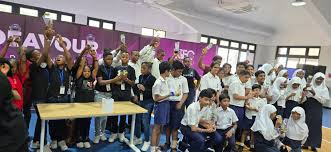
Students with visual impairments are among the young innovators selected to represent Nigeria at the Codeavour 7.0 National Championship after excelling at the national finals held at Charterhouse Lagos.
The competition brought together student teams from across the country who showcased artificial intelligence-driven innovations designed to address real-world challenges. At the end of the national finals, 36 teams qualified to represent Nigeria at the Codeavour International Championship scheduled for May in Jakarta, Indonesia.
Among the standout participants was a team of visually impaired students known as “Beyond Sight.” The team developed an AI-powered audio wearable device designed to help visually impaired people navigate their surroundings more independently.
The students also created a smart walking stick capable of detecting environmental hazards such as smoke and fire and sending audio alerts to users.
Team lead Nnoye Cletus, a student of the Bethesda Home and School for the Blind in Lagos, said the project was designed to improve everyday mobility for people living with visual impairment.
“Our goal with this innovation is to make everyday life safer and more independent for people with visual impairment,” Cletus said. “The wearable glasses can interpret the user’s surroundings and provide real-time audio guidance.”
Speaking at the event, Habeebah Ibrahim, Chief Executive Officer of Beebahtics Enterprise and country partner for the Codeavour programme in Nigeria, said the students’ success highlights the importance of inclusive technology education.
“Today we have witnessed that innovation has no physical boundaries,” Ibrahim said. “Seeing visually impaired students qualify for the international championship with AI-powered solutions shows what is possible when the right tools and an inclusive environment are provided.”
She added that initiatives like Codeavour are designed to encourage young people to see technology as a tool for solving societal challenges.
“At Beebahtics, we are not just teaching coding; we are empowering a generation to see problems as opportunities for invention,” Ibrahim said.
Organisers said the national championship followed regional rounds held in Lagos and Abuja, where students presented innovations in artificial intelligence, robotics and coding aimed at solving societal problems.
Education stakeholders at the event described the participation of visually impaired students as a milestone for inclusive innovation in Nigeria, noting that it reflects the growing interest in artificial intelligence among young Nigerians and the potential of technology to improve accessibility and safety.
Related Read:
The upcoming global competition will bring together student innovators from several countries to showcase AI-driven projects that address challenges in education, healthcare, safety, and environmental sustainability.

Senior Reporter/Editor
Bio: Ugochukwu is a freelance journalist and Editor at AIbase.ng, with a strong professional focus on investigative reporting. He holds a degree in Mass Communication and brings extensive experience in news gathering, reporting, and editorial writing. With over a decade of active engagement across diverse news outlets, he contributes in-depth analytical, practical, and expository articles exploring artificial intelligence and its real-world impact. His seasoned newsroom experience and well-established information networks provide AIbase.ng with credible, timely, and high-quality coverage of emerging AI developments.