

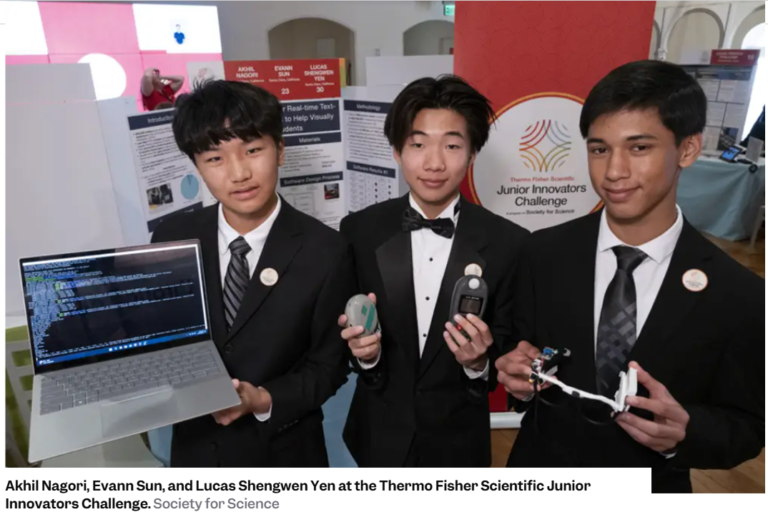
Three 15-year-olds from Santa Clara built a pair of low-cost wearable glasses that turn printed words into spoken audio. Their device uses a camera to capture text, software to extract the words, and tiny speakers in the frame to play the speech.
They want to help people with visual impairment access books, receipts, and other printed material quickly and cheaply. The team zeroed in on accuracy and speed, which honestly makes sense if you’ve ever tried to use clunky assistive tech.
Their prototype reads text with over 90% accuracy. It usually takes about 13 seconds from photo to audio, not exactly instant, but pretty reasonable for a first try.
They spent five months working on the prototype, tweaking the software to keep load times down. That kind of patience at 15? Impressive.
Their efforts landed them a $10,000 prize at a national science competition. They didn’t just chase a cool idea; they saw a real need during family visits, where reading Braille or receipts by hand was slow and exhausting for older relatives.
So, they decided to build something more efficient and affordable. Here’s what their glasses can do:
- Camera capture: snaps pictures of pages, receipts, or labels.
- Text extraction: turns images into editable text.
- Text-to-speech: plays clear audio through built-in speakers.
- Portability: wearable glasses that keep your hands free.
- Low cost: parts and assembly stay under $100.
Why does this matter? Well
- Accessibility: gives a low-cost option for learners and workers who are visually impaired.
- Practicality: wearable design frees up your hands and makes moving around easier.
- Scalability: simple parts make it easier to get these glasses out to more people, even in places with fewer resources.
Big companies in Silicon Valley pour billions into AI wearables, but these teens show that grassroots projects can deliver real assistive tech that actually works. Their main goals are to keep costs low and make it fast enough for daily use- shaping every design choice and test.
Sun, Nagori and Yen trained their model with 800 classroom images
They built a compact wearable system that reads printed text aloud. To make the software work well, they trained a convolutional recurrent neural network (CRNN) to handle the different print styles found in school materials.
The CRNN learns from sequences of visual features, so it is well-suited to reading lines of text from photos taken with a small camera on the glasses. They gathered a dataset of 800 images from textbooks, worksheets, and other classroom pages.
The images included colourful layouts and many fonts so that the model could handle the messy reality of school print. They intentionally shot each page under three lighting setups: bright classroom light, dim indoor light, and outdoor light.
Collecting data involved a lot of trial and error. They fed photos into the CRNN, checked the extracted text, and converted the output to MP3 audio to see whether the spoken result matched the original.
When they ran into errors, they tweaked training labels, added more examples, or tuned the model until accuracy improved. This hands-on loop helped them reduce misreads caused by fancy fonts, coloured backgrounds, and weird lighting.
They made the model lightweight enough to run on a small computer board in the glasses. That meant they had to balance model size and speed-big networks do better, but chew up memory and battery.
The goal: a compact CRNN that recognises text well but doesn’t drain the battery before lunch. Testing on the actual device showed the limits.
Real-time processing forced them to optimise image pre-processing, sequence decoding, and audio generation. They trimmed image resolution, simplified the character set, and used efficient decoding to cut latency.
They also ran hardware tests to see how camera angle, battery life, and speaker volume affected the user experience. A few hardware failures and last-minute repairs reminded them to keep wiring robust and maintenance simple.
After a lot of back-and-forth, refining the dataset and model through multiple rounds of testing, they developed a reading system that works with the kinds of printed school materials students use every day.
Key points:
- Model: convolutional recurrent neural network (CRNN)
- Dataset: 800 images from educational materials
- Lighting: pictures shot in the classroom, low light, and outdoor conditions
- Evaluation: checked text extraction against originals, rendered as MP3 audio
- Optimisation: reduced resolution and efficient decoding for on-device use
Want to know more about their project and background? Check out Lucas Shengwen Yen’s profile at the Society for Science: https://www.societyforscience.org/jic/2025-student-finalists/lucas-shengwen-yen/
Scaling up
These 15-Year-Olds Built Their Wearable AI Products for Under $100
They shifted from a classroom prototype to a plan for broader use. After winning national recognition and cash awards, the team bought tools and parts to improve the eyewear and start small-scale production.
Now, they run a workshop with a large 3D printer. Multiple single-board computers and cameras help them assemble and test units.
Here’s what they focused on as they scaled up:
- Refining the prototype for durability and comfort.
- Standardising assembly with jigs, templates, and clear steps.
- Automating repetitive tasks using simple scripts and batch testing.
- Securing small grants and awards for parts, shipping, and outreach.
Funding and recognition opened doors to real-world support. Besides the main prize, one team member snagged an invention award, and another received a leadership merit with a cash bonus.
They used these funds for components, testing gear, and pilot distribution in local schools and clinics.
Technical improvements matter, but they also keep community access in mind. The team works to lower per-unit costs and create a training pack so local volunteers can fit and maintain the devices.
They’re rolling things out in phases, starting with a pilot in a few Californian communities. If user uptake and device reliability look good, they’ll consider a broader launch.
Director/CEO
As the co-founder of AIBase, Joy established this platform to make artificial intelligence knowledge more accessible and relevant within the Nigerian ecosystem. She is an accounting graduate with a diverse professional background in multimedia and catering, experiences that have strengthened her adaptability and creative problem-solving skills.
Now transitioning into artificial intelligence and technology writing, Joy blends analytical thinking with engaging storytelling to explore and communicate emerging technology trends. Her drive to establish aibase.ng is rooted in a passion for bridging the gap between complex AI innovations and practical, real-world understanding for individuals and businesses.