
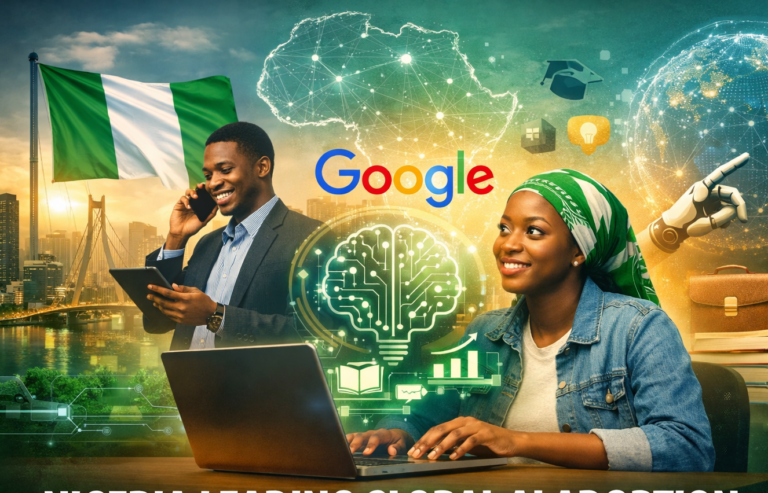
Nigeria has emerged as the world leader in the adoption of artificial intelligence (AI) for learning, work and entrepreneurship, according to the latest Our Life with AI: Helpfulness in the Hands of More People report published by Google in partnership with Ipsos. The data places the West African nation well ahead of global averages and highlights a rapid shift from experimental to purposeful AI use across society.
The comprehensive Google/Ipsos survey shows that 88 per cent of Nigerian adults have used an AI chatbot, significantly above the global average of 62 per cent. This marks an 18-percentage-point increase from the previous year, signalling one of the strongest year-on-year adoption gains recorded across all markets surveyed.
In Nigeria, AI is being integrated into daily life not as a novelty but as a tool for tangible gains in education, professional productivity and new business ventures. The report’s findings underline that AI is no longer confined to early adopters or technology enthusiasts in the country but is being widely used for meaningful personal and economic purposes.
AI Use Across Learning, Work and Entrepreneurship
The data reveals that Nigerians are embracing AI as a learning accelerator. 93 per cent of respondents reported using AI to learn or understand complex topics, well above the global average of 74 per cent. This suggests that Nigerians are turning to AI tools not just for quick answers but to master material that might otherwise be difficult or inaccessible.
AI is also increasingly seen as a workplace ally. 91 per cent of Nigerian users say they use AI to assist with work tasks, including research and writing, planning, and productivity support. Meanwhile, 80 per cent of respondents said they use AI to explore new business ideas or consider career changes — nearly double the global rate of 42 per cent for this purpose.
Positive Views on AI’s Impact
Sentiment around AI in Nigeria is overwhelmingly positive. 91 per cent of respondents believe that AI has a positive impact on learning and access to information — a sentiment significantly higher than the global perception. 95 per cent say that university students and educators are likely to benefit from AI’s increasing presence in education.
This optimism extends to broader attitudes toward the technology’s future. 80 per cent of Nigerians report feeling more excited than concerned about AI, a stark contrast to the global outlook, where enthusiasm and anxiety are more evenly divided. Among frequent AI users in Nigeria, that excitement rises to 90 per cent, underlining the confidence many Nigerians have in the technology’s potential to drive economic and social progress.
What the Report Says and How It Was Conducted
The Our Life with AI: Helpfulness in the Hands of More People report was carried out by Ipsos on behalf of Google between 22 September and 10 October 2025. It draws on online surveys of roughly 1,000 adults aged 18 and above in Nigeria, representing the country’s online adult population. The study’s methodology and global comparisons provide the basis for understanding Nigeria’s leading position in AI adoption.
The full report and detailed findings can be accessed here: https://static.googleusercontent.com/media/publicpolicy.google/en//resources/our_life_with_ai_2026.pdf?utm_source=chatgpt.com
Experts Weigh In
Taiwo Kola-Ogunlade, Communications and Public Affairs Manager for Google in West Africa, said the findings reflect not just widespread use but purposeful engagement with AI across sectors. “It’s inspiring to see how Nigerians are creatively and purposefully using AI to unlock new opportunities for learning, growth and economic empowerment,” he said. “This report doesn’t just show high adoption rates; it tells the story of a nation actively shaping its future with technology.”
As AI continues to evolve, Nigeria’s positioning at the forefront of global adoption highlights the country’s unique blend of youthful demographics, entrepreneurial spirit and hunger for innovation — factors that may well influence how digital transformation unfolds across Africa and beyond in the coming years.
Director
Bio: An (HND, BA, MBA, MSc) is a tech-savvy digital marketing professional, writing on artificial intelligence, digital tools, and emerging technologies. He holds an HND in Marketing, is a Chartered Marketer, earned an MBA in Marketing Management from LAUTECH, a BA in Marketing Management and Web Technologies from York St John University, and an MSc in Social Business and Marketing Management from the University of Salford, Manchester.
He has professional experience across sales, hospitality, healthcare, digital marketing, and business development, and has worked with Sheraton Hotels, A24 Group, and Kendal Nutricare. A skilled editor and web designer, He focuses on simplifying complex technologies and highlighting AI-driven opportunities for businesses and professionals.