

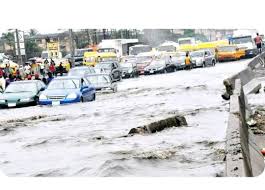
A member of the Lagos State Executive Council, Tokunbo Wahab, has said that the state government has introduced an artificial intelligence-driven system to detect early signs of flooding and strengthen preparedness against recurring flood incidents across Lagos.
Wahab, who is the Commissioner for the Environment and Water Resources, disclosed this in Lagos on Thursday, noting that the initiative forms part of the government’s broader strategy to modernise environmental management through technology and data-driven solutions.
He explained that the AI system is designed to analyse environmental and hydrological data to identify flood-prone areas before water levels reach critical stages, enabling authorities to respond more quickly with drainage maintenance, desilting operations, and emergency interventions.
He said the technology has already been deployed to improve early warning capacity across the state, adding that, “We’ve now set up early warning signs-AI-driven, technology-driven to monitor our waterways and water levels statewide,” Wahab stated.
According to him, the deployment of predictive tools reflects the state’s growing emphasis on early warning systems as climate variability, rapid urban expansion, and drainage obstruction continue to worsen flooding risks in several parts of Lagos.
Wahab added that the system will support real-time decision-making by environmental agencies and improve coordination among response teams, particularly during periods of heavy rainfall when flood risk is highest.
He also noted that the state government is strengthening collaboration with relevant agencies and local communities to ensure that data generated from the system translates into timely action on the ground.
Flooding remains a persistent challenge in Lagos, especially during peak rainy seasons, when heavy rainfall overwhelms drainage infrastructure and disrupts homes, businesses, and transport networks.
The government has, in recent years, intensified drainage clearance, enforcement against indiscriminate waste disposal, and removal of structures obstructing waterways as part of broader efforts to reduce flood impact.
Wahab said the integration of artificial intelligence into environmental monitoring marks a significant step in improving the state’s climate resilience and disaster risk management framework.

Senior Reporter/Editor
Bio: Ugochukwu is a freelance journalist and Editor at AIbase.ng, with a strong professional focus on investigative reporting. He holds a degree in Mass Communication and brings extensive experience in news gathering, reporting, and editorial writing. With over a decade of active engagement across diverse news outlets, he contributes in-depth analytical, practical, and expository articles exploring artificial intelligence and its real-world impact. His seasoned newsroom experience and well-established information networks provide AIbase.ng with credible, timely, and high-quality coverage of emerging AI developments.