

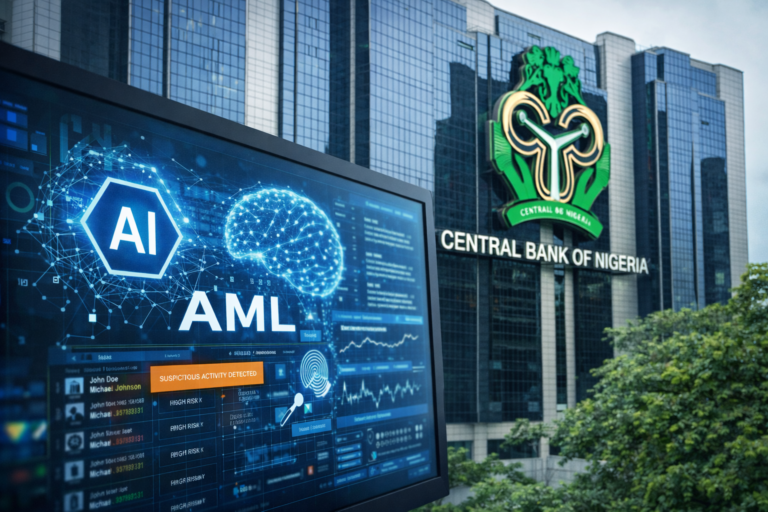
The Central Bank of Nigeria (CBN) has introduced new regulatory standards requiring financial institutions to adopt automated and technology-driven systems, including artificial intelligence (AI), to strengthen anti-money laundering (AML) monitoring across the country’s financial sector.
The move forms part of the CBN’s Baseline Standards for Automated Anti-Money Laundering Solutions, a regulatory framework designed to modernise how banks, fintech firms and other financial institutions detect and report suspicious financial activity.
Under the proposed standards, regulated institutions will be required to deploy automated AML systems capable of monitoring transactions, analysing risk patterns and flagging suspicious activity in real time. The framework applies to deposit money banks, microfinance banks, payment service providers and other financial institutions operating under the CBN’s supervision.
Technology-Driven Approach to Financial Crime
The CBN released the draft framework in May 2025, signalling a shift towards technology-based compliance as Nigeria’s financial ecosystem becomes increasingly digital.
The new standards promote the use of AI, machine learning and big data analytics to improve the detection of illicit financial flows and enhance the reporting of suspicious transactions.
Regulators say traditional manual monitoring systems are becoming less effective as financial transactions grow in scale and complexity, particularly with the rapid expansion of digital banking and fintech services.
Compliance Timeline for Banks and Fintechs
According to the framework, financial institutions will be given 12 months to align their AML systems with the new baseline standards once the final regulations are issued.
The requirements include the deployment of systems capable of:
Customer identity verification and risk profiling
Detection of politically exposed persons (PEPs)
Screening against international sanctions lists
Continuous monitoring of transactions and suspicious activity reporting
The standards also require AML platforms to integrate with existing banking systems and support real-time data exchange across financial networks.
Aligning Nigeria with Global AML Standards
The CBN said the initiative is intended to bring Nigeria’s financial crime controls closer to international best practices, including recommendations from the Financial Action Task Force (FATF), the global body that sets standards for combating money laundering and terrorist financing.
Analysts say the integration of AI into AML supervision reflects a wider global trend, with regulators increasingly relying on advanced analytics and automated monitoring to detect complex financial crime networks.
Strengthening Nigeria’s Financial System
The CBN believes the adoption of AI-powered AML systems will help financial institutions identify suspicious patterns more quickly and reduce false alerts generated by traditional rule-based monitoring systems.
By embedding advanced technology into regulatory compliance, the central bank aims to improve transparency, strengthen financial stability and safeguard the integrity of Nigeria’s banking system as digital financial services continue to expand.
Read also: AI Regulations in Nigeria
The new standards represent one of the most significant steps yet in Nigeria’s push to modernise financial crime prevention and adapt regulatory oversight to the realities of an increasingly technology-driven financial sector.

Director
Bio: An (HND, BA, MBA, MSc) is a tech-savvy digital marketing professional, writing on artificial intelligence, digital tools, and emerging technologies. He holds an HND in Marketing, is a Chartered Marketer, earned an MBA in Marketing Management from LAUTECH, a BA in Marketing Management and Web Technologies from York St John University, and an MSc in Social Business and Marketing Management from the University of Salford, Manchester.
He has professional experience across sales, hospitality, healthcare, digital marketing, and business development, and has worked with Sheraton Hotels, A24 Group, and Kendal Nutricare. A skilled editor and web designer, He focuses on simplifying complex technologies and highlighting AI-driven opportunities for businesses and professionals.