

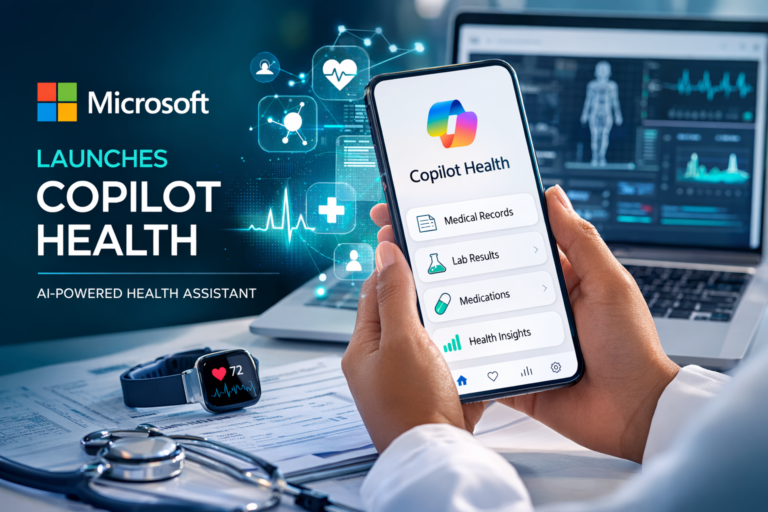
Microsoft has unveiled Copilot Health, a new artificial intelligence-powered feature designed to help individuals better understand and manage their personal health information. The launch marks the company’s latest expansion of its AI assistant ecosystem into the rapidly growing digital healthcare sector.
The new tool is integrated into Microsoft Copilot and allows users to connect medical records, wearable device data and other health information in one place. By analysing these datasets, the AI assistant can generate personalised insights and provide explanations for complex medical information.
AI Assistant for Personal Health Insights
According to Microsoft, Copilot Health is designed to simplify how people access and interpret healthcare data, which is often fragmented across multiple providers, platforms and devices.
The system can integrate information such as:
Electronic health records
Laboratory test results
Medication history
Data from wearable health devices
Users can then ask questions about their health data through natural language queries, allowing the AI assistant to explain medical terminology, highlight potential health trends and provide summaries of medical reports.
The feature is intended to help patients prepare for consultations with doctors and better understand the context of their medical information.
Integration with Health Providers and Wearables
Microsoft said Copilot Health connects with thousands of healthcare providers through established health data networks. The system can also integrate data from popular wearable devices and health tracking platforms, including Fitbit and Apple Health.
By combining clinical records with lifestyle data, the AI assistant can provide a more comprehensive view of a user’s health profile.
Microsoft emphasised that users maintain control over their health information and that the system uses encrypted connections and privacy safeguards to protect sensitive medical data.
Growing Role of AI in Healthcare
The launch of Copilot Health reflects the increasing role of artificial intelligence in healthcare technology, where AI tools are being used to analyse medical data, assist clinicians and support patient engagement.
Technology companies and healthcare providers have been investing heavily in AI-driven solutions aimed at improving diagnostics, reducing administrative workloads and enhancing personalised healthcare services.
By integrating health capabilities into its Copilot platform, Microsoft is positioning AI as a central interface for managing personal information, including productivity, finance and now healthcare.
Early Rollout in the United States
Copilot Health is initially being introduced in the United States through an early access programme and waitlist while Microsoft tests the platform and gathers user feedback.
The company has not yet announced a global rollout timeline but indicated that the feature could expand to additional markets as regulatory and healthcare data integrations evolve.
Expanding the Copilot Ecosystem
The launch represents another step in Microsoft’s broader strategy to embed AI assistants across everyday digital services. Since introducing Copilot across its productivity software, search tools and operating systems, the company has continued to explore new sectors where AI assistants could simplify complex information.
With Copilot Health, Microsoft is now bringing that approach to healthcare aiming to give individuals clearer insights into their medical data and help them make more informed decisions about their wellbeing.
As artificial intelligence becomes more integrated into digital health platforms, tools like Copilot Health may play an increasingly important role in how patients interact with healthcare information and services.

AI Writer
Bio: Joseph Michael is an MBA graduate in Marketing from Ladoke Akintola University of Technology and a passionate tech enthusiast. As a professional writer and author at AIbase.ng, he simplifies complex AI concepts, explores digital innovation, and creates practical guides for Nigerian learners and businesses. With a background in marketing and brand communication, Joseph brings clarity, insight, and real-world relevance to every article he writes.