

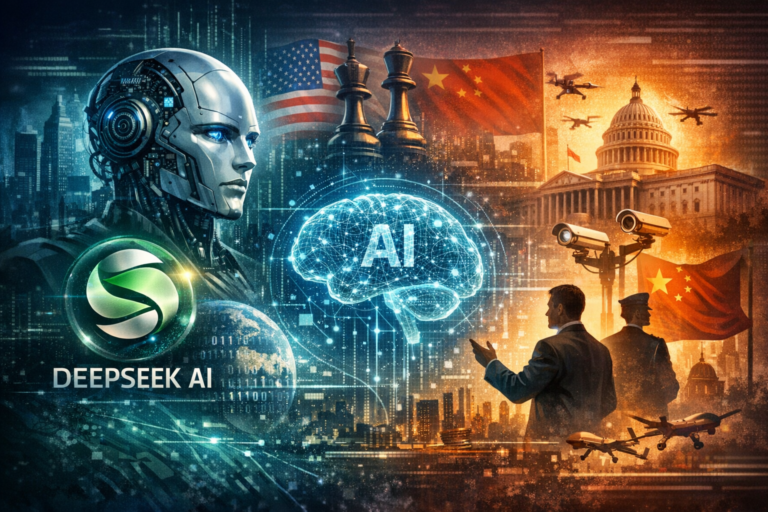
Why AI Control Has Become a Defining Question of Our Time
In little more than a decade, artificial intelligence has shifted from a specialised research pursuit to a foundational layer of modern life. Systems that generate text, analyse images, write software, and make complex predictions now operate far beyond laboratories. They are embedded in offices, public institutions, creative industries, and everyday consumer tools. This rapid expansion has brought a central question into sharp focus: who controls AI, and according to which rules?
The debate over AI control is not merely technical. It sits at the crossroads of power, economics, governance, and social values. Decisions about how AI models are designed, trained, deployed, and constrained determine who benefits from the technology and who carries its risks. As competition intensifies among technology companies and governments alike, issues of openness, safety, sovereignty, and accountability have become inseparable from the future of innovation itself.
The emergence of DeepSeek has added new urgency to this debate. Often associated with a more strategically aligned approach to AI development, DeepSeek represents a contrast to the commercially driven, Silicon Valley–centred model that has shaped much of the global conversation. Its rise has prompted renewed scrutiny of how AI power is accumulated and exercised, and whether existing governance frameworks are adequate for a technology of such reach and consequence.
This article situates DeepSeek AI within the broader global discourse on AI control, examining what the concept entails, how different models of AI governance operate, and why DeepSeek’s trajectory has become a focal point in debates over regulation, openness, and technological autonomy.
Understanding AI Control: What the Term Really Means
“AI control” is frequently invoked, but rarely defined with precision. At its core, it refers to the capacity to shape how artificial intelligence systems are created, governed, and used across society.
One layer is technical control. This includes access to large datasets, advanced computing infrastructure, model architectures, and optimisation techniques. Because state-of-the-art AI systems require immense resources, those who control these inputs exert outsized influence over what AI can do and who can deploy it.
Another layer is institutional control. This concerns who sets the rules: private companies, governments, international bodies, or some combination of all three. Decisions about safety standards, deployment boundaries, and accountability mechanisms fall squarely within this domain.
Narrative control also matters. How AI is framed in public discourse influences policy choices and public trust. Whether AI is presented as a neutral productivity tool, a profit-driven platform, or a strategic national asset shapes how societies respond to its expansion.
Finally, there is operational control. This involves how AI systems are monitored once deployed, how failures or harms are addressed, and who holds the authority to intervene when problems arise.
The debate surrounding DeepSeek touches on all these dimensions, making it a revealing case study in the global struggle over AI governance.
What Is DeepSeek AI?
DeepSeek AI is a research-driven artificial intelligence organisation that has gained attention for developing large language models and related systems with a focus on efficiency, scale, and strategic relevance. Unlike many Western counterparts, DeepSeek operates within an ecosystem where advanced AI development is closely linked to long-term national priorities.
From a technical standpoint, DeepSeek’s models are broadly comparable to leading global systems in areas such as language understanding, reasoning, and code generation. What distinguishes the organisation is not simply performance, but the context in which its models are built and deployed.
DeepSeek reflects an approach to AI that prioritises strategic autonomy. Rather than relying heavily on external platforms or open ecosystems dominated by foreign firms, it emphasises domestic expertise, infrastructure, and intellectual property. This orientation has made DeepSeek a reference point in debates over whether AI development should remain globally open or become more nationally contained.
Competing Models in the Global AI Landscape
DeepSeek’s significance becomes clearer when viewed against the broader AI landscape. Three overlapping models of AI development currently dominate global discussions.
The first is the market-driven model. Organisations such as OpenAI, Anthropic, and Google DeepMind operate primarily as commercial entities, even when structured as hybrids or non-profits. Their incentives are shaped by competition, investment, and user adoption, with control exercised through platforms, pricing, and proprietary access.
The second is the open or community-oriented model. This approach emphasises open-source software, shared datasets, and collaborative research. Advocates argue that openness reduces concentration of power and enables broader scrutiny, while critics warn that widely accessible models can be difficult to govern and susceptible to misuse.
The third is the state-aligned or strategic model, often associated with DeepSeek. In this framework, AI is treated as critical infrastructure, comparable to energy or telecommunications, and developed through close coordination between researchers, industry, and public institutions.
In practice, no model exists in pure form. Market-driven firms work closely with governments, and state-aligned projects depend on commercial expertise. What varies is the balance between openness, profit, and strategic control.
Why DeepSeek Has Intensified the Debate
DeepSeek’s growing prominence has sharpened debates over AI control for several reasons.
First, it challenges long-held assumptions about where cutting-edge AI innovation can occur. For years, progress appeared concentrated among a small group of Western technology firms. DeepSeek’s advances point to a more multipolar AI landscape.
Second, it raises questions about transparency. Critics argue that strategically aligned AI development may limit external scrutiny, while supporters contend that excessive openness can undermine security and long-term stability.
Third, DeepSeek’s rise has implications for global competition. AI is increasingly understood as a general-purpose technology with economic, political, and military significance. Control over advanced models is therefore seen as a source of strategic leverage.
Together, these factors have made DeepSeek a focal point in discussions over whether AI governance should evolve through global cooperation or increasingly fragmented national approaches.
How AI Control Operates in Practice
In reality, AI control is exercised through a combination of infrastructure, regulation, and norms.
Infrastructure remains the most visible factor. High-performance computing systems, specialised chips, and energy supply chains determine who can train advanced models. Control over these resources directly shapes AI capability.
Regulation governs how AI is deployed. Licensing regimes, export controls, and safety requirements influence where and how systems are used, while also serving industrial or strategic objectives.
Norms and standards operate more subtly. Shared expectations regarding the responsible use of AI shape corporate behaviour and public trust. Even non-binding international guidelines can affect reputations and market access.
DeepSeek operates within a framework that emphasises coordination across these dimensions, in contrast to more decentralised, market-led ecosystems.
Broader Implications for Economy, Work, and Governance
The debate over AI control has far-reaching consequences.
Economically, control determines who captures value from automation and innovation. While concentrated control can accelerate productivity gains, it can also deepen inequality if benefits accrue to a narrow group.
In the labour market, governance choices shape the pace of automation adoption and how societies manage workforce transitions. Deployment decisions determine whether AI complements or replaces human labour.
From a governance perspective, AI control raises fundamental questions about accountability. When algorithms influence or make decisions, clarity over responsibility becomes essential. Systems developed under opaque conditions can erode trust, while overly restrictive control can slow beneficial innovation.
DeepSeek’s trajectory illustrates how these outcomes are shaped by institutional choices rather than abstract technological forces.
Safety, Ethics, and Oversight
Safety concerns are frequently cited as justification for tighter AI control. Advanced models can generate harmful content, reinforce bias, or behave unpredictably in complex environments. Aligning these systems with human values remains a central challenge.
Approaches differ. Some emphasise internal safeguards and post-deployment monitoring; others argue for licensing and pre-deployment evaluation; and still others advocate international agreements governing high-risk systems.
DeepSeek’s work has attracted scrutiny in this context. Supporters argue that coordinated oversight can enhance safety, while critics warn that limited external review reduces the ability to identify and correct failures. The tension highlights a broader dilemma: how to balance effective control with sufficient transparency to maintain public trust.
A Debate Still Taking Shape
DeepSeek AI has become a prominent reference point in the global debate over who controls artificial intelligence and how that control should be exercised. Its rise reflects a world in which AI is no longer confined to a small set of companies or countries, but is instead a contested domain shaped by competing visions of power, responsibility, and progress.
The questions raised by DeepSeek will not be resolved quickly. As AI systems grow more capable and more deeply embedded in society, the tension between openness and control will only intensify. Understanding this debate is essential not to take sides, but to grasp how the future of AI governance is being shaped in real time.
At its core, the debate over AI control is not about a single organisation or development model. It is about how societies choose to manage a technology that is steadily redefining what control itself means in the digital age.

Senior Reporter/Editor
Bio: Ugochukwu is a freelance journalist and Editor at AIbase.ng, with a strong professional focus on investigative reporting. He holds a degree in Mass Communication and brings extensive experience in news gathering, reporting, and editorial writing. With over a decade of active engagement across diverse news outlets, he contributes in-depth analytical, practical, and expository articles exploring artificial intelligence and its real-world impact. His seasoned newsroom experience and well-established information networks provide AIbase.ng with credible, timely, and high-quality coverage of emerging AI developments.