

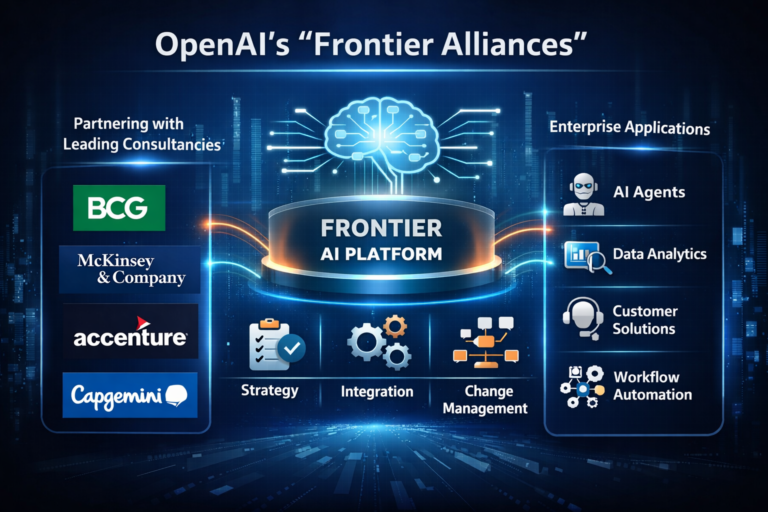
In February 2026, OpenAI launched the Frontier Alliances, multi-year partnerships with four leading consulting firms, to help enterprises adopt and scale AI “coworkers” on its Frontier platform. By combining technical expertise with strategy, integration, and change management, these alliances aim to move AI from isolated pilots to operational systems that deliver real impact.
What is the Frontier platform?
To understand the Frontier Alliances, it is important to first understand Frontier itself.
Launched by OpenAI in early 2026, Frontier is an enterprise platform that lets organisations build, deploy, manage, and scale AI agent software workers capable of navigating complex workflows using shared context and memory, and seamlessly integrating with corporate systems.
Frontier moves beyond standalone AI tools, enabling agents to handle real work end-to-end: resolving customer issues, accessing corporate data, checking policies, filing updates, and escalating only when necessary. The platform includes a secure semantic layer for system access, with built-in governance and auditability. Early adopters span technology, insurance, healthcare, and logistics.
Yet technology alone is not enough. Many enterprises struggle to adapt processes, operating models, and culture to realise AI’s full potential. The Frontier Alliances exist to bridge that gap, combining technical capability with strategy, integration, and change management.
The Frontier Alliances: Who’s Involved
OpenAI has formed its Frontier Alliances with four major global consulting and technology services firms:
- Boston Consulting Group (BCG)
- McKinsey & Company
- Accenture
- Capgemini
Each partner brings complementary strengths to the initiative.
Boston Consulting Group (BCG)
BCG focuses on strategic alignment, operating model design, and enterprise transformation. With deep experience in linking strategy to organisational processes, BCG helps leadership teams identify high-value AI use cases, redesign workflows, and embed AI into broader business strategy. BCG X combines technology build and design capabilities with business insight to deliver scalable AI solutions.
McKinsey & Company
McKinsey provides transformation and enterprise-wide change management expertise. Through its AI-focused consulting units, McKinsey supports clients in defining where and how AI should be deployed, redesigning operating models, and driving adoption across functions. Teams also collaborate closely with OpenAI engineering to accelerate deployment.
Accenture
Accenture bridges strategy and execution. It advises on enterprise AI strategy, data architecture, and manages systems integration, cloud deployment, and operationalisation of Frontier-powered agents across complex technology stacks. Its strength lies in end-to-end implementation and lifecycle support.
Capgemini
Capgemini focuses on systems integration and transformation at scale. It helps clients embed the Frontier platform throughout business operations — from data and applications to governance and processes. Capgemini emphasises secure implementation, reliable operations, and measurable business outcomes.
The Alliances at Work
Together, OpenAI and its Frontier Alliance partners provide a comprehensive AI adoption pathway that includes:
- Strategy and Use-Case Identification
Partners help organisations prioritise workflows where AI agents can deliver the most value, focusing on efficiency, accuracy, and strategic impact. - Operating Model Redesign
Leadership teams work with consultants to reshape processes so that AI becomes a core part of transformation rather than an add-on tool. - Systems Integration
Partners ensure secure connections between Frontier and enterprise systems such as CRM, HR platforms, and data stores. This guarantees the reliable operation of AI agents in real-world environments. - Change Management and Adoption
Consulting teams support cultural change, training, and governance to ensure AI adoption is sustainable beyond pilot projects.
OpenAI’s own engineering teams work alongside consultants and client IT departments to tailor solutions and ensure smooth deployment.
Importance of the Alliance
The Frontier Alliances address a key enterprise challenge: moving from pilot AI projects to production-scale adoption.
- Enterprises often struggle to transition AI experiments into deployed solutions. Frontier Alliances provide a structured pathway for operationalising AI at scale.
- By combining strategy, integration, and change management with Frontier’s technical capabilities, these partnerships help organisations transform processes rather than just implement new tools.
- The alliances exemplify a broader shift in AI adoption: moving from promising models to productive systems that deliver measurable business outcomes.
Organisations investing in AI can benefit from a clearer roadmap and access to expertise that accelerates scaled adoption, especially where internal resources are limited.
Organisational Benefits
The Frontier Alliances offer several practical benefits:
- Accelerated transition from pilots to production deployments
- Stronger alignment of AI technology with business outcomes
- Support for complex integration with legacy systems
- Enhanced risk management, governance, and compliance
AI agents can support workflows across customer service and sales, as well as software development and operations. The partnerships help ensure that these deployments deliver tangible organisational impact.
Limitations
As much as there are inherent benefits, organisations should consider:
- Cost and Resource Requirements: Large-scale AI transformation requires investment in services, integration, and change management.
- Governance and Security: Ensuring data privacy, model reliability, and compliance with local regulations is critical.
- Organisational Readiness: Cultural change, executive sponsorship, and staff training are key to successful adoption.
These considerations are particularly relevant in regions with evolving AI regulation or developing digital infrastructure.
Forging Ahead
The Frontier Alliances represent a strategic shift, making consulting partners key enablers of scaled, real-world AI adoption. Success now depends less on model sophistication and more on embedding intelligence into daily operations with proper governance and alignment. Organisations that integrate people, processes, and technology are best placed to realise AI’s full potential.

Senior Reporter/Editor
Bio: Ugochukwu is a freelance journalist and Editor at AIbase.ng, with a strong professional focus on investigative reporting. He holds a degree in Mass Communication and brings extensive experience in news gathering, reporting, and editorial writing. With over a decade of active engagement across diverse news outlets, he contributes in-depth analytical, practical, and expository articles exploring artificial intelligence and its real-world impact. His seasoned newsroom experience and well-established information networks provide AIbase.ng with credible, timely, and high-quality coverage of emerging AI developments.