

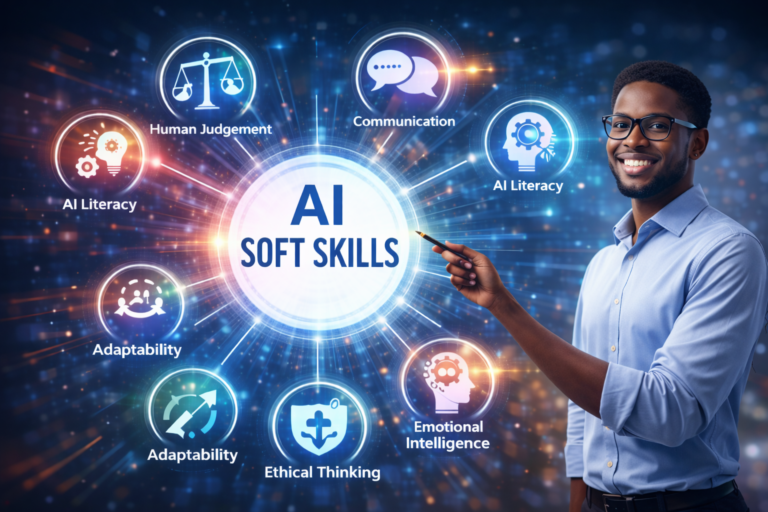
As artificial intelligence (AI) continues to reshape industries worldwide, Nigeria is no exception. From fintech and healthtech to media, agriculture and public services, AI is rapidly transforming how work is done. However, while technical AI skills such as coding and data science are valuable, they are no longer enough on their own.
Today’s employers are increasingly prioritising transferable AI soft skills—human-centred abilities that enable graduates to work effectively with AI tools, adapt to change and remain relevant in a fast-evolving digital economy.
In this article, we explore the AI Soft Skills Every Nigerian Graduate Must Have to succeed in the modern workplace, regardless of discipline or career path.
Why AI Soft Skills Matter for Nigerian Graduates
Nigeria produces hundreds of thousands of graduates every year, yet unemployment and underemployment remain significant challenges. At the same time, organisations are adopting AI-driven tools that automate routine tasks, analyse data and enhance decision-making.
This shift means employers are not just looking for technical know-how; they want graduates who can:
-
Think critically alongside AI systems
-
Communicate insights clearly
-
Adapt to new technologies quickly
-
Use AI responsibly and ethically
Developing these skills gives Nigerian graduates a competitive edge both locally and globally.
1. Critical Thinking and Analytical Reasoning
One of the most essential AI soft skills every Nigerian graduate must have is critical thinking. AI can generate answers, predictions and recommendations, but it cannot always judge context, bias or real-world implications.
Graduates must be able to:
-
Question AI-generated outputs
-
Identify errors, gaps or bias in data
-
Make informed decisions rather than blindly trusting algorithms
In sectors like journalism, finance, education and governance, critical thinking ensures AI is used as a support tool, not a replacement for human judgment.
2. Digital Literacy and AI Awareness
You do not need to be an AI engineer to work with AI. However, every graduate should understand the basics of how AI works and how it is applied in their field.
AI literacy includes:
-
Knowing what AI can and cannot do
-
Understanding tools such as chatbots, data analytics platforms and automation software
-
Using AI responsibly for research, productivity and problem-solving
For Nigerian graduates, digital literacy is essential for navigating modern workplaces where AI tools are becoming standard.
3. Adaptability and Continuous Learning
AI technologies evolve rapidly. Skills that are relevant today may become outdated tomorrow. This makes adaptability a core requirement for career success.
Graduates must be willing to:
-
Learn new tools and platforms regularly
-
Reskill or upskill as industries change
-
Embrace change rather than resist it
In Nigeria’s dynamic job market, adaptability helps graduates move across roles, industries and even international opportunities.
4. Communication and Storytelling Skills
AI can process data, but humans are still needed to clearly and persuasively explain insights. Strong communication skills are, therefore, among the AI soft skills every Nigerian graduate must have.
This includes the ability to:
-
Translate complex AI insights into simple language
-
Present findings to non-technical audiences
-
Collaborate effectively with diverse teams
Whether writing reports, pitching ideas or working remotely, clear communication remains a highly valued skill.
Consider reading these:
- AI challenges in Nigeria
- AI in the Nigerian retail sector
- Artificial Intelligence adoption in Nigeria
- Viable AI Startup Business Ideas for Nigerians
- AI is creating new job roles in Nigeria
- AI regulations in Nigeria
- Funding providers for Nigerian AI startups
5. Ethical Awareness and Responsible AI Use
As AI adoption grows, so do concerns around privacy, bias, misinformation and job displacement. Nigerian graduates must understand the ethical implications of using AI.
Key ethical AI soft skills include:
-
Respecting data privacy and consent
-
Avoiding plagiarism and over-reliance on AI-generated content
-
Recognising and addressing bias in AI systems
Graduates who demonstrate ethical awareness are more likely to earn trust and leadership opportunities in organisations.
6. Creativity and Problem-Solving
AI excels at pattern recognition, but creativity remains a uniquely human strength. Employers value graduates who can use AI as a creative partner rather than a shortcut.
Creative problem-solving involves:
-
Using AI tools to generate ideas, then refining them with human insight
-
Applying AI to solve local Nigerian challenges in innovative ways
-
Thinking beyond automation to value creation
From entrepreneurship to product development, creativity sets graduates apart in an AI-driven economy.
7. Collaboration and Emotional Intelligence
Modern workplaces rely heavily on teamwork-often across cultures, time zones and digital platforms. Emotional intelligence (EQ) helps graduates collaborate effectively alongside both humans and AI systems.
Important aspects include:
-
Empathy and interpersonal skills
-
Conflict resolution and active listening
-
Understanding human needs that AI cannot replicate
In leadership and customer-facing roles, emotional intelligence is irreplaceable.
How Nigerian Graduates Can Develop AI Soft Skills
Developing these skills does not require expensive degrees or foreign travel. Nigerian graduates can:
-
Take online courses on AI literacy and digital skills
-
Practise using AI tools ethically for learning and productivity
-
Participate in internships, hackathons and collaborative projects
-
Follow AI news platforms and communities within Nigeria
Consistency and curiosity are key.
Conclusion
As AI continues to redefine the future of work, technical skills alone are no longer sufficient. The AI Soft Skills Every Nigerian Graduate Must Have-critical thinking, adaptability, communication, ethics, creativity and emotional intelligence-are what truly determine long-term career success.
Graduates who invest in these transferable skills will not only remain employable but will also play a vital role in shaping Nigeria’s AI-powered future.

Director/CEO
As the co-founder of AIBase, Joy established this platform to make artificial intelligence knowledge more accessible and relevant within the Nigerian ecosystem. She is an accounting graduate with a diverse professional background in multimedia and catering, experiences that have strengthened her adaptability and creative problem-solving skills.
Now transitioning into artificial intelligence and technology writing, Joy blends analytical thinking with engaging storytelling to explore and communicate emerging technology trends. Her drive to establish aibase.ng is rooted in a passion for bridging the gap between complex AI innovations and practical, real-world understanding for individuals and businesses.