

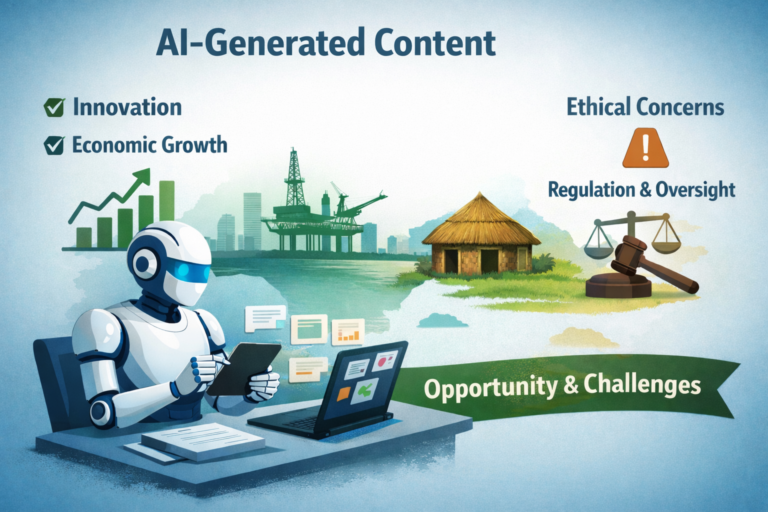
Artificial intelligence (AI) is revolutionising how content is produced and shared, with AI-generated content impacting journalism, marketing, education, and corporate communications. While it offers efficiency, cost savings, and improved engagement, it also presents limitations and ethical challenges that decision-makers and educators must carefully manage.
Meaning of AI-Generated Content
AI-generated content is created with minimal human input using algorithms trained on large datasets. These systems analyse patterns in language, images, or audio to produce text, visuals, or multimedia that mimic human creativity. Tools like OpenAI’s GPT, Google’s Bard, and Anthropic’s Claude can generate articles, social media posts, reports, and marketing content, ranging from simple summaries to complex, original outputs that emulate human reasoning and style.
Merits
1. Efficiency and Speed
One of the most immediate benefits of AI-generated content is the speed of production. What would traditionally take hours or even days can now be completed in minutes. Marketing teams, for instance, can quickly generate multiple versions of promotional material, enabling rapid A/B testing and adaptation to audience feedback.
2. Cost Reduction
For businesses and media organisations, AI content creation reduces reliance on large teams of writers or designers. This can translate into significant cost savings, particularly for startups and SMEs that need consistent content output but may lack the resources to produce it.
3. Scalability and Consistency
AI systems can produce content at scale while maintaining a consistent tone and style. Educational institutions or corporate organisations can deploy AI to generate learning materials, training guides, or policy summaries across multiple departments or campuses without compromising uniformity.
4. Multilingual Capabilities
Advanced AI tools are increasingly proficient in multiple languages, making global outreach more feasible. For countries like Nigeria, with over 500 languages spoken, this presents opportunities to create educational or informational content in widely spoken local languages such as Yoruba, Igbo, or Hausa.
5. Personalisation and Data-Driven Insights
AI can tailor content to specific audiences based on behavioural data, engagement patterns, or demographic information. In marketing and e-learning, this capability enables targeted campaigns and customised learning paths, enhancing relevance and effectiveness.
Demerits
1. Quality and Accuracy Concerns
While AI can generate coherent and compelling text, it may inadvertently produce inaccuracies or misleading information. Without human oversight, errors in data interpretation, context, or cultural nuance can easily go unnoticed.
2. Ethical and Legal Implications
Questions about authorship, copyright, and accountability remain unresolved in many jurisdictions. The Nigerian Copyright Commission has yet to provide comprehensive guidelines for AI-generated works, which could lead to disputes over ownership or liability.
3. Creativity and Originality Constraints
AI excels at replicating patterns from existing datasets but may struggle with genuinely novel ideas or deeply contextual creative expression. For sectors such as journalism or literature, human intuition and critical thinking remain indispensable.
4. Risk of Bias
AI models can inadvertently reproduce biases present in their training data. This may lead to content that perpetuates stereotypes or marginalises underrepresented groups, particularly sensitive in Nigeria’s diverse cultural and ethnic landscape.
5. Dependence on Technology
Overreliance on AI for content creation may undermine human skill development in writing, critical thinking, and creative problem-solving. Educational institutions risk producing graduates who are adept at utilising AI but less proficient in foundational skills.
Global View on Adoption
In North America and Europe, AI-generated content is increasingly integrated into journalism, marketing, and corporate communications, often under strict editorial oversight. Regulatory frameworks in the European Union, such as the AI Act, emphasise transparency, accountability, and human oversight.
Asian markets, particularly in China and Japan, demonstrate rapid adoption for e-commerce and social media, where AI is employed to generate product descriptions, reviews, and advertisements at massive scale. However, censorship and content regulation often shape these deployments.
For Africa, adopting best practices from global markets can guide effective and responsible use of AI. Integrating AI into content workflows should balance efficiency gains with ethical safeguards, transparency, and the protection of local cultural narratives.
Addressing the Challenges
To maximise benefits and mitigate risks, stakeholders should consider:
- Developing regulatory guidelines that clarify authorship, liability, and acceptable usage.
- Ensuring human oversight, especially for high-stakes content such as news, academic materials, or policy reports.
- Investing in skill development to complement AI capabilities with critical thinking, creativity, and ethical reasoning.
- Promoting local datasets to train AI systems that reflect cultural diversity and social realities.
- Encouraging transparency so audiences can distinguish between AI-generated and human-created content.
By carefully managing AI-generated content through regulation, human oversight, and cultural awareness, emerging markets can leverage it for innovation, economic growth, and cultural preservation. While AI offers speed, efficiency, and scalability, its accuracy and ethical limitations require thoughtful integration to ensure it serves as a positive, transformative tool rather than a source of challenges.

Senior Reporter/Editor
Bio: Ugochukwu is a freelance journalist and Editor at AIbase.ng, with a strong professional focus on investigative reporting. He holds a degree in Mass Communication and brings extensive experience in news gathering, reporting, and editorial writing. With over a decade of active engagement across diverse news outlets, he contributes in-depth analytical, practical, and expository articles exploring artificial intelligence and its real-world impact. His seasoned newsroom experience and well-established information networks provide AIbase.ng with credible, timely, and high-quality coverage of emerging AI developments.