

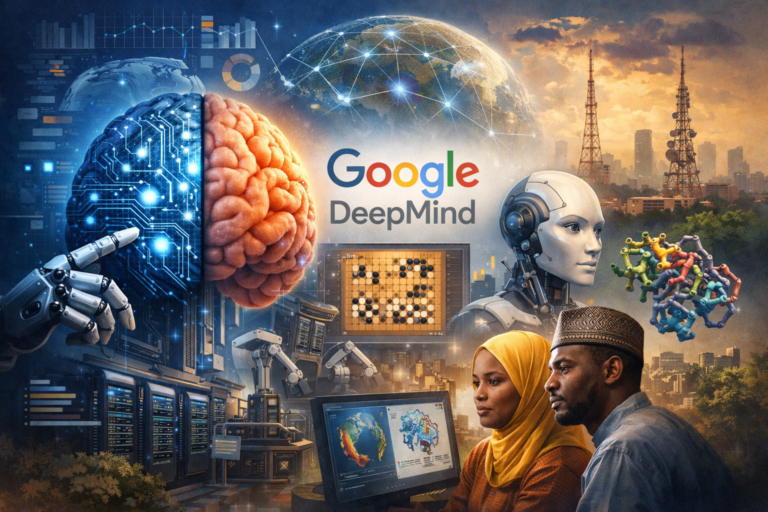
Why Google DeepMind Matters Now
Over the past decade, artificial intelligence has moved from academic laboratories into the centre of global economic and political power. Systems that once struggled to recognise images or translate simple sentences now generate human-like text, predict protein structures, optimise energy systems, and support medical diagnosis. Behind many of these advances sits Google DeepMind, one of the world’s most influential AI research organisations.
For Nigerian readers, DeepMind’s relevance is no longer abstract. AI-powered tools increasingly shape search engines, digital advertising, smartphones, healthcare research, education platforms, and even public administration systems that Nigerians interact with daily. Decisions made in research centres thousands of kilometres away now influence how information is accessed, how businesses compete, and how skills are valued in Nigeria’s labour market.
Understanding Google DeepMind is therefore not simply about tracking global technology trends. It is about understanding the intellectual engine driving many of Google’s most advanced AI capabilities, the scientific assumptions behind them, and the broader implications for countries like Nigeria that are both consumers and potential contributors to the global AI ecosystem.
This article offers a comprehensive, fact-based exploration of Google DeepMind: its origins, how it works, what it has achieved, and why its research agenda matters for Nigeria today.
What Is Google DeepMind?
Google DeepMind is an artificial intelligence research organisation that operates as part of Google’s parent company, Alphabet. It focuses on advancing the science of AI through fundamental research while also translating those discoveries into practical systems that can be deployed across Google’s products and, in some cases, wider society.
DeepMind was founded in London in 2010 by Demis Hassabis, Shane Legg, and Mustafa Suleyman. From the outset, its ambition was unusually broad. Rather than building narrow commercial AI applications, the founders aimed to pursue artificial general intelligence, a form of AI capable of learning and reasoning across a wide range of tasks.
In 2014, Google acquired DeepMind, integrating it into its long-term research strategy. While DeepMind retained a distinct research culture and location outside the United States for several years, its work became increasingly central to Google’s AI roadmap. In 2023, Google consolidated its AI research units, formally bringing DeepMind and Google Brain together under the single banner of Google DeepMind.
Today, Google DeepMind operates at the intersection of academic research and industrial-scale deployment, publishing in leading scientific journals while also shaping the AI systems embedded in Google Search, cloud services, and consumer products.
Defining Key Concepts Behind DeepMind’s Work
To understand DeepMind’s influence, it is important to clarify some of the key concepts that underpin its research.
Artificial intelligence refers broadly to computer systems designed to perform tasks that typically require human intelligence, such as perception, reasoning, learning, and decision-making.
Machine learning is a subset of AI in which systems improve their performance by learning patterns from data rather than following explicitly programmed rules.
Deep learning is a further subset of machine learning that uses large neural networks inspired by the structure of the human brain. These models are particularly effective at processing images, language, and complex data patterns.
Reinforcement learning, a core focus of DeepMind, involves training agents to make decisions by interacting with an environment and receiving feedback in the form of rewards or penalties. Over time, the agent learns strategies that maximise long-term rewards.
These approaches are not theoretical abstractions. They are the technical foundations of systems that recommend videos, detect fraud, optimise logistics, and increasingly generate text, code, and scientific hypotheses.
DeepMind’s Research Philosophy
What distinguishes DeepMind from many other AI labs is its emphasis on first-principles research. Rather than starting with a specific product requirement, researchers often begin with a scientific question about intelligence itself.
DeepMind has consistently invested in long-term projects that may not yield immediate commercial returns but can unlock entirely new capabilities. This research-driven approach has led to breakthroughs that were initially viewed as academic curiosities but later became commercially transformative.
At the same time, DeepMind operates within Google’s vast computational infrastructure. Access to large-scale data, specialised hardware, and global deployment channels enables its research to move from theory to practice faster than in most academic settings.
This dual identity, part research institute and part industrial lab, gives DeepMind a unique position in the global AI landscape.
Landmark Breakthroughs That Defined DeepMind
Several high-profile achievements have shaped DeepMind’s reputation and influence.
One of the earliest was the development of reinforcement learning systems that learned to play classic video games directly from raw pixels, without prior knowledge of the rules. This demonstrated that a single algorithmic framework could master diverse tasks, a key step toward more general intelligence.
In 2016, DeepMind’s AlphaGo system defeated a world champion in the game of Go, a feat long considered beyond the reach of machines due to the game’s complexity. The significance of AlphaGo lay not only in winning a game but in showing that machines could develop creative strategies that surprised human experts.
Perhaps DeepMind’s most far-reaching contribution came with AlphaFold, an AI system that predicts the three-dimensional structure of proteins from their amino acid sequences. Protein folding had been a central challenge in biology for decades. AlphaFold’s success has accelerated research in medicine, drug discovery, and biotechnology worldwide.
These breakthroughs illustrate a pattern: DeepMind tackles problems that sit at the limits of existing knowledge, then applies its solutions across multiple domains.
How DeepMind’s Work Powers Google’s AI Products
While DeepMind’s research often makes headlines for scientific achievements, its practical impact is felt through Google’s products and services.
Advances in natural language processing contribute to more accurate search results, better translation systems, and more conversational AI assistants. Reinforcement learning techniques help optimise data centre energy use, reducing operational costs and environmental impact.
In cloud computing, DeepMind’s research informs AI tools offered to businesses, including predictive analytics, recommendation systems, and generative models that support software development and customer service.
For Nigerian users, this means that interactions with Google Search, Android devices, and cloud-powered services increasingly rely on DeepMind-derived technologies, even if the organisation itself remains largely invisible.
Global Perspectives on DeepMind’s Influence
Internationally, DeepMind is often viewed as a benchmark for cutting-edge AI research. Its publications shape academic agendas, and its open sharing of some tools and datasets has influenced research communities worldwide.
Governments and policy-makers also pay close attention to DeepMind’s work, particularly in areas such as AI safety, ethics, and long-term societal impact. The organisation has been vocal about the need for responsible AI development, though critics argue that the concentration of AI capabilities within large technology firms raises concerns about power, transparency, and accountability.
In developed economies, DeepMind’s breakthroughs are closely linked to innovation ecosystems that include venture capital, advanced universities, and robust regulatory frameworks. The situation is markedly different in many developing countries, including Nigeria.
Nigeria’s AI Landscape in Context
Nigeria has one of Africa’s largest and most dynamic technology sectors, driven by a young population, growing internet penetration, and a vibrant startup ecosystem. AI is increasingly discussed in policy circles, universities, and private firms, particularly in areas such as fintech, agriculture, health, and public service delivery.
However, Nigeria’s AI ecosystem faces structural constraints. Research funding is limited, access to high-performance computing infrastructure is uneven, and links between academia and industry are often weak. While Nigerian developers and researchers use global AI tools, few local institutions have the capacity to develop foundational models comparable to those produced by organisations like DeepMind.
This asymmetry makes understanding global AI leaders especially important. Nigeria is more likely to adopt, adapt, and regulate AI technologies developed elsewhere than to shape their core design.
Implications of DeepMind’s Work for Nigeria
DeepMind’s research has several implications for Nigeria’s economy and society.
In education, AI-powered tools informed by DeepMind’s advances can enhance learning through personalised content, automated assessment, and language translation. This has the potential to address teacher shortages and expand access, particularly in underserved regions.
In healthcare, breakthroughs such as protein structure prediction and diagnostic AI systems may indirectly benefit Nigerian medical research and practice, especially as global pharmaceutical and health technology firms adopt these tools.
Economically, AI-driven productivity gains could support sectors such as finance, logistics, and telecommunications, where Nigeria already has strong market activity. At the same time, automation raises concerns about job displacement, particularly in routine clerical and administrative roles.
In governance, AI systems influence data analysis, fraud detection, and service delivery, but their deployment also raises questions about data sovereignty, privacy, and accountability in a context where regulatory frameworks are still evolving.
Challenges and Constraints Unique to Nigeria
Despite the potential benefits, Nigeria faces specific challenges in engaging meaningfully with the AI revolution led by organisations like DeepMind.
Infrastructure remains a fundamental constraint. Reliable electricity, high-speed internet, and access to advanced computing resources are prerequisites for serious AI research and deployment.
Human capital is another challenge. While Nigeria produces talented software developers and data scientists, opportunities for advanced AI research training are limited. Brain drain further reduces the pool of experienced researchers.
Regulatory capacity also lags behind technological change. Nigeria’s data protection laws and digital policies are still maturing, making it difficult to address complex issues such as algorithmic bias, transparency, and cross-border data flows.
These constraints mean that Nigeria risks becoming a passive consumer of AI technologies rather than an active participant in shaping their development and governance.
What Would Meaningful Progress Look Like?
For Nigeria to engage more effectively with the kind of AI research exemplified by DeepMind, several shifts would be necessary.
Investment in higher education and research infrastructure would need to increase, particularly in universities and research institutes focused on computer science, mathematics, and related fields.
Stronger collaboration between Nigerian institutions and global AI research centres could help transfer knowledge and build local capacity. This does not require replicating DeepMind’s scale; rather, it involves developing niches aligned with Nigeria’s needs, such as agricultural AI or language technologies for local languages.
Policy-makers would also need to strengthen regulatory frameworks to ensure that AI deployment aligns with national priorities, protects citizens’ rights, and supports inclusive growth.
These changes are complex and long-term, but they are essential if Nigeria is to move beyond consumption toward contribution.
Understanding the Brain Behind the Breakthroughs
Google DeepMind represents one of the most ambitious attempts to understand and engineer intelligence in human history. Its research has reshaped what machines can do, influencing everything from scientific discovery to everyday digital services.
For Nigerian readers, the significance of DeepMind lies not only in its technical achievements but in what it reveals about the changing nature of power, knowledge, and opportunity in a digital world. AI breakthroughs increasingly emerge from a small number of global centres, yet their effects are felt everywhere.
By understanding how DeepMind operates, what it has achieved, and the assumptions guiding its work, Nigerians can better engage with the technologies shaping their future. This understanding does not offer simple answers or guarantees. Instead, it provides a clearer view of the forces at work, enabling more informed discussion about how Nigeria can navigate, adapt to, and ultimately influence the AI-driven transformations of the years ahead.

Senior Reporter/Editor
Bio: Ugochukwu is a freelance journalist and Editor at AIbase.ng, with a strong professional focus on investigative reporting. He holds a degree in Mass Communication and brings extensive experience in news gathering, reporting, and editorial writing. With over a decade of active engagement across diverse news outlets, he contributes in-depth analytical, practical, and expository articles exploring artificial intelligence and its real-world impact. His seasoned newsroom experience and well-established information networks provide AIbase.ng with credible, timely, and high-quality coverage of emerging AI developments.