

From Accelerators to AI Infrastructure
The modern history of artificial intelligence is inseparable from advances in computing hardware. While early breakthroughs in machine learning were driven largely by algorithmic innovation, the last decade has shown that progress at scale depends just as much on specialised processors capable of handling immense volumes of data and computation. Graphics processing units, originally designed for rendering images, became the unlikely engine of the deep learning revolution, transforming research labs, data centres, and entire industries.
Within this context, the release of the NVIDIA Blackwell architecture marks a pivotal moment. Named after mathematician David Blackwell, the architecture represents more than a routine generational upgrade. It reflects a shift in how AI systems are conceived, built, and deployed, at a time when models are growing larger, more complex, and more tightly integrated into economic and social systems.
Blackwell arrives amid intense global demand for computing power. Large language models, multimodal systems, and AI-driven scientific simulations are pushing existing infrastructure to its limits. The question is no longer whether hardware can keep pace with algorithms, but whether the next generation of hardware can fundamentally change what is feasible. Blackwell is NVIDIA’s answer to that challenge.
Understanding NVIDIA Blackwell Architecture
At its core, Blackwell is a new GPU architecture designed explicitly for the demands of contemporary and future AI workloads. It succeeds the Hopper architecture, building on lessons learned from the explosive growth of generative AI and large-scale training.
The Blackwell platform is best understood not as a single chip, but as an integrated system. It combines advanced silicon design, high-speed interconnects, memory innovations, and software optimisation into a coherent whole. The aim is to reduce the friction between raw computation and practical AI deployment.
One of Blackwell’s defining features is its emphasis on scale. Where previous architectures focused on accelerating individual models or workloads, Blackwell is designed to operate efficiently across large-scale GPU clusters, enabling the training and inference of models with trillions of parameters. This reflects the reality that AI progress increasingly depends on distributed systems rather than standalone processors.
Key Architectural Innovations
A New Class of GPU Design
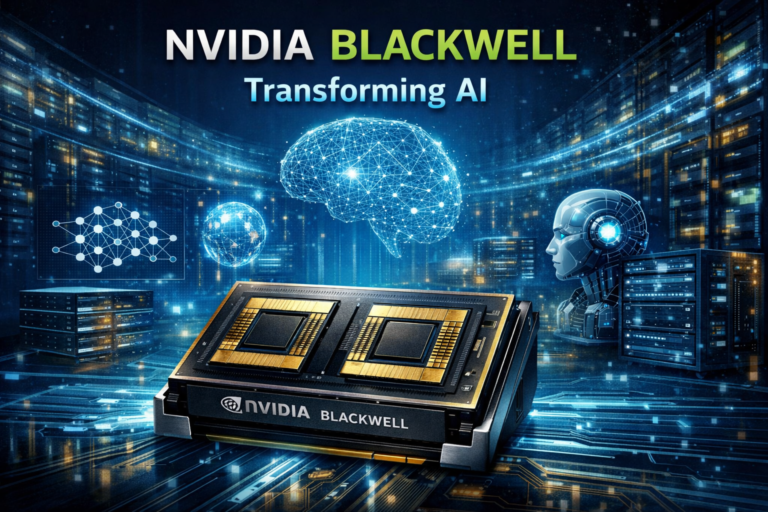
Blackwell introduces a dual-die GPU design that effectively links two large processing units into a single logical GPU. This approach allows NVIDIA to push beyond traditional limits of chip size while maintaining performance and yield. The result is significantly higher computational density without proportionate increases in power consumption.
This design choice addresses one of the most pressing constraints in modern AI computing: energy efficiency. As data centres expand, power and cooling have become as critical as raw performance. Blackwell’s architecture aims to deliver more AI capability per watt, a metric increasingly defining competitiveness in large-scale deployments.
Memory and Data Movement
AI workloads are often bottlenecked not by computation itself, but by data movement between memory and processors. Blackwell tackles this challenge with next-generation high-bandwidth memory and optimised data pathways that reduce latency and increase throughput.
The architecture supports larger memory pools per GPU, allowing entire models or significant portions of them to reside closer to the compute cores. This reduces the need for constant data shuffling, which can slow training and inference and increase energy consumption.
NVLink and System-Level Integration
Blackwell is tightly integrated with NVIDIA’s latest NVLink technology, enabling GPUs to communicate with each other at unprecedented speeds. In practice, this means that multiple Blackwell GPUs can function as a single, cohesive computing unit.
This system-level approach reflects a broader shift in AI infrastructure. Rather than treating GPUs as isolated accelerators, Blackwell positions them as building blocks of large, unified AI systems. This is particularly important for training frontier models, where performance gains increasingly come from better coordination across hardware rather than faster individual components.
Blackwell and the Evolution of AI Workloads
Training Large Language Models
The rise of large language models has fundamentally changed the profile of AI workloads. Training these models requires substantial matrix computation, memory, and interconnect bandwidth. Blackwell is optimised for precisely these tasks, with specialised tensor cores capable of handling mixed-precision arithmetic at scale.
By supporting lower-precision formats without sacrificing accuracy, Blackwell enables faster training times and reduced energy use. This makes it feasible to experiment with larger models or more training runs, accelerating research cycles and lowering the barrier to entry for advanced AI development.
Inference at Scale
While training often captures headlines, inference is where AI systems deliver real-world value. Deploying models to serve millions or billions of users requires hardware that can respond quickly, reliably, and efficiently.
Blackwell’s architecture includes features designed specifically for high-throughput inference. These include improved scheduling, better memory utilisation, and support for sparsity, which allows the hardware to skip unnecessary computations. The result is faster response times and lower operational costs, particularly for generative AI services.
Beyond Text: Multimodal and Scientific AI
AI is no longer confined to text or images. Increasingly, systems must integrate data from multiple modalities, including audio, video, sensor data, and scientific measurements. Blackwell’s flexibility makes it well-suited to these heterogeneous workloads.
In scientific computing, for example, AI models are being used to simulate physical systems, accelerate drug discovery, and analyse complex datasets. Blackwell’s ability to handle both traditional high-performance computing tasks and modern AI workloads positions it as a bridge between these domains.
Software Ecosystem and Developer Impact
Hardware alone does not transform AI; it must be matched by a mature and accessible software ecosystem. NVIDIA’s long-standing investment in software is a crucial part of Blackwell’s impact.
The architecture is fully integrated with NVIDIA’s CUDA platform, which remains the dominant programming model for GPU-accelerated computing. Developers can leverage Blackwell’s capabilities without rewriting their applications from scratch, providing continuity that lowers adoption barriers.
In addition, NVIDIA has expanded its suite of AI frameworks, libraries, and tools to exploit Blackwell’s features. These include optimised kernels for popular machine learning frameworks and system-level software that simplifies the management of large GPU clusters. The result is an environment where performance gains are accessible not only to hardware specialists but to a broad range of AI practitioners.
Global Perspectives on Blackwell’s Significance
Competitive Dynamics in the Semiconductor Industry
Blackwell enters a highly competitive landscape. Other chipmakers are investing heavily in AI accelerators, each with its own architectural philosophies. Some focus on custom ASICs tailored to specific workloads, while others pursue general-purpose designs with broad applicability.
NVIDIA’s approach with Blackwell emphasises versatility and ecosystem integration. Rather than optimising for a single model class, the architecture is designed to support a wide spectrum of AI applications. This strategy reinforces NVIDIA’s position as a platform provider rather than merely a hardware vendor.
Implications for Cloud and Enterprise AI
Cloud service providers are among the primary adopters of Blackwell-based systems. The architecture’s scalability and efficiency align closely with the economics of cloud computing, where utilisation rates and energy costs are critical.
For enterprises, Blackwell lowers the threshold for deploying advanced AI internally. By offering higher performance within a more manageable power and space footprint, it enables organisations to run sophisticated models without relying exclusively on external cloud services.
Research and Public Sector Applications
Beyond commercial use, Blackwell has significant implications for research institutions and public sector projects. Fields such as climate modelling, genomics, and materials science increasingly depend on AI-driven simulation and analysis.
The ability to run larger, more accurate models can translate directly into better scientific outcomes. In this sense, Blackwell’s impact extends beyond the technology sector, influencing how knowledge itself is produced and applied.
Broader Implications for Economy, Jobs, and Society
Productivity and Economic Transformation
By making advanced AI more efficient and scalable, Blackwell contributes to broader productivity gains. Tasks that once required extensive human effort can be automated or augmented, freeing resources for higher-value activities.
This has implications across sectors, from manufacturing and logistics to finance and healthcare. While the distribution of these gains will vary, the underlying trend is toward deeper integration of AI into everyday economic processes.
Skills and Workforce Evolution
As AI systems become more capable, the skills required to build and manage them evolve. Blackwell’s emphasis on system-level optimisation underscores the growing importance of expertise in distributed computing, data engineering, and AI operations.
At the same time, improved hardware efficiency can democratise access to AI development, allowing smaller teams and organisations to experiment with advanced models. This may broaden participation in AI innovation, even as it raises the bar for technical proficiency.
Governance and Ethical Considerations
The scaling enabled by Blackwell also intensifies debates around governance and ethics. More powerful models can amplify both positive and negative effects, from improved decision-making to increased risks of misuse.
While hardware architectures do not determine how AI is used, they shape what is possible. As such, the capabilities unlocked by Blackwell heighten the need for thoughtful oversight, transparency, and alignment between technological progress and societal values.
What Comes Next for AI Hardware
Blackwell is unlikely to be the final word in AI acceleration. Instead, it represents a waypoint in a longer journey toward increasingly specialised and integrated computing systems.
Future architectures may further blur the line between hardware and software, incorporating adaptive elements that respond dynamically to workloads. Others may focus on sustainability, prioritising carbon efficiency alongside performance.
What Blackwell demonstrates is that hardware innovation remains a central driver of AI progress. As models grow and applications expand, the architectures that support them will continue to shape the trajectory of artificial intelligence.
Conclusion: A Foundational Shift in AI Computing
The NVIDIA Blackwell architecture stands as a significant milestone in the evolution of AI infrastructure. By addressing the intertwined challenges of scale, efficiency, and integration, it redefines what modern GPUs can achieve.
Its impact extends beyond faster training runs and lower inference costs. More fundamentally, Blackwell reshapes the boundaries of possibility, enabling new classes of models and applications that were previously impractical. In doing so, it reinforces the idea that progress in artificial intelligence is as much about the systems that support it as the algorithms themselves.
For researchers, enterprises, and policymakers alike, understanding Blackwell is essential to understanding where AI is heading. It offers a glimpse of a future in which computing power is no longer the primary constraint, but a flexible resource that can be marshalled to address some of the most complex challenges of our time.

Senior Reporter/Editor
Bio: Ugochukwu is a freelance journalist and Editor at AIbase.ng, with a strong professional focus on investigative reporting. He holds a degree in Mass Communication and brings extensive experience in news gathering, reporting, and editorial writing. With over a decade of active engagement across diverse news outlets, he contributes in-depth analytical, practical, and expository articles exploring artificial intelligence and its real-world impact. His seasoned newsroom experience and well-established information networks provide AIbase.ng with credible, timely, and high-quality coverage of emerging AI developments.