

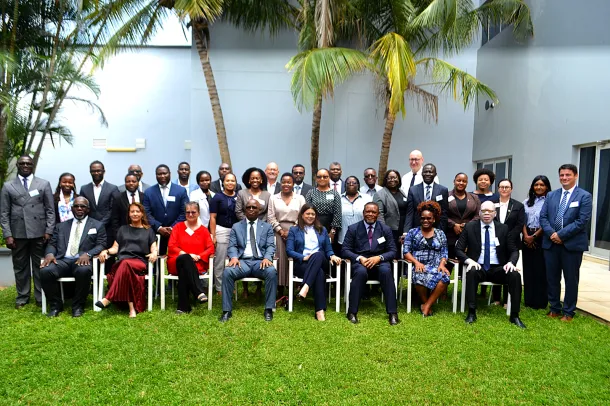
Judicial leaders from across Africa have gathered in Maputo to examine how artificial intelligence is beginning to shape court systems and raise new questions around transparency, accountability, and human rights.
The regional workshop, organised by the African Network of Judicial Trainers (ANJT) in collaboration with UNESCO, brought together 31 participants, including directors of judicial training institutes, Supreme Court justices, and senior magistrates from several African countries.
The meeting focused on how AI technologies — such as automated translation tools and legal research systems — are increasingly being introduced into judicial processes.
Opening the workshop, Michael Croft, Regional Director of UNESCO in Mozambique, said courts must prepare for technological change while preserving the human foundations of justice.
“Judges and judicial educators must be equipped to make informed decisions about emerging technologies,” Croft said. “Justice must remain human-centred, especially in the digital age.”
Participants shared experiences from their respective countries, including early experiments with AI tools that assist courts with translation, document analysis, and legal research. While these technologies can improve efficiency and expand access to justice, participants also highlighted concerns about algorithmic bias, discrimination, and limited transparency in automated systems.
Discussions during the workshop focused on how courts can ensure fairness and accountability when AI tools are used within judicial processes, as well as how judges should assess evidence generated through algorithmic systems.
To support judicial training efforts, UNESCO introduced two resources designed for legal professionals: Guidelines for the Use of AI in Courts and Tribunals and AI Essentials for Judges. The materials aim to help judges better understand AI systems and adopt responsible practices when integrating them into judicial work.
By the end of the workshop, participants agreed to incorporate lessons from the discussions into national training programmes to strengthen AI literacy across Africa’s judicial systems.
Organisers said the dialogue marked an important step toward ensuring that technological innovation supports, rather than undermines, the rule of law as AI adoption grows within public institutions across the continent.
Senior AI Writer
Bio: Okikiola is a writer and AI enthusiast with a background in Office Technology and Management from the Federal Polytechnic Offa. She went further to study an MSc in International Business at De Montfort University (DMU). With extensive work experience across administrative and business roles, she now focuses on exploring how artificial intelligence can transform work, innovation, and everyday life.