
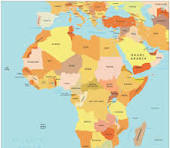
Across Africa, governments are leveraging AI for governance, economic growth, and social services, while investment flows into startups focused on enterprise AI, developer tools, and multi-language platforms. Regional clusters are emerging with unique strengths shaped by local needs, language diversity, and international partnerships, with Morocco and Tunisia forming a compact North African hub backed by French investors.
Despite investor enthusiasm for Africa’s untapped data and large consumer base, venture data from Launch Base Africa shows that AI activity is concentrated in five key hubs-Egypt, South Africa, Nigeria, Morocco, and Tunisia-accounting for nearly 90% of venture-backed deals, reflecting local economic conditions, founder backgrounds, and investor priorities.
Let us start with the first, Egypt.
Egypt: The Arabic AI Bet
With 13 AI startups tracked, Egypt has emerged as the continent’s most active AI market. The dominant theme is language.
Widebot, which raised a $3M pre-Series A round in March 2025, is building a large language model for Arabic, a market of 400 million speakers largely underserved by English-first AI. The round was co-led by Keheilan Asset Management II (backed by Saudi firm Wafra), with participation from Enza Capital, DisrupTech Ventures, LoftyInc Capital, Den VC, and SparkLabs Ventures.
Intella secured a significantly larger $12.5M Series A round in September 2025, led by Prosus with participation from 500 Global, Wa’ed Ventures, Hala Ventures, Idrisi Ventures, and HearstLab.
Gulf capital plays a prominent role in Egypt’s AI ecosystem, with Saudi-backed funds and regional investors driving most of the larger, recent (2025) rounds, alongside global investors like Prosus.
Beyond language AI, Egypt’s cluster spans cybersecurity (THE WHITEGUARD), enterprise compliance (Tactful AI), and developer tooling (Stakpak).
However, a notable gap remains: AI has yet to make a significant impact on Egypt’s dominant fintech sector.
South Africa: Infrastructure First
South Africa’s AI startups are overwhelmingly B2B and infrastructure-focused.
Cerebrium is a prime example, raising an $8.5M seed round (2024) led by Gradient Ventures (Google’s AI fund), with participation from Y Combinator and Authentic Ventures (as widely reported in venture disclosures and startup databases).
Funding pattern and timing:
- Most notable rounds occurred between 2023 and 2025, largely at the seed stage
- Backed primarily by S. venture capital firms and global accelerators
- Deal sizes typically range from $2M–$10M for early-stage infrastructure startups
This reflects South Africa’s deep integration into global venture ecosystems, especially Silicon Valley capital networks.
Nigeria: AI Embedded in Sectors
Nigerian AI startups are primarily vertical plays.
Compared to Egypt and South Africa, funding is smaller and earlier-stage, with most disclosed rounds occurring between 2022 and 2025.
Typical funding characteristics:
- Deal sizes: $100K – $2M (pre-seed to seed)
- Sources: local VCs, angel investors, and pan-African funds
- Limited presence of large Series A rounds
For example:
- Health-tech and AI startups in Nigeria often raise sub-$1M seed rounds from local investors
- Energy and legal-tech AI ventures are largely bootstrapped or grant-supported, with occasional early-stage VC backing
This reflects a funding ecosystem still heavily skewed toward fintech, leaving AI undercapitalised.
Despite Nigeria hosting Africa’s largest fintech ecosystem, AI-native fintech startups remain scarce.
Morocco & Tunisia: The Francophone AI Corridor
Morocco
Startups focus on AI infrastructure and applied enterprise solutions. ToumAI raised $1M in a seed round (2024) to build multilingual data platforms.
Funding sources and timing:
- Primarily French and European investors (2023–2025)
- Deal sizes typically $500K – $2M (seed stage)
- Additional support from EU innovation programmes and research-linked grants
Other startups like DeepEcho and Hypeo AI operate within similar early-stage funding brackets.
Tunisia
The ecosystem is scaling faster in terms of ticket size.
Thunders raised a $9M round (2023) for AI-powered software testing, one of the largest AI-related deals in Francophone Africa.
Nucleon Security secured a $3.5M seed round (2024) for cybersecurity AI solutions.
Funding pattern:
- Larger-than-average seed rounds ($3M – $10M)
- Strong participation from French VCs and European tech investors
- Increasing access to cross-border accelerator funding (EU-linked programmes)
Regional trend
Across both countries, funding activity between 2023 and 2025 shows a clear pattern:
- Morocco: smaller, earlier-stage rounds (~$0.5M–$1M)
- Tunisia: larger seed rounds (~$3M–$9M)
- Strong reliance on French and European capital pipelines
Key Takeaways
- Egypt leads in deal volume and mid-sized rounds (2025 peak activity: $3M–$12.5M)
- South Africa attracts global deep-tech capital (mostly $5M–$10M seed rounds)
- Nigeria remains underfunded in AI (mostly sub-$2M rounds)
- Tunisia is emerging as a surprise leader in larger seed tickets (up to $9M)
- Morocco remains early-stage but strategically positioned via EU/French funding
Africa’s AI landscape is not evolving uniformly- it is being shaped by who is funding it, how much is being deployed, and where that capital is coming from. The data from Egypt, South Africa, Nigeria, Morocco, and Tunisia show a clear pattern: funding sources directly influence the type of AI innovation emerging in each market.
Egypt stands out for its mid-sized, growth-stage rounds (up to $12.5M in 2025) driven largely by Gulf and global investors, enabling it to lead in Arabic-language AI. South Africa, backed by U.S. venture capital and global accelerators, is positioning itself as the continent’s AI infrastructure backbone, with consistent seed rounds in the $5M–$10M range.
Nigeria, despite its scale and entrepreneurial depth, remains underfunded in AI, with most startups operating on sub-$2M early-stage capital, limiting the emergence of large, AI-first platforms, especially in fintech. In contrast, Tunisia is punching above its weight, attracting larger seed rounds (up to $9M between 2023–2024), while Morocco continues to build steadily through smaller, strategic early-stage funding (around $0.5M–$1M) supported by European ecosystems.
What emerges is a continent where AI innovation is highly regionalised:
- Gulf capital → language AI in Egypt
- S. capital → infrastructure in South Africa
- European capital → developer tools in North Africa
- Limited/local capital → slower AI scale in Nigeria
The broader implication is clear: capital is not just enabling AI in Africa-it is defining its direction.
As investment deepens and diversifies, the next phase of growth will likely come from bridging current gaps, particularly in AI-native fintech and large-scale consumer applications. The markets that succeed will be those that not only attract funding but also align it with scalable, locally relevant innovation capable of competing on a global stage.
Read:
- Morocco Launches AI Research Institute, Targets 50,000
- 28+ Potential Funding Providers for Nigerian AI Startups

Senior Reporter/Editor
Bio: Ugochukwu is a freelance journalist and Editor at AIbase.ng, with a strong professional focus on investigative reporting. He holds a degree in Mass Communication and brings extensive experience in news gathering, reporting, and editorial writing. With over a decade of active engagement across diverse news outlets, he contributes in-depth analytical, practical, and expository articles exploring artificial intelligence and its real-world impact. His seasoned newsroom experience and well-established information networks provide AIbase.ng with credible, timely, and high-quality coverage of emerging AI developments.
