

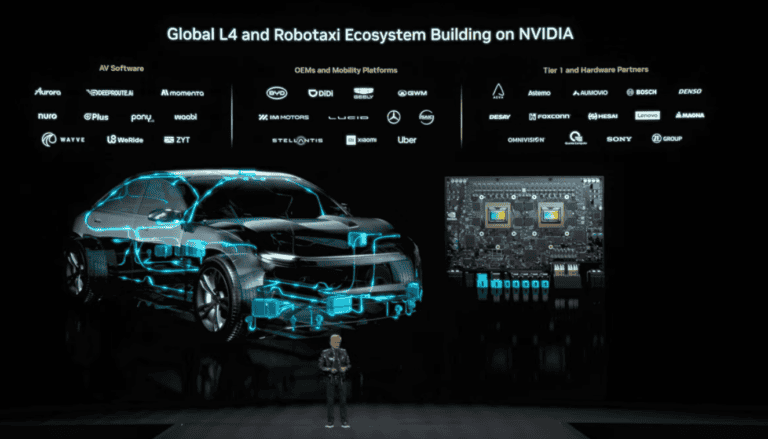
NVIDIA’s Alpamayo is an open “physical AI” framework for autonomous driving that shifts systems from simple object detection to reasoning-based decision-making. Unlike conventional software that mainly relies on pattern recognition and rule-based responses, it is designed to understand context, evaluate complex driving situations, and interpret environments in a more human-like manner.
Instead of reacting only to immediate road conditions such as pedestrians or traffic signals, Alpamayo incorporates scenario planning, contextual awareness, and decision traceability. This allows it to assess multiple possible outcomes before acting, making its driving decisions more explainable, structured, and aligned with real-world complexity.
Against this backdrop, it is important in this article to examine the key qualities of Alpamayo and what sets it apart from existing autonomous driving systems, particularly its reasoning capability, adaptability, and emphasis on transparent decision-making in real-world driving environments.
Understanding Alpamayo
Alpamayo is a research-focused autonomous driving platform developed by NVIDIA that combines three core technologies:
- Vision-Language-Action (VLA) models: These are AI systems that connect visual input (what the vehicle sees), structured reasoning (how it interprets the scene), and actions (such as braking, steering, or accelerating). This allows the system to behave more like a human driver who understands situations rather than just reacting to them.
- Large-scale driving datasets: These are massive collections of real-world driving data gathered from different environments such as cities, highways, and rural roads. They expose the model to diverse traffic patterns, weather conditions, and road behaviours, helping it generalise better.
- Simulation tools (AlpaSim): A high-fidelity virtual environment where autonomous systems can be trained and tested safely. It allows engineers to recreate rare, dangerous, or complex driving scenarios without real-world risk.
Basic Concepts: Reasoning-Based Autonomous Driving
Traditional autonomous systems are mostly reactive-they detect objects and respond. Alpamayo introduces reasoning, meaning it tries to understand why a situation is happening before deciding what to do. Its features include;
- Context-aware scene understanding:
The system does not just identify objects on the road; it interprets the full situation. For example, instead of only detecting a pedestrian, it understands that the pedestrian may behave unpredictably and attempt to cross. - Future outcome prediction:
It evaluates possible consequences before taking action, such as what might happen if the vehicle speeds up, slows down, or changes lanes, helping it choose safer decisions. - Explainable decision-making:
It provides clear reasoning behind its actions, making it easier for engineers and regulators to understand why a particular driving choice was made. - Long-tail event handling:
It is built to handle rare and unusual situations, such as sudden road closures, erratic driving behaviour, or confusing intersections, that often cause failures in traditional autonomous systems.
Key Components of Alpamayo
(a) Alpamayo 1 (Reasoning VLA Model)
This is the core intelligence layer of the system, meaning it is the main AI model responsible for understanding driving situations and deciding how the vehicle should respond.
- It generates driving actions such as steering, braking, and lane changes based on real-time perception, continuously interpreting what is happening on the road and issuing immediate driving commands.
- It also produces reasoning traces that explain why a decision was made (for example, slowing down because a vehicle is braking ahead), making the system’s behaviour more transparent and easier to understand.
- It acts as a “teacher model,” helping train smaller, efficient models that can be deployed in real vehicles, allowing complex reasoning knowledge to be transferred into faster, practical driving systems.
(b) AlpaSim (Simulation and Testing Environment)
This is the simulation and testing environment used to safely evaluate autonomous driving behaviour before real-world deployment.
- It recreates realistic traffic conditions, including congestion, weather changes, and road complexity, so the system can experience a wide range of driving environments in a controlled virtual setting.
- It allows safe testing of dangerous scenarios, such as near-collisions or sudden pedestrian movement, which would be too risky or impractical to test on real roads.
- It helps evaluate system performance before real-world deployment, reducing safety risks by identifying weaknesses and improving reliability before vehicles operate in live traffic.
(c) Physical AI Datasets
These datasets form the learning foundation of the system, providing the real-world experience the AI learns from before deployment in vehicles.
- They include real-world driving data from multiple geographies and environments, such as different countries, cities, highways, weather conditions, and traffic patterns. This helps the system understand how driving behaviour changes across locations.
- They capture rare but critical events essential to safety training, such as sudden accidents, near-collisions, unusual pedestrian behaviour, or unexpected road obstacles. These are important because they are the situations most likely to cause failures in real-world driving.
- They improve the model’s ability to respond to unpredictable and unfamiliar road situations by exposing it to a wide variety of scenarios during training, helping it generalise better when it encounters new conditions.
Key Functionalities of NVIDIA Alpamayo
- Reasoning-based driving decisions
The system evaluates context and potential outcomes before taking action, improving decision quality in complex traffic conditions. - Vision-Language-Action integration
It connects perception, reasoning, and motion planning into a single system that converts understanding into driving behaviour. - Long-tail scenario handling
It is designed to manage rare and unusual driving events that are difficult to capture in traditional training systems. - Simulation-driven training (AlpaSim)
It uses virtual environments to safely replicate and test high-risk driving situations at scale. - Explainable AI decision traces
The system can show step-by-step reasoning behind driving actions, improving transparency and auditability. - Real-world data learning
It continuously improves using large-scale driving datasets collected from diverse real-world environments.
Its Importance for Road Safety
Alpamayo tackles the “long-tail problem”-rare but dangerous driving situations that are hard for autonomous systems to predict or learn from. These include;
- Improving response to unexpected road events: It helps vehicles react more effectively to sudden situations such as emergency braking, abrupt lane changes, or unpredictable drivers.
- Enhancing transparency: It makes the system’s decisions easier to understand, so engineers and regulators can see why the vehicle chose a particular action.
- Strengthening safety validation through simulation: It uses advanced virtual testing to safely recreate risky scenarios before cars are deployed on real roads.
- Increasing trust through explainability: It provides clear reasoning behind driving decisions, making the system more reliable and easier for humans to trust.
Comparison with Other Autonomous Driving Systems
| Feature | NVIDIA Alpamayo | Waymo | Tesla Full Self-Driving (FSD) |
| Core Approach | Reasoning-based AI using Vision-Language-Action models | A hybrid of rules, ML, and HD mapping | End-to-end neural network learning |
| Decision Style | Context-aware reasoning with explainable outputs | Structured and safety-engineered planning | Real-time neural predictions |
| Simulation Use | Heavy use of AlpaSim for scenario testing | Strong closed-course + real-world testing | Large-scale fleet-based learning |
| Transparency | High (provides reasoning traces) | Moderate | Lower (more black-box behaviour) |
| Rare Event Handling | Focused on long-tail reasoning generalisation | Map + redundancy systems | Data-driven continuous improvement |
| Primary Goal | General-purpose reasoning-based physical AI | Safe geofenced autonomy | Scalable consumer autonomy |
Industrial Impact
Alpamayo reflects NVIDIA’s broader push into “physical AI,” where machines are designed not just to perceive the world, but to reason and act within it.
Its impact includes:
- Faster development of safer autonomous driving systems: It speeds up innovation by combining real-world data, AI reasoning, and simulation, allowing engineers to test and refine systems more quickly.
- Reduced reliance on purely reactive AI models: It shifts autonomy away from systems that only respond to what they see, toward ones that understand context and reason before acting.
- Improved testing efficiency through simulation: It allows millions of driving scenarios to be tested virtually, including dangerous edge cases that would be difficult or unsafe to recreate in real life.
- Stronger pathways toward Level 4 autonomous driving capability: It supports progress toward high-level autonomy, in which vehicles can operate independently under defined conditions with minimal or no human intervention.
Concisely, NVIDIA Alpamayo represents a major shift in autonomous driving from systems that simply react to what they see to systems that can understand, reason, and explain their decisions. By combining advanced AI models, real-world datasets, and simulation environments, it aims to significantly improve road safety and accelerate the development of reliable autonomous vehicles.
Related Read:
- AI-Powered Self-Driving Vehicle Trials on UK Roads from 2026
- Qualcomm and Wayve Partner to Accelerate AI-Powered Driver

Senior Reporter/Editor
Bio: Ugochukwu is a freelance journalist and Editor at AIbase.ng, with a strong professional focus on investigative reporting. He holds a degree in Mass Communication and brings extensive experience in news gathering, reporting, and editorial writing. With over a decade of active engagement across diverse news outlets, he contributes in-depth analytical, practical, and expository articles exploring artificial intelligence and its real-world impact. His seasoned newsroom experience and well-established information networks provide AIbase.ng with credible, timely, and high-quality coverage of emerging AI developments.