

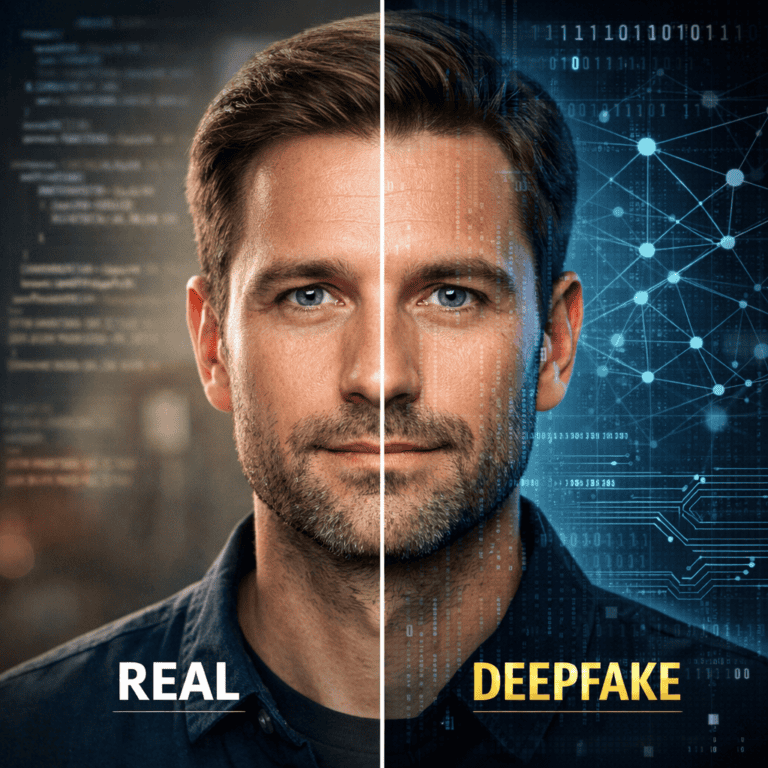
AI deepfakes are highly realistic fake videos, images, or audio created using advanced machine learning. While they offer creative opportunities in entertainment and education, they also pose serious risks when been used with wrong motive, such as misinformation and fraud, making it essential for people to learn how to identify manipulated content.
What Are AI Deepfakes?
AI deepfakes are synthetic media created using techniques like Deep Learning and Generative Adversarial Networks, which learn to mimic a person’s appearance, voice, and mannerisms. Once trained, they can produce content that makes it seem as if someone is saying or doing things they never actually did, often targeting celebrities, politicians, or other public figures.
How Deepfake Technology Works
Deepfake technology typically relies on two AI- driven networks working together. One network generates synthetic content while the other evaluates whether the output looks realistic. Through repeated iterations, the system gradually improves until the generated media becomes difficult to distinguish from real footage.
Modern AI tools can now produce convincing deepfake videos with minimal technical expertise, making the technology widely accessible.
Common Uses of Deepfakes
Deepfakes are not always malicious. In some cases, they serve legitimate purposes:
- Film and entertainment: Actors’ faces can be digitally recreated or de-aged for movies and television.
- Education and historical storytelling: Historical figures can be digitally reconstructed to enhance learning experiences.
- Content creation and marketing: Creators can generate realistic avatars or voiceovers for videos and advertisements.
However, misuse of deepfakes has led to growing concerns.
Risks and Dangers of Deepfakes
Deepfake technology can pose several serious risks:
- Misinformation and political manipulation: Fake videos of leaders or public figures can spread rapidly online, influencing public opinion.
- Fraud and scams: Cybercriminals may use cloned voices or faces to impersonate individuals for financial gain.
- Reputation damage: Manipulated videos can be used to harass or defame individuals.
- Erosion of trust: As deepfakes become more realistic, it becomes harder for people to trust what they see online.
These risks have led governments, technology companies, and researchers to develop and invest in deepfake detection technologies to help identify and prevent manipulated content.
Global Examples of Deepfake Misuse
Misinformation and Political Manipulation (Nancy Pelosi video)
In June 2020, researchers confirmed that a slowed and manipulated version of Nancy Pelosi’s speech was widely circulated online, misleading viewers about her speech patterns (The Washington Post, 2019).
Fraud and Scams (UK energy company CEO voice impersonation)
In September 2019, AI voice cloning was used in a scam targeting a UK energy company, resulting in a transfer of €220,000 after fraudsters impersonated the CEO’s voice; this case was reported in The Wall Street Journal article “Fraudsters Used AI to Clone CEO’s Voice in Unusual Cybercrime Case” published in March 2020.
Reputation Damage (Social media influencer deepfake)
In 2021, several social media influencers reported that deepfake videos of them were circulated without consent, causing harassment and reputational harm before the content was taken down; this was documented in Forbes / Variety in the article “Deepfakes and Harassment: Real Cases of Celebrities Targeted Online” (2021)
Erosion of Trust (Public scepticism toward video content)
Between 2022 and 2023, surveys found a growing public doubt about the authenticity of online videos due to the increasing prevalence of deepfakes; this trend was reported in MIT Technology Review in the article “As Deepfakes Spread, Trust in Video Evidence Falls” (2023).
In Nigeria and other parts of Africa, cases of deepfake misuse abound, underscoring the importance of checkmating the excesses of the perpetrators.
5 Tips to Help You Spot a Deepfake Videos
1. Watch for Facial and Physical Anomalies
- Check for Abnormal Blinking: AI often struggles to replicate natural, frequent blinking. The subject may blink too little, too much, or not at all.
- Look at the Eyes and Mouth: Misaligned eyes, unnatural eye movement, and strange, rigid teeth are common indicators.
- Spot Face-Swap Lines: Look for faint lines around the face, neck, or jawline, where the manipulated face has been blended onto the original body.
- Analyze Hair and Skin: Skin may appear overly smooth, airbrushed, or, conversely, too wrinkly. Hair might look unnatural, blurry, or fail to move realistically with the head.
- Examine Features for Symmetry: Check if ears are uneven, or if one eye is larger than the other.
- Lagging Audio: Often, the mouth movement does not perfectly match the audio, particularly with certain letter sounds like M, B, and P.
- Robotic Voice: The audio may sound flat, robotic, or lack natural emotional inflection, suggesting it was generated from a voice clone.
- Background Noise Issues: If the speaker is in a busy environment (e.g., a city park) but there is no ambient background noise, it is likely a fake.
- Stiff Movements: The head or body might move in an unnaturally rigid way. The face might also move independently of the head.
- Lighting Inconsistencies: Shadows may fall in the wrong direction or fail to change as the person moves. Glare on glasses might not shift, or the skin might be too evenly lit.
- Flickering or Blurring: Look for “melting” or shimmering effects around the edges of the face or background when the subject turns their head.
- Stop and Take a Breath: Deepfakes are designed to stir up strong emotions like anger or fear, which clouds judgment.
- Investigate the Source: Is the video from a reputable, verified account? If the source is unknown, it is highly suspect.
- Find Better Coverage: Search for the same news or event from credible news outlets. If no one else is reporting it, it’s likely a fake.
- Trace the Media: Use reverse image search tools like Google Images or TinEye to find the original context of the video.
- Reverse Search Tools: Platforms like TinEye or InVID can help uncover if the video is a manipulation of old footage.
- Browser Extensions: Tools such as the McAfee Deepfake Detector can analyze videos in real-time, sending alerts if AI-generated audio is detected.
- Specialized Websites: Resources like the “Which Face is Real” game can help train your eyes to spot AI-generated content.
5 Tips to Help You Spot a Deepfake images
- Facial Anomalies: Look for unnatural skin texture (too smooth or waxy), strange wrinkles, or inconsistent, misaligned, or blinking eyes.
- Distorted Details: Examine the ears, teeth, and hair, which are often poorly rendered or inconsistent.
- Lighting and Shadow Issues: Check if the shadows align with the light source. Deepfakes often struggle with consistent, natural lighting.
- Background Glitches: Look for warping, blurring, or inconsistent backgrounds that seem unnatural.
- Context and Source: Verify if the image comes from a reputable source, and use Google Lens or TinEye to find the original context.
How to Verify Suspected Images
- Perform a Reverse Image Search: Use Google Lens, TinEye, or Bing Visual Search to check if the image has appeared elsewhere or to find the original, unmanipulated version.
- Check Fact-Checking Sites: Consult resources like Snopes or Full Fact to see if the image has been flagged.
- Examine Context: Consider whether the source is reliable and if the image seems designed to trigger strong emotions like fear or anger.
Top list of tools to help detect deepfake images or videos
1. DeepFake Check
A free, browser‑based detector for images, videos, and audio.
URL: https://deepfakecheck.com
2. AI Deepfake Detection (Online Free)
Detects deepfake images, videos, and voices with reports.
URL: https://deepfakedetection.ai
3. DetectVideo AI
A video‑focused deepfake checker supporting uploads and URLs.
4. Hive Detect
Detects AI‑generated and deepfake images, videos, and audio.
URL: https://hivemoderation.com/detect
The Future of Deepfake Detection
- Physiological & Biometric Analysis: Future systems like Intel’s FakeCatcher focus on “biological signals” such as heart rate, blood flow changes in the face, and pupil dilation.
- Multimodal Fusion: Detectors are evolving to analyze synchronicity between audio (speech patterns), video (lip movements), and text simultaneously to find subtle cross-modal mismatches.
- Explainable AI (XAI): To be useful in legal settings, future AI must not only flag a fake but provide visual heatmaps or natural language explanations of why it was flagged.
- GAN Fingerprinting: Identifying the unique “digital noise” or artifacts left behind by specific generative architectures (like GANs or Diffusion Models).
- Digital Watermarking: Embedding invisible, tamper-proof metadata at the moment of capture.
- Blockchain Records: Creating immutable ledgers that track a file’s history from the camera to the viewer, ensuring it hasn’t been altered along the way.
- Rapid Removal Rules: India recently enforced a three-hour removal rule for identified harmful deepfakes.
- Expanded Labeling: YouTube is expanding its detection tools to identify and label AI-generated content featuring politicians and journalists.
- Standardized Benchmarks: New global challenges and datasets are being developed to test detectors against real-world, low-resolution “wild” deepfakes rather than perfect laboratory samples.
Must Read Articles:
10 Major AI-Generated Disinformation Incidents
Closing Insights
AI deepfakes are both a groundbreaking technology and a serious digital challenge. While they enable creative storytelling and innovation, they also risk spreading misinformation and deception. Understanding how deepfakes are made and learning to spot them helps individuals become more critical consumers of online content and prevents the spread of manipulated media.

Senior Reporter/Editor
Bio: Ugochukwu is a freelance journalist and Editor at AIbase.ng, with a strong professional focus on investigative reporting. He holds a degree in Mass Communication and brings extensive experience in news gathering, reporting, and editorial writing. With over a decade of active engagement across diverse news outlets, he contributes in-depth analytical, practical, and expository articles exploring artificial intelligence and its real-world impact. His seasoned newsroom experience and well-established information networks provide AIbase.ng with credible, timely, and high-quality coverage of emerging AI developments.