

Project management has long been defined by uncertainty. Deadlines shift, resources tighten, and decisions are often made under sustained pressure. In recent years, intelligent software has moved decisively from theory into daily project tools, becoming embedded in how organisations plan work, allocate resources, anticipate risk, and monitor delivery.
Across global businesses, public institutions, startups, and development-focused organisations, AI delivers clear, measurable value. It analyses patterns across large volumes of tasks, identifies risks early, and automates routine coordination that previously consumed significant management time.
This article explains what AI project management tools are, how they operate in practice, and how leading platforms apply intelligence to real organisational challenges. It also examines their implications for productivity, governance, and employment.
AI in Project Management
AI project management tools are software platforms that use machine learning, data analytics, and automation to support the planning, execution, and monitoring of projects. Unlike traditional project management software, which relies heavily on manual input and fixed rules, AI-enabled systems learn continuously from historical data and ongoing activity.
At a basic level, AI automates repetitive actions such as task assignment, progress updates, and status reporting. At a more advanced level, it can forecast delays, recommend resource adjustments, identify workload imbalances, and surface risks that may not be immediately visible to human managers.
The effectiveness of these tools depends largely on data quality. They draw insights from previous projects, user behaviour, time-tracking records, and communication patterns. As more accurate data flows through the system, predictions and recommendations improve, provided the underlying information is reliable and representative.
Practical Terms
In everyday use, AI project management tools operate largely in the background. A project manager may create a plan in the usual way, while the system continuously analyses dependencies, deadlines, and team capacity. When a task begins to drift, the tool flags the risk early. When a team member is overloaded, it suggests reallocation of work. Where similar projects have struggled in the past, the system highlights comparable risk patterns.
In collaborative environments, AI also supports decision-making by summarising discussions, extracting action points from meetings, and generating progress reports. This reduces administrative burden and allows managers to focus on judgment, leadership, and stakeholder engagement rather than constant manual tracking.
AI Project Management Tools
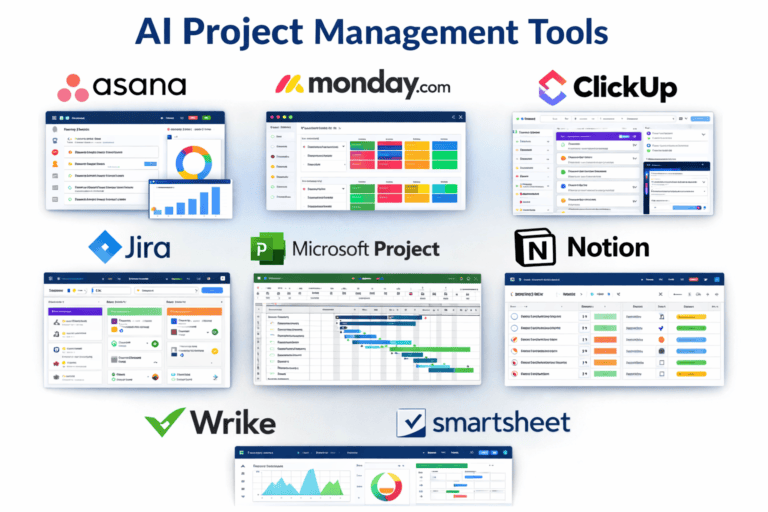
1. Asana
Primary use case
Asana is designed for organisations managing complex, cross-functional projects that require strong coordination and visibility. It is widely used in marketing, product development, operations, and service delivery environments where multiple teams contribute to shared objectives.
Best functionality
Asana’s AI-driven work intelligence analyses task dependencies, deadlines, and workload distribution in real time. It identifies potential blockers before they affect delivery and recommends priority adjustments, enabling managers to move from reactive tracking to proactive intervention without increasing administrative workload.
2. Monday.com
Primary use case
Monday.com is well-suited to organisations running multiple project types simultaneously, often across departments with different workflows. It is commonly adopted by professional services firms, NGOs, and growing enterprises seeking flexibility alongside structure.
Best functionality
Its AI capabilities automate recurring processes, generate predictive timelines, and adapt workflow templates based on historical usage. By learning how teams work over time, the platform reduces setup effort while maintaining consistency and control.
3. ClickUp
Primary use case
ClickUp supports teams that want a single environment for project management, documentation, and collaboration. It is particularly effective in startups, creative agencies, and technology-enabled organisations where speed and frequent context switching are common.
Best functionality
ClickUp’s AI assistant enables task summarisation, content drafting, and intelligent retrieval of project information. This reduces time spent on documentation and status updates while maintaining continuity between planning, execution, and reporting.
4. Atlassian Jira
Primary use case
Jira is purpose-built for software development and technical project environments operating under agile or iterative methodologies. It is widely used by engineering teams managing complex backlogs and frequent releases.
Best functionality
Jira’s AI-driven analytics forecast sprint outcomes, prioritise backlogs, and detect issue patterns that signal delivery risk. Analysing historical and real-time data helps teams improve predictability and maintain development momentum.
5. Microsoft Project
Primary use case
Microsoft Project is most effective in large organisations and public sector institutions that require structured planning, formal governance, and integration with enterprise systems.
Best functionality
Through AI-powered forecasting and scenario modelling, Microsoft Project supports trade-off analysis between cost, time, and scope. Its integration with the wider Microsoft ecosystem enables data-driven reporting and portfolio oversight at scale.
6. Notion
Primary use case
Notion is widely used by research-driven teams, policy units, and knowledge-intensive organisations where projects are closely linked to documentation and institutional memory.
Best functionality
Notion’s AI converts unstructured content into actionable project data using natural language prompts. It generates summaries, extracts tasks, and enables intuitive querying, bridging the gap between thinking, writing, and execution.
7. Wrike
Primary use case
Wrike is designed for enterprise environments managing large volumes of work with strict delivery timelines and compliance requirements. It is frequently adopted in regulated industries and donor-funded programmes.
Best functionality
Wrike’s AI-powered work intelligence highlights delivery risks, detects workload imbalances, and provides portfolio-level performance insights, supporting executive oversight and accountability.
8. Smartsheet
Primary use case
Smartsheet is ideal for organisations transitioning from manual, spreadsheet-based tracking to more structured project management systems, particularly in operations, construction, and programme delivery.
Best functionality
Its AI features enhance forecasting, detect anomalies, and automate reporting while retaining a familiar spreadsheet-style interface, easing adoption and improving analytical depth.
Global View on Adoption
In North America and Europe, AI project management tools are increasingly viewed as core productivity infrastructure. Adoption is driven by remote work, globally distributed teams, and pressure to deliver measurable outcomes. In Asia, particularly within technology hubs, these tools support rapid scaling and agile execution.
Across Africa, adoption is more uneven. While multinational firms and technology startups embrace AI-enabled platforms, many local organisations continue to rely on manual processes. Cost, skills gaps, and data quality remain challenges, although cloud-based pricing and mobile accessibility are gradually lowering barriers.
Relevance in Productivity, Jobs, and Governance
The economic impact of AI project management is largely positive. By reducing inefficiencies and rework, organisations can deliver more with existing resources, an important consideration in capital-constrained environments.
These tools do not remove the need for project managers. Instead, they reshape the role. Routine coordination becomes automated, while human judgment, leadership, and stakeholder management become more important. This shift requires upskilling rather than workforce reduction.
In governance, AI-supported reporting can strengthen transparency, provided systems are used responsibly. Clear accountability frameworks remain essential, particularly in public sector and donor-funded projects.
Limitations
Data quality remains a key constraint. AI systems are only as effective as the information they analyse, and inconsistent record-keeping weakens predictive accuracy. Skills shortages also pose challenges, as successful adoption depends on training, organisational buy-in, and committed leadership.
Cost considerations are equally important. Although subscription models lower entry barriers, long-term affordability remains a concern for smaller organisations and public institutions.
To realise meaningful value, organisations must invest in digital skills and treat data as a strategic asset rather than an administrative task. Leadership must also adopt evidence-based decision-making, using AI insights to strengthen, not replace, human judgment.
Forward-Looking
AI project management tools represent a subtle but significant shift in how work is organised and delivered. They do not promise flawless execution, but they offer improved foresight, coordination, and learning from experience. For organisations prepared to invest in data quality, skills, and thoughtful adoption, these tools can strengthen delivery and accountability.

Senior Reporter/Editor
Bio: Ugochukwu is a freelance journalist and Editor at AIbase.ng, with a strong professional focus on investigative reporting. He holds a degree in Mass Communication and brings extensive experience in news gathering, reporting, and editorial writing. With over a decade of active engagement across diverse news outlets, he contributes in-depth analytical, practical, and expository articles exploring artificial intelligence and its real-world impact. His seasoned newsroom experience and well-established information networks provide AIbase.ng with credible, timely, and high-quality coverage of emerging AI developments.