

From Shared Origins to Diverging Visions
Few developments in contemporary technology have generated as much global attention as the rapid rise of artificial intelligence. At the centre of this transformation sits a small group of technology leaders whose ideas, investments, and disagreements have helped shape the direction of AI research and deployment. Among them, Elon Musk occupies a particularly complex position.
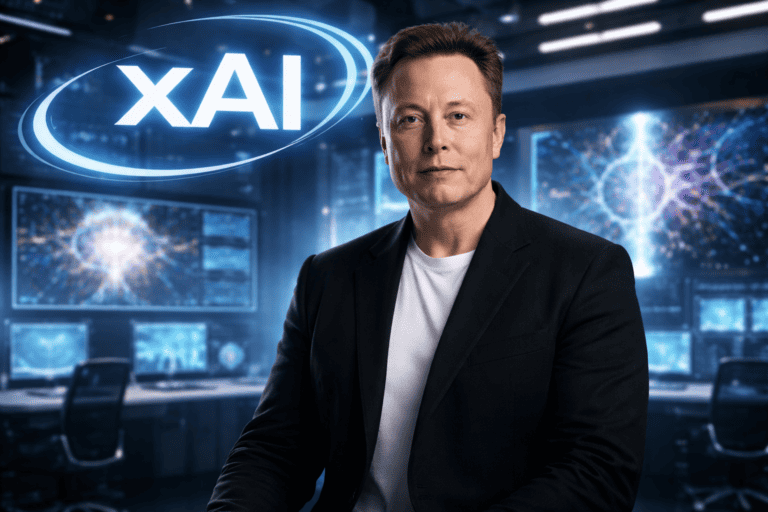
He was a co-founder of OpenAI in 2015, helped fund its early work, publicly warned about the dangers of unregulated AI, and then later became one of its most vocal critics. In 2023, Musk launched a new artificial intelligence company, xAI, marking a decisive break from OpenAI and signalling a different philosophy about how powerful AI systems should be built and governed.
For Nigerian readers, this story is not merely about Silicon Valley rivalries or personal disagreements between billionaires. It raises deeper questions about who controls foundational technologies, whose values shape AI systems, and how countries such as Nigeria can navigate a world in which artificial intelligence increasingly influences education, work, governance, media, and security.
Understanding why Musk built xAI after leaving OpenAI offers insight into broader global debates about AI safety, openness, commercialisation, and power, debates that will inevitably affect Nigeria’s digital future.
This article explains the historical background, ideological tensions, and strategic motivations behind xAI’s creation. It situates these developments within global AI trends while carefully relating them to Nigeria’s economic realities, regulatory environment, and technological ambitions.
The Origins of OpenAI and Musk’s Early Role
OpenAI was founded in December 2015 by a group that included Elon Musk, Sam Altman, Greg Brockman, Ilya Sutskever, and others. At the time, the organisation was established as a non-profit research lab with a stated mission to ensure that artificial general intelligence, AI systems capable of performing most intellectual tasks humans can do, would benefit all of humanity.
Musk’s involvement was shaped by his long-standing concern about existential risks from advanced AI. He had repeatedly warned, in interviews and public forums, that unchecked AI development could pose serious dangers if controlled by a small number of corporations or governments. OpenAI’s non-profit structure was intended to act as a counterbalance to large technology firms such as Google, which Musk feared might dominate AI research without sufficient regard for safety or societal consequences.
In its early years, OpenAI published research openly, released tools to the public, and framed itself as a collaborative scientific institution rather than a conventional technology company. Musk reportedly committed significant funding, though he was not involved in day-to-day operations.
The Break with OpenAI
By 2018, Elon Musk had stepped down from OpenAI’s board. Several factors contributed to this separation. One was a potential conflict of interest: Musk was accelerating Tesla’s internal AI and autonomous driving efforts, which increasingly overlapped with OpenAI’s research domain. Another was disagreement over strategic direction.
As OpenAI’s work advanced, it became clear that cutting-edge AI research required enormous computational resources, specialised hardware, and sustained funding. In 2019, OpenAI created a “capped-profit” subsidiary, enabling it to accept large-scale investment while maintaining its stated mission. Microsoft later emerged as its primary strategic partner, providing cloud infrastructure and billions of dollars in funding.
Musk publicly criticised this shift. He argued that OpenAI had moved away from its original non-profit, open ethos and had become too closely aligned with corporate interests. In his view, the organisation designed to counterbalance Big Tech had effectively become part of it.
While OpenAI maintained that its structure was necessary to fund safe and responsible AI development, the philosophical divide between Musk and OpenAI leadership widened.
Defining xAI: Purpose and Stated Mission
xAI was announced in 2023 as a new artificial intelligence company with a mission “to understand the true nature of the universe”. Although broad and abstract, this framing reflects Musk’s long-standing interest in first-principles thinking and fundamental science.
More concretely, xAI positions itself as an organisation focused on building advanced AI systems that are, in Musk’s words, maximally truth-seeking. This emphasis suggests a reaction against what Musk perceives as ideological bias, content moderation constraints, or opaque decision-making in existing AI systems.
Unlike OpenAI’s original non-profit framing or its later hybrid structure, xAI is openly a private company. It draws talent from leading AI research institutions and works closely with Musk’s other ventures, particularly X, the social media platform formerly known as Twitter.
Philosophical Differences: Control, Openness, and Alignment
At the heart of Musk’s decision to build xAI lie philosophical disagreements about how AI should be governed and aligned with human values.
One point of contention is openness. Musk has repeatedly criticised what he sees as selective openness in AI research, in which models are presented as public-facing tools but remain largely closed with respect to training data, internal safeguards, and commercial incentives. xAI presents itself as a corrective to this, though in practice it also operates within competitive and proprietary constraints.
Another issue is alignment. Musk argues that many AI systems are trained in ways that prioritise safety through restriction, potentially at the expense of accuracy or intellectual honesty. He has described this as a risk to free inquiry. xAI’s framing of itself as truth-oriented reflects this concern, though the challenge of defining “truth” in complex social and political contexts remains unresolved.
These debates are not abstract. They shape how AI systems respond to questions about history, politics, religion, and economics, areas of particular sensitivity in diverse societies like Nigeria.
The Role of X and Data Advantage
One of xAI’s strategic advantages is its close integration with X. Social media platforms generate vast quantities of real-time data reflecting public discourse, cultural trends, and breaking events. Access to such data is valuable for training and refining large language models.
By linking xAI’s development to X’s infrastructure, Musk is attempting to build an AI ecosystem that combines data, distribution, and deployment within a single corporate orbit. This approach contrasts with OpenAI’s reliance on partnerships with cloud providers and enterprise clients.
For countries like Nigeria, where social media platforms play a significant role in news consumption, political mobilisation, and cultural exchange, this raises important questions about representation. Whose voices are captured in these datasets? How are African contexts interpreted by globally trained AI systems?
Global Competition and Geopolitical Context
The creation of AI must also be understood in the context of intensifying global competition for AI leadership. Governments and corporations increasingly see AI as a strategic asset with implications for national security, economic productivity, and geopolitical influence.
The United States, China, and the European Union are investing heavily in AI research and regulation. Private companies operate within this landscape, often aligning their strategies with broader national interests.
Musk has expressed concern that AI development could become overly centralised, either in state-controlled systems or in a handful of dominant firms. xAI can be seen as an attempt to diversify centres of power within the AI ecosystem, though critics argue that it still concentrates influence in the hands of a few individuals.
For Nigeria, which is largely a consumer rather than a producer of frontier AI technologies, these dynamics underscore the importance of understanding the origins of global AI systems and the priorities they reflect.
Practical Differences Between OpenAI and xAI
In practice, OpenAI and xAI differ in structure, partnerships, and deployment strategies. OpenAI operates through a complex relationship with Microsoft, embedding its models in enterprise software, cloud services, and consumer applications. Its focus increasingly includes productisation, safety governance, and regulatory engagement.
xAI, by contrast, is more tightly controlled by Musk and more closely linked to his broader technology vision. Its research and products are integrated into X, and its public messaging emphasises speed, independence, and philosophical clarity.
Neither approach is inherently superior, but they reflect different assumptions about how AI should scale and who should benefit from it.
Related: Microsoft Copilot AI
Implications for Nigeria’s Economy and Workforce
The emergence of competing AI philosophies has practical consequences for Nigeria. AI tools developed by companies such as OpenAI and xAI are already used by Nigerian students, journalists, developers, and entrepreneurs.
Differences in model behaviour, accessibility, pricing, and content handling can influence the extent to which these tools support local innovation. For example, AI systems that poorly understand Nigerian English, indigenous languages, or local institutional contexts may reinforce digital inequality rather than reduce it.
Moreover, as AI reshapes global labour markets, Nigeria faces both opportunity and risk. AI can enhance productivity in sectors such as finance, agriculture, media, and education. At the same time, it may disrupt entry-level jobs or outsourcing models that have traditionally provided employment.
Understanding the motivations behind companies like xAI helps policymakers and educators anticipate how these technologies might evolve and how Nigeria can position itself strategically.
Governance, Regulation, and Nigerian Institutions
Nigeria’s regulatory framework for AI remains in its early stages. Agencies such as the National Information Technology Development Agency have begun articulating principles around data protection, digital innovation, and emerging technologies, but comprehensive AI-specific legislation remains limited.
Global debates between figures such as Musk and organisations such as OpenAI highlight the difficulty of balancing innovation with accountability. For Nigeria, the challenge is compounded by infrastructure gaps, limited research funding, and reliance on foreign platforms.
If AI systems are shaped primarily by external values and priorities, Nigerian regulators may struggle to ensure alignment with local norms, legal standards, and developmental goals.
Cultural Context and Knowledge Representation
AI systems do not merely process information; they encode assumptions about language, relevance, and authority. Musk’s critique of AI bias reflects a broader concern about who defines acceptable knowledge.
For Nigeria, a country with immense linguistic, ethnic, and cultural diversity, representation matters. AI systems trained predominantly on Western data may misinterpret local realities, from informal economies to traditional governance structures.
The rise of xAI and similar initiatives underscores the importance of local data ecosystems and research capacity. Without them, Nigerian perspectives risk remaining marginal in global AI development.
Challenges and Constraints Unique to Nigeria
While global AI debates unfold rapidly, Nigeria faces structural constraints that limit its ability to respond effectively. These include unreliable electricity, high connectivity costs, limited access to advanced computing infrastructure, and brain drain in technical fields.
There is also a gap between policy ambition and implementation capacity. While national strategies often recognise the importance of AI, sustained investment in education, research institutions, and public-sector digital capacity remains uneven.
These constraints mean that Nigeria is more likely to adapt imported AI tools than to shape their design. Understanding the motivations and limitations of companies like xAI, therefore, becomes a matter of strategic literacy rather than mere curiosity.
What Would Meaningful Progress Require?
Meaningful engagement with global AI developments requires more than enthusiasm. It demands deliberate investment in digital literacy, data governance, and institutional capacity.
Nigeria does not need to replicate Silicon Valley models, but it does need to cultivate local expertise capable of critically assessing and adapting AI systems. This includes strengthening universities, supporting applied research, and fostering collaboration between government, academia, and the private sector.
Global debates, such as those that led Musk to build xAI, provide valuable lessons about the consequences of centralisation, misalignment, and opaque governance.
Beyond Personalities to Structural Questions
Elon Musk did not build xAI simply because of personal disagreement with OpenAI’s leadership. He built it because of deeper concerns about control, openness, alignment, and the direction of artificial intelligence as a civilisational force. xAI represents one response to these concerns, shaped by Musk’s worldview, resources, and strategic ambitions.
For Nigerian readers, the significance of this story lies less in choosing sides and more in understanding the structural forces at work. AI is being shaped by a small number of actors operating within specific economic and cultural contexts. Their decisions will influence how knowledge is produced, how work is organised, and how societies govern themselves.
By examining why xAI emerged from the shadow of OpenAI, Nigerians can better appreciate the importance of agency, governance, and local context in the age of artificial intelligence. The future of AI in Nigeria will not be decided in Silicon Valley alone; however, an informed awareness of these global dynamics is an essential starting point.

Senior Reporter/Editor
Bio: Ugochukwu is a freelance journalist and Editor at AIbase.ng, with a strong professional focus on investigative reporting. He holds a degree in Mass Communication and brings extensive experience in news gathering, reporting, and editorial writing. With over a decade of active engagement across diverse news outlets, he contributes in-depth analytical, practical, and expository articles exploring artificial intelligence and its real-world impact. His seasoned newsroom experience and well-established information networks provide AIbase.ng with credible, timely, and high-quality coverage of emerging AI developments.