

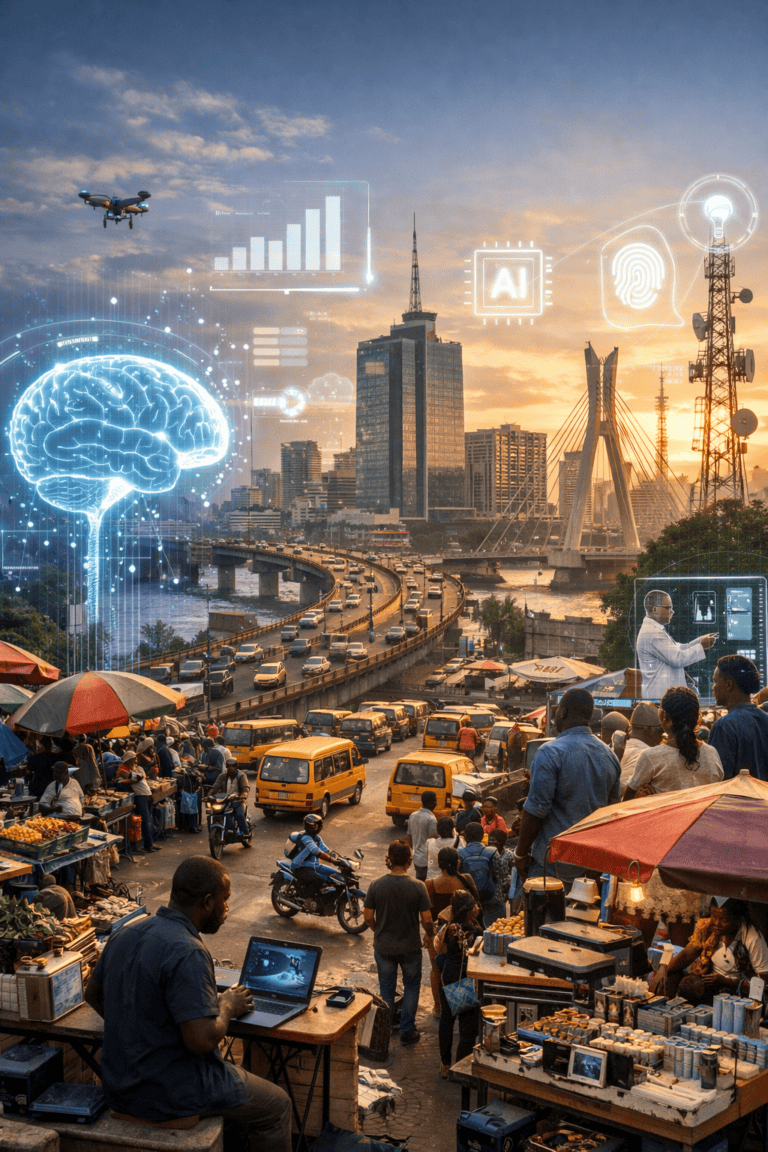
Artificial intelligence is no longer a distant idea discussed only in advanced economies and research laboratories. It is fast becoming the engine that powers modern societies-reshaping how people work, learn, access healthcare, secure their communities, and interact with government. An AI-driven future is one in which machines analyse data, learn from patterns, and support or automate decision-making across critical sectors of life. Across the world, countries are racing to harness this technology. Nigeria, Africa’s most populous nation, is watching closely-and cautiously.
In Nigeria, artificial intelligence is already quietly at work. Banks rely on AI systems to detect fraud and assess credit risk. Educational platforms use intelligent software to personalise learning for students preparing for WAEC, NECO, and JAMB examinations. Healthcare providers are exploring AI-powered diagnostics and telemedicine tools in a system burdened by a severe shortage of doctors. Security agencies increasingly experiment with data-driven surveillance and intelligence gathering. These developments show that Nigeria is not outside the AI conversation. The deeper question, however, is whether the country is prepared to fully participate-or whether it risks being left behind as others move faster.
At the centre of Nigeria’s readiness challenge is digital infrastructure. Artificial intelligence depends on powerful data centres, cloud computing, and high-performance servers. Yet much of the infrastructure supporting AI in Nigeria is located abroad. Local startups, financial institutions, and tech companies rely heavily on foreign cloud providers, raising concerns around cost, data sovereignty, and long-term sustainability. Within the country, digital infrastructure remains unevenly distributed, with major cities enjoying better access while many rural communities remain digitally excluded. This imbalance threatens to create a two-speed nation, one plugged into the digital future, and another left behind.
Compounding this challenge is Nigeria’s long-standing electricity crisis. AI systems require constant and reliable power to operate effectively, but frequent outages force businesses to depend on diesel generators and alternative energy sources. For tech startups and data centres, this dramatically increases operating costs and discourages investment. Public institutions such as schools, hospitals, and government offices-key areas where AI could deliver major benefits-also struggle to adopt intelligent systems in the absence of stable electricity. Without addressing the power problem, Nigeria’s AI ambitions will remain constrained.
Internet access presents another hurdle. While Nigeria boasts millions of internet users, access remains expensive, slow, and uneven. High data costs render AI tools inaccessible to many students, entrepreneurs, and small businesses. Rural and semi-urban communities continue to face poor connectivity, which limits the adoption of AI-powered services in education, agriculture, and healthcare. In an AI-driven world, internet access is not a luxury-it is a prerequisite for participation.
Yet Nigeria’s greatest strength lies in its people. With one of the youngest populations in the world, the country possesses a vast pool of potential talent. Many young Nigerians are already teaching themselves to code, conduct data analysis, and use AI through online platforms and boot camps. However, this energy is not matched by institutional support. Universities are slow to update curricula, dedicated AI degree programmes are scarce, and research infrastructure remains weak. Without structured pathways to nurture talent, Nigeria risks losing its brightest minds to opportunities abroad.
Policy gaps further complicate the picture. Nigeria does not yet have a comprehensive National AI strategy to guide the development, deployment, and regulation of AI. While data protection laws exist, enforcement remains weak, and public awareness is low. This regulatory uncertainty creates risks, from misuse and surveillance to ethical breaches and discrimination. As other regions move ahead with clear AI frameworks, Nigeria risks becoming a rule-taker rather than a rule-maker in a technology that will shape global power and influence.
The imbalance between private- and public-sector leadership is also striking. Banks, fintech firms, telecoms companies, and startups are driving AI adoption for commercial gain, while government institutions lag behind. Weak public-private collaboration means that many promising AI innovations remain confined to corporate use rather than scaled for national impact. Without stronger government leadership, AI growth will continue to be fast but uneven.
These gaps raise a critical concern: economic inequality. AI adoption in Nigeria currently favours urban centres, large companies, and skilled professionals. Without deliberate inclusion, the technology could deepen existing social and economic divides, displacing workers and excluding informal sectors that form the backbone of the economy. However, this outcome is not inevitable.
If harnessed strategically, artificial intelligence offers Nigeria a rare opportunity to leapfrog persistent development challenges. AI-powered learning tools can support overstretched classrooms. Intelligent health systems can extend care to underserved communities. Smart agriculture solutions can boost productivity and strengthen food security. Data-driven governance can improve efficiency, transparency, and service delivery. The greatest impact will come from localised AI solutions designed around Nigerian languages, data, and realities.
To be truly AI-ready, Nigeria must act decisively. This means investing in reliable power and nationwide broadband, reforming education to build AI-relevant skills, developing a clear national AI policy framework, and positioning government as an active enabler rather than a passive observer. Most importantly, inclusion must be central to Nigeria’s AI journey, ensuring that benefits extend beyond elites and urban centres.
Nigeria’s readiness for an AI-driven future is not predetermined. It will be shaped by the choices made today. Artificial intelligence can either widen existing cracks or help bridge them. Whether Nigeria leads, follows, or is left behind will depend not on the speed of technology but on the speed of national responsiveness.

Senior Reporter/Editor
Bio: Ugochukwu is a freelance journalist and Editor at AIbase.ng, with a strong professional focus on investigative reporting. He holds a degree in Mass Communication and brings extensive experience in news gathering, reporting, and editorial writing. With over a decade of active engagement across diverse news outlets, he contributes in-depth analytical, practical, and expository articles exploring artificial intelligence and its real-world impact. His seasoned newsroom experience and well-established information networks provide AIbase.ng with credible, timely, and high-quality coverage of emerging AI developments.