

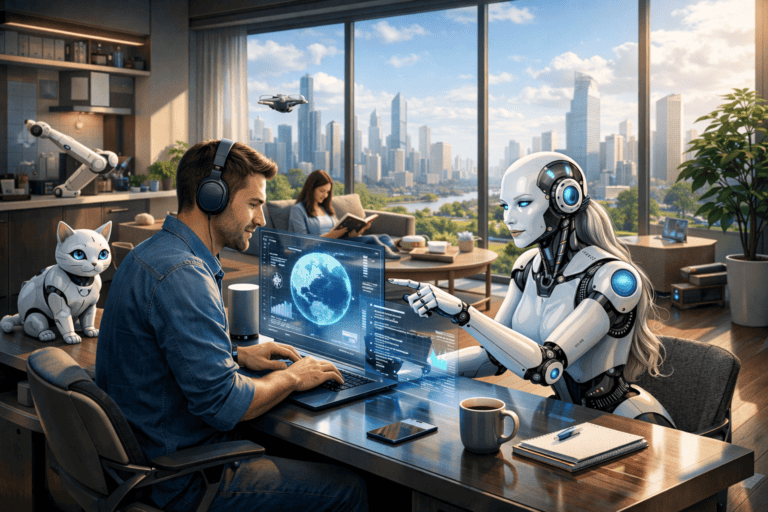
Artificial intelligence is no longer a distant or abstract concept. It is already embedded in how we work, communicate, shop, learn and even relax. From the workplace to our personal devices, AI is quietly redefining everyday life, reshaping productivity, social interaction and decision-making. Understanding how to work with AI — and live responsibly alongside it — has become one of the most important skills of the modern age.
Working With AI: A New Way of Doing Jobs
In today’s workplace, AI is less about replacing humans and more about reshaping how work gets done. Across sectors such as finance, media, healthcare, education, and logistics, AI tools are used to automate repetitive tasks, analyse large volumes of data, and support better decision-making.
For professionals, this means spending less time on routine activities such as scheduling, data entry, and document review, and more time on tasks that require judgment, creativity, and human insight. Journalists use AI to transcribe interviews and analyse datasets, bankers rely on AI to flag suspicious transactions, and HR teams use it to screen applications and improve workforce planning.
AI is also transforming collaboration. Intelligent tools can summarise meetings, track project progress, and recommend more efficient workflows. In healthcare and education, AI supports professionals by providing evidence-based guidance, personalised learning paths, and early warning signals, while leaving final decisions to humans.
The key shift is not the disappearance of jobs, but the evolution of roles. Workers who learn how to use AI as a productivity partner are increasingly better positioned to remain relevant and competitive in a changing job market.

Living With AI: Technology in Everyday Life
Beyond the workplace, AI has become deeply woven into daily life. Smartphones, social media platforms, navigation apps, streaming services and digital banking systems all rely on AI to personalise experiences and make services faster and more accessible.
AI helps people find routes through traffic, recommend music and films, translate languages, detect fraud and even monitor health indicators. For many Africans, especially mobile-first users, AI-powered services have improved access to information, financial inclusion and digital opportunities.
However, living with AI also comes with new responsibilities and concerns. Many AI systems depend on large amounts of personal data, raising important questions about privacy, consent and data security. The same algorithms that personalise content can also amplify misinformation, reinforce bias, or subtly influence public opinion.
As AI shapes what people see, read and interact with online, digital awareness and critical thinking become essential skills. Understanding how algorithms work-and how they can shape behaviour-is now part of modern citizenship.
- Related: AI is creating new job opportunities
Balancing Opportunity and Responsibility
The challenge of working and living with AI is not simply about adoption, but about balance. While AI offers enormous benefits in productivity, efficiency and access, it also demands thoughtful governance, ethical standards and digital literacy.
For organisations, this means using AI transparently, protecting user data and ensuring that technology complements human skills rather than undermines them. For individuals, it means learning how to use AI tools effectively while remaining aware of their limitations and risks.
Governments and institutions also have a role to play-creating policies that encourage innovation while safeguarding rights, promoting skills development and ensuring that AI benefits are shared broadly across society.
Preparing for an AI-Driven Future
Working and living with AI is no longer optional; it is becoming a defining feature of modern life. The societies that thrive in this new era will be those that invest in education, promote ethical use of technology and empower people to work confidently alongside intelligent systems.
Rather than fearing AI, the focus is shifting toward understanding it- how it works, how it affects daily life and how humans can remain firmly in control. In doing so, AI can become not a threat, but a tool for progress, inclusion and sustainable development.
Working and Living with AI from a Nigerian Perspective

Senior Reporter/Editor
Bio: Ugochukwu is a freelance journalist and Editor at AIbase.ng, with a strong professional focus on investigative reporting. He holds a degree in Mass Communication and brings extensive experience in news gathering, reporting, and editorial writing. With over a decade of active engagement across diverse news outlets, he contributes in-depth analytical, practical, and expository articles exploring artificial intelligence and its real-world impact. His seasoned newsroom experience and well-established information networks provide AIbase.ng with credible, timely, and high-quality coverage of emerging AI developments.