
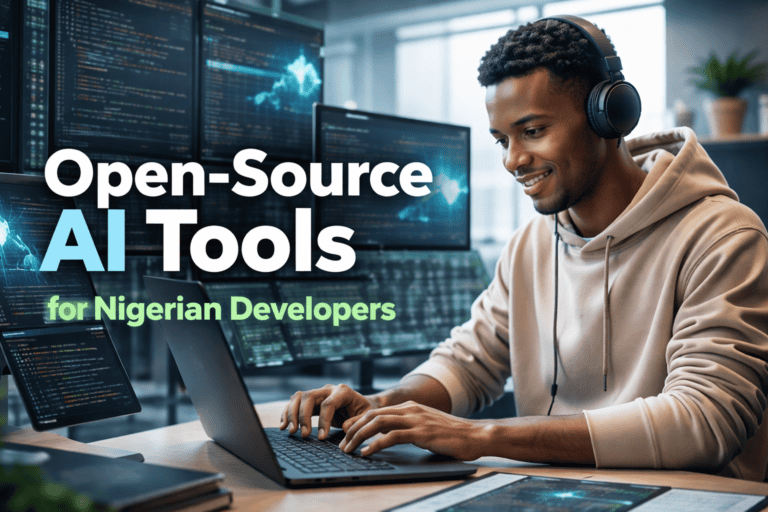
In the era when Artificial Intelligence (AI) continues to expand rapidly and open‑source tools are at the heart of this transformation, especially for developers and startups in Nigeria and across Africa, there is a need for low‑cost, high‑impact resources. This guide highlights the most popular and practical open‑source AI frameworks, libraries and platforms available today, what they’re suitable for, and how you can start using them.
1. TensorFlow – The Most Widely Used AI Framework
🔗 Visit: https://www.tensorflow.org
What it is: TensorFlow is an open‑source ML and deep learning framework by Google that provides flexible tools for building and deploying AI applications.
Best for:
-
Training neural networks
-
Computer vision, speech recognition, and time series analysis
-
Production‑ready AI systems
Why Nigerian startups should care:
-
Backed by a large, open community
-
Works with Android and edge devices for offline AI apps
-
Ideal for scaling from research to production
2. PyTorch – Developer‑Friendly Deep Learning
🔗 Visit: https://pytorch.org
What it is: PyTorch is a dynamic deep learning framework that’s highly popular among researchers and engineers for building neural networks.
Best for:
-
Research experiments
-
Natural language processing (NLP)
-
Computer vision
Features:
-
Intuitive Pythonic API
-
Strong GPU support for faster training
-
Great for prototypes and production deployments
3. Hugging Face Transformers – LLMs Made Easy
🔗 Visit: https://huggingface.co
What it is: A massive open platform providing access to thousands of pre‑trained models for text, code, images and more — all usable via an easy Python API.
Best for:
-
Chatbots and conversational agents
-
Translation and summarisation
-
Text classification and sentiment analysis
Why it stands out:
-
Includes open models (e.g., BLOOM, GPT‑like alternatives and fine‑tunable LLMs)
-
Developers can run models locally or in cloud environments
-
Hugging Face Spaces provides web demos you can customise
4. Keras – Simple API for Deep Learning
🔗 Visit: https://keras.io
What it is: High‑level neural network API that runs on top of TensorFlow, making deep learning fast and easy — especially for beginners.
Best for:
-
Quick prototyping
-
Teaching and experimentation
-
Image and text neural networks
Features:
-
Clean, intuitive syntax
-
Works seamlessly with TensorFlow backend
-
Excellent stepping stone into deep learning
5. Scikit‑Learn – Classic Machine Learning Library
🔗 Visit: https://scikit‑learn.org
What it is: A versatile ML library for Python with tools for classification, regression and clustering.
Best for:
-
Predictive modeling
-
Data preprocessing
-
Baseline models before deep learning
Why use it:
-
No GPU needed – runs on modest hardware
-
Excellent for startups working with structured data
-
A vast range of ready‑to‑use algorithms
6. OpenCV – Computer Vision Made Accessible
🔗 Visit: https://opencv.org
What it is: The most popular open‑source library for computer vision and image processing.
Best for:
-
Object detection (e.g., faces, cars)
-
Agricultural solutions (pest, crop monitoring)
-
Video and webcam processing
Why it’s helpful in Nigeria:
-
Works on low‑cost hardware like Raspberry Pi
-
Ideal for robotics and smart agriculture
7. MindSpore – Easy AI Model Building
🔗 Visit: https://www.mindspore.cn/en
What it is: An open‑source machine learning framework developed by Huawei that supports Python and automatic differentiation.
Use cases:
-
Deep learning research
-
Edge AI on diverse hardware
-
Scalable model development pipelines
Unique feature: Simplifies the creation and optimisation of computational graphs.
8. CatBoost – Categorical Machine Learning
🔗 Visit: https://catboost.ai
What it is: Advanced open‑source library for gradient boosting, particularly effective with categorical features (like customer data).
Best for:
-
Tabular data modelling
-
Predictive analytics
-
Business intelligence AI models
Suitable for developers without huge compute resources.
9. Neural Network Intelligence (NNI) – AutoML Toolkit
🔗 Visit: https://nni.readthedocs.io/
What it does: Automates model selection, hyperparameter tuning and neural architecture search.
Why it matters:
-
Speeds up AI experimentation
-
Helps find the best‑performing model configurations
-
Ideal for startups with limited AI research capacity
10. Horovod – Distributed Deep Learning Training
🔗 Visit: https://github.com/horovod/horovod
What it does: Let’s you scale PyTorch, TensorFlow, and MXNet training across multiple GPUs or machines to accelerate large models.
Why developers use it:
-
Makes training big models affordable
-
Efficient use of compute resources
-
Works well on cloud infrastructure
Bonus Tools and Trends
Stable Diffusion – Open Image Generation
A powerful open‑source model for text‑to‑image generation (image AI).
ONNX Runtime – Cross‑Platform AI Inference
Standardised model format that lets you run AI models across frameworks.
LangChain & LlamaIndex – AI Agents & Retrieval‑Augmented Workflows
Useful for building knowledge agents and connecting LLMs to databases.
Read Also
- Viable AI Startup Business Ideas for Nigerians
- AI is creating new job roles in Nigeria
- AI regulations in Nigeria
- Funding providers for Nigerian AI startups
- Essential AI skills Nigrians need to launch a career in AI
- Artificial Intelligence in Nigerian Agriculture
How to Get Started (Without Big Costs)
For Nigerian Developers:
-
Use Hugging Face Spaces to experiment with models online without hardware costs. Richly AI
-
Run experiments on Kaggle notebooks (free GPUs). Richly AI
-
Combine PyTorch + Transformers to build chatbots or local NLP tools. CipherSense AI
-
Use OpenCV for vision apps that run offline.
Why Open Source Matters for Nigeria
Open‑source AI empowers developers and startups to:
-
Build real products without expensive licenses
-
Customise models to local languages and problems
-
Collaborate with a global community
-
Scale solutions for healthcare, agriculture, finance, and education

AI Writer
Bio: Joseph Michael is an MBA graduate in Marketing from Ladoke Akintola University of Technology and a passionate tech enthusiast. As a professional writer and author at AIbase.ng, he simplifies complex AI concepts, explores digital innovation, and creates practical guides for Nigerian learners and businesses. With a background in marketing and brand communication, Joseph brings clarity, insight, and real-world relevance to every article he writes.