


Current Applications of AI in Nigerian Banking
Customer Service Automation
AI-powered chatbots and virtual assistants have become increasingly common in Nigeria’s banking sector. Major banks have deployed these technologies to handle routine customer inquiries, reducing wait times and improving service delivery. For instance, UBA’s “Leo” chatbot (launched in 2019) and Zenith Bank’s “ZIVA” (launched in 2023) allow customers to check balances, transfer funds, and receive support through conversational AI interfaces on platforms like WhatsApp and web portals.
“AI chatbots in Nigerian banks now handle over 70% of routine customer inquiries, allowing human agents to focus on more complex issues that require empathy and critical thinking.”
These AI assistants operate 24/7, providing instant responses to customer queries without the limitations of traditional banking hours. Implementing natural language processing (NLP) enables these systems to understand and respond to customer inquiries in a conversational manner, creating a more natural interaction experience. This has significantly reduced the burden on call centres and physical branches, allowing human agents to focus on more complex customer needs.
Fraud Detection and Prevention
With digital transactions increasing across Nigeria, banks face growing challenges in detecting and preventing fraud. AI and machine learning algorithms have proven highly effective in identifying suspicious patterns and anomalies in transaction data. According to the Central Bank of Nigeria, fraudulent incidents in Nigeria resulted in a loss of N472 million in Q1 2023 alone, underscoring the critical need for robust security measures.
Benefits of AI Fraud Detection
- Real-time monitoring of thousands of transactions simultaneously
- Ability to detect subtle patterns invisible to human analysts
- Continuous learning from new fraud techniques
- Reduction in false positives compared to rule-based systems
- Significant cost savings from preventing fraud
Challenges in Implementation
- High initial investment in AI infrastructure
- Need for specialised talent to develop and maintain systems
- Data privacy concerns and regulatory compliance
- Integration with legacy banking systems
- Keeping pace with evolving fraud techniques
Nigerian banks like Access Bank and GTBank have implemented advanced AI systems that analyse transaction patterns and flag unusual activities that may indicate fraud. These systems consider various factors, including transaction amount, location, time, and historical user behaviour, to determine risk levels. When suspicious activity is detected, the system can automatically block transactions or trigger additional verification steps, significantly reducing fraud losses.
Credit Scoring and Risk Assessment
Traditional credit scoring methods have limited reach in Nigeria, where a significant portion of the population lacks a formal credit history. AI-based credit scoring models are helping to bridge this gap by analysing alternative data sources to assess creditworthiness. These systems evaluate factors such as mobile phone usage patterns, utility bill payments, and social media activity to create more inclusive credit profiles.
| Data Source | Information Analyzed | Risk Indicators |
| Transaction History | Spending patterns, income stability, cash flow | Irregular income, excessive withdrawals, overdrafts |
| Mobile Phone Data | Call patterns, airtime purchases, and mobile money usage | Frequent SIM changes, erratic usage patterns |
| Utility Payments | Consistency of bill payments, amount variations | Missed payments, irregular payment amounts |
| Digital Footprint | Online behaviour, social media presence | Inconsistencies in reported information |
| Psychometric Data | Responses to specialised questionnaires | Risk tolerance, financial responsibility indicators |
Fintech companies like Carbon and Renmoney are leveraging AI to provide quick, collateral-free loans to consumers and small businesses through mobile apps. These platforms can approve loans within minutes rather than days, dramatically improving access to credit for underserved populations. The integration of machine learning allows these systems to continuously improve their accuracy as they process more data and observe repayment behaviours.
Building Trust Through AI-Enhanced Security and Personalisation
In a country where trust in financial institutions has historically been a challenge, AI is playing a crucial role in building confidence through enhanced security measures and personalised services. Nigerian banks are leveraging AI to create more secure and tailored banking experiences that resonate with customers’ specific needs.
Enhanced Security Protocols
AI-powered biometric authentication systems are revolutionising security in Nigerian banking. Facial recognition, fingerprint scanning, and voice recognition technologies provide more secure alternatives to traditional passwords and PINs. These systems are particularly valuable in Nigeria, where identity theft and account takeover attempts are significant concerns.
Beyond authentication, AI systems continuously monitor account activities to detect unusual patterns that may indicate security breaches. These systems analyse factors such as login locations, device information, and typical usage patterns to identify potential threats. When suspicious activity is detected, additional verification steps are triggered, or accounts may be temporarily frozen to prevent unauthorised access.
Personalised Banking Experiences
AI is enabling Nigerian banks to move away from one-size-fits-all approaches to more personalised service models. By analysing customer data, AI systems can identify patterns in spending, saving, and investment behaviours, allowing banks to offer tailored product recommendations and financial advice. This level of personalisation was previously impossible at scale without AI technologies.
How does AI personalisation benefit Nigerian bank customers?
AI personalisation provides Nigerian customers with relevant product recommendations, customised financial advice, and spending insights based on their unique financial behaviours. This helps customers make better financial decisions, discover suitable banking products they might not have known about, and receive timely alerts about potential issues, such as upcoming bill payments or unusual spending patterns. The technology also enables banks to provide more relevant communication and offers, reducing information overload for customers.
What types of data do Nigerian banks use for AI personalisation?
Nigerian banks utilise various data sources for personalisation, including transaction history, account balances, product usage, demographic information, and interaction data from digital channels. Some advanced systems also incorporate external data (with appropriate permissions), such as social media activity, mobile phone usage, and location data. All data collection and usage must comply with Nigerian data protection regulations, with customer consent being a critical requirement.
How do banks balance personalisation with privacy concerns?
Nigerian banks implement several measures to balance personalisation with privacy, including transparent data policies that clearly explain how customer information is used, opt-in/opt-out options for personalisation features, data anonymisation techniques that protect individual identities while allowing pattern analysis, and strict access controls that limit who can view customer data. Banks also invest in secure infrastructure to protect data from breaches and regularly audit their AI systems to ensure compliance with privacy regulations.
Banks like Guaranty Trust Bank (GTBank) and First Bank of Nigeria are using AI to analyse customer transaction data and provide personalised financial insights through their mobile apps. These insights help customers understand their spending patterns, set budgets, and make more informed financial decisions. By providing value-added services beyond basic banking functions, these institutions are strengthening customer relationships and building trust.
AI-Driven Risk Management Solutions
Risk management is a critical function for Nigerian financial institutions, particularly given the country’s economic volatility and regulatory environment. AI technologies are providing powerful new tools for identifying, assessing, and mitigating various types of risks, from credit default to market fluctuations and operational failures.
AI-powered risk management systems provide real-time insights for Nigerian banks.
Predictive Analytics for Risk Assessment
Nigerian banks are increasingly using AI-powered predictive analytics to forecast potential risks before they materialise. These systems analyse vast amounts of historical and real-time data to identify patterns that may indicate emerging risks. For example, machine learning algorithms can detect early warning signs of loan default by analysing changes in customer behaviour, economic indicators, and market conditions.
Traditional Risk Assessment
- Relies heavily on historical financial data
- Limited to structured data sources
- Manual analysis by risk professionals
- Periodic risk reviews (monthly/quarterly)
- Standardised risk models across customer segments
- Reactive approach to emerging risks
AI-Enhanced Risk Assessment
- Incorporates alternative and real-time data
- Analyses both structured and unstructured data
- Automated analysis with human oversight
- Continuous risk monitoring and assessment
- Personalised risk models for different segments
- Proactive identification of emerging risks
Banks like Stanbic IBTC and Access Bank have implemented AI systems that continuously monitor economic indicators, news events, and market data to assess potential impacts on their loan portfolios and investment positions. These systems can automatically adjust risk ratings and trigger mitigation actions when thresholds are crossed, enabling more proactive risk management.
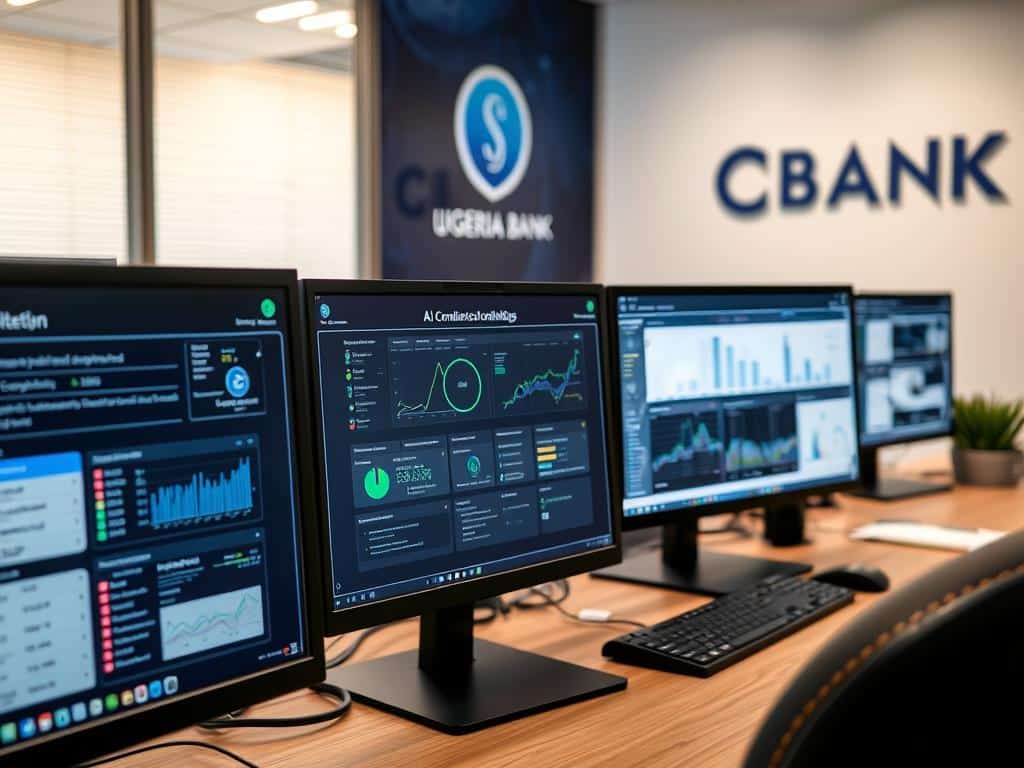
AI compliance monitoring systems help Nigerian banks navigate complex regulations.
Regulatory Compliance and Reporting
Navigating Nigeria’s complex and evolving financial regulations presents significant challenges for banks. AI technologies are helping institutions automate compliance processes, reducing both the risk of regulatory violations and the operational burden of compliance activities. Natural language processing systems can analyse regulatory documents to extract relevant requirements and automatically map them to internal policies and procedures.
“AI-powered compliance systems have reduced our regulatory reporting preparation time by 60% while improving accuracy by 35%. This allows our compliance team to focus on strategic risk management rather than routine documentation.”
AI systems also enhance anti-money laundering (AML) efforts by identifying suspicious transaction patterns that may indicate illicit activities. These systems can analyse complex networks of transactions to detect money laundering schemes that might be invisible to traditional rule-based systems. By reducing false positives and directing human investigators to high-risk cases, AI improves the efficiency and effectiveness of AML programs.
Portfolio Optimisation and Stress Testing
Nigerian banks are using AI to enhance their portfolio management and stress testing capabilities. Machine learning algorithms can analyse historical performance data to identify optimal asset allocations based on risk tolerance, regulatory constraints, and market conditions. These systems can also simulate thousands of potential economic scenarios to assess portfolio resilience under various stress conditions.
| AI Application | Key Benefits | Implementation Status in Nigerian Banks |
| Portfolio Optimization | Improved risk-adjusted returns, dynamic rebalancing | Widely adopted by large banks, emerging in mid-sized institutions |
| Stress Testing | More comprehensive scenario analysis, faster processing | Implemented by top-tier banks, growing adoption |
| Credit Risk Modelling | Higher accuracy, inclusion of alternative data | Widespread adoption across the banking sector |
| Market Risk Analysis | Real-time risk assessment, improved VaR models | Advanced implementation in investment banks |
| Operational Risk Management | Proactive risk identification, process optimisation | Early adoption stage, growing interest |
By leveraging AI for risk management, Nigerian banks are not only reducing potential losses but also optimising their capital allocation. This allows them to maintain appropriate risk levels while maximising returns, ultimately creating more value for shareholders and customers alike.
Value Creation Through AI-Driven Operational Efficiency
Beyond risk management and security, AI is creating significant value for Nigerian financial institutions through operational efficiencies and new revenue opportunities. By automating routine processes and enabling data-driven decision-making, AI is helping banks reduce costs, improve service quality, and develop innovative financial products.
AI automation is transforming back-office operations in Nigerian banks
Process Automation and Efficiency Gains
Nigerian banks are implementing AI-powered robotic process automation (RPA) to streamline back-office operations. These systems can automate repetitive tasks such as data entry, document processing, and reconciliation, reducing processing times and minimising human errors. For example, AI-based document management systems can automatically extract, classify, and validate information from various document types, significantly accelerating processes like loan applications and account openings.
Document Processing
AI systems achieve 92.3% accuracy in document classification and reduce average retrieval time to 3.8 seconds, dramatically improving efficiency in document-intensive processes.
Customer Onboarding
AI-powered KYC processes have reduced customer onboarding time from days to hours, with some digital banks now able to verify identities and open accounts in minutes.
Transaction Processing
Automated transaction reconciliation has reduced processing costs by up to 70% while improving accuracy rates to over 99.5% in leading Nigerian banks.
The efficiency gains from AI automation are substantial. According to industry estimates, Nigerian banks that have implemented AI-driven process automation have reduced operational costs by 15-25% in affected departments while improving processing speeds by 40-60%. These improvements not only reduce expenses but also enhance customer satisfaction through faster service delivery and fewer errors.

AI is enabling innovation in financial product development at Nigerian banks.
New Financial Products and Services
AI is enabling Nigerian banks to develop innovative financial products tailored to the unique needs of different customer segments. By analysing customer data and market trends, banks can identify unmet needs and design products with higher adoption potential. For instance, AI-powered micro-savings platforms analyse spending patterns to automatically set aside small amounts based on individual financial behaviours and goals.
Case Study: AI-Powered Micro-Investment Platform
A leading Nigerian fintech company launched an AI-driven micro-investment platform that analyses users’ transaction data to identify optimal investment opportunities based on their risk profile, financial goals, and market conditions. The platform automatically invests small amounts in diversified portfolios, making investment accessible to customers who previously lacked the knowledge or capital to participate in financial markets. Within 18 months of launch, the platform attracted over 200,000 users and processed more than N5 billion in investments, demonstrating the potential of AI to create inclusive financial products.
Banks are also using AI to develop more sophisticated lending products. For example, some institutions now offer dynamic pricing models that adjust interest rates based on individual risk profiles and market conditions. Others have created flexible repayment plans that adapt to borrowers’ cash flow patterns, reducing default rates while maintaining profitability.
Enhanced Decision-Making and Strategic Planning
AI analytics are transforming how Nigerian banks approach decision-making and strategic planning. Advanced data analysis tools can process vast amounts of structured and unstructured data to identify trends, opportunities, and threats that might be invisible to human analysts. These insights enable more informed decisions about branch locations, product offerings, marketing campaigns, and resource allocation.
AI analytics enhance strategic decision-making in Nigerian financial institutions.
For example, AI systems can analyse demographic data, economic indicators, and competitor activities to identify promising locations for new branches or ATMs. They can also predict the potential impact of economic changes on different business lines, allowing banks to adjust their strategies proactively. By leveraging these capabilities, Nigerian banks are making more data-driven decisions that improve their competitive positioning and financial performance.
Stay updated on AI Analysis and trends in Nigeria.
Join our newsletter to receive the latest updates, news and analysis like this.
Challenges and Considerations for AI Implementation
While the potential benefits of AI in Nigerian banking are substantial, implementing these technologies presents significant challenges. Financial institutions must navigate obstacles across infrastructure, talent, regulation, and cultural factors to deploy AI solutions successfully.
Nigerian banks face technical challenges when integrating AI with existing systems.
Technical Infrastructure and Data Quality
Many Nigerian banks operate legacy systems that were not designed to support AI. Integrating AI solutions with these existing infrastructures often requires significant investment in system upgrades or middleware solutions. Additionally, inconsistent power supply and internet connectivity in some regions can impact the reliability of AI systems that require continuous data processing.
Data Quality Challenges in Nigerian Banking
- Fragmented Data: Information siloed across different departments and systems
- Inconsistent Formats: Varying data structures and naming conventions
- Incomplete Records: Missing or partial customer information
- Manual Processes: Paper-based records and manual data entry errors
- Limited Historical Data: Insufficient historical data for robust model training
Data quality is another critical challenge. AI systems require large volumes of clean, structured data to function effectively. However, many Nigerian banks struggle with data inconsistencies, gaps in historical records, and integration issues across different systems. Addressing these data quality issues is often a necessary first step before implementing advanced AI solutions.
Nigerian banks are investing in AI talent development to address skills gaps.
Talent and Expertise Gaps
The successful implementation of AI requires specialised skills in data science, machine learning, and software engineering. Nigeria faces a shortage of professionals with these capabilities, creating competition for talent among banks and other industries. This talent gap can slow AI adoption and increase implementation costs as institutions compete for limited human resources.
“The most significant barrier to AI adoption in Nigerian banking isn’t technology—it’s finding people who understand both AI and banking well enough to implement meaningful solutions. We need to invest in developing local talent rather than relying solely on international expertise.”
To address this challenge, some Nigerian banks are establishing partnerships with universities and technical institutions to develop AI talent pipelines. Others are investing in training programs to upskill existing employees or creating centres of excellence to concentrate AI expertise within the organisation. These initiatives are crucial for building sustainable AI capabilities within Nigeria’s financial sector.
Regulatory and Ethical Considerations
Nigeria’s regulatory framework for AI in banking is still evolving, creating uncertainty for institutions implementing these technologies. Banks must navigate multiple regulations on data protection, consumer rights, and financial stability when deploying AI solutions. The Central Bank of Nigeria and other regulatory bodies are working to develop guidelines that balance innovation with appropriate safeguards.
Key Regulatory Considerations for AI in Nigerian Banking
- Compliance with the Nigeria Data Protection Regulation (NDPR) for customer data usage
- Ensuring transparency in AI-based decision-making, especially for credit decisions
- Maintaining human oversight of critical AI systems to prevent algorithmic errors
- Implementing robust security measures to protect AI systems from manipulation
- Developing clear accountability frameworks for AI-related decisions and outcomes
Ethical considerations also play an important role in AI implementation. Banks must ensure that their AI systems do not perpetuate biases or discrimination, particularly in credit scoring and lending decisions. This requires careful attention to training data, algorithm design, and ongoing monitoring to identify and address potential biases. Transparency in how AI systems make decisions is also crucial for maintaining customer trust and regulatory compliance.
Customer attitudes toward AI banking services vary across different segments in Nigeria.
Cultural Adoption and Change Management
Implementing AI requires significant cultural and organisational changes within banking institutions. Employees may resist new technologies due to concerns about job security or discomfort with changing work processes. Customers may also be hesitant to trust AI-driven services, particularly in a market where face-to-face banking has traditionally been important.
Internal Adoption Challenges
- Employee concerns about job displacement
- Resistance to changing established workflows
- Lack of understanding about AI capabilities
- Insufficient training on new AI-powered tools
- Organisational silos are preventing collaboration
Customer Adoption Challenges
- Preference for human interaction in banking
- Concerns about data privacy and security
- Limited digital literacy in some segments
- Scepticism about AI decision-making
- Varying access to required technology
Successful AI implementation requires comprehensive change management strategies that address both employee and customer concerns. This includes clear communication about how AI will be used, appropriate training programs, and phased implementation approaches that allow for adjustment and feedback. Banks that effectively manage these cultural aspects of AI adoption are more likely to realise the full benefits of these technologies.
Future Trends and Financial Inclusion Impact
As AI technologies continue to evolve, their impact on Nigeria’s banking sector will expand and deepen. Several emerging trends are likely to shape the future of AI in Nigerian banking, with significant implications for financial inclusion and the broader economy.
Emerging AI technologies will further transform Nigerian banking in the coming years.
Emerging AI Technologies in Banking
Several advanced AI technologies are beginning to enter Nigerian banking, with the potential to create new capabilities and business models. These include:
Generative AI
Generative AI systems, such as large language models, are enabling more sophisticated customer interactions and content creation. Nigerian banks are exploring applications in personalised financial advice, automated report generation, and more natural conversational interfaces.
Explainable AI
As regulatory scrutiny increases, explainable AI technologies that provide transparency into decision-making processes are becoming essential. These systems allow banks to understand and explain how AI reaches specific conclusions, particularly in credit decisions.
Federated Learning
This approach allows AI models to be trained across multiple institutions without sharing sensitive data, addressing privacy concerns while enabling more robust models. Nigerian banks are exploring federated learning for fraud detection and risk assessment.
The integration of AI with other emerging technologies, such as blockchain and the Internet of Things (IoT), is also creating new possibilities. For example, AI-powered smart contracts on blockchain networks could automate complex financial agreements. At the same time, IoT data could enhance credit scoring models by providing real-time insights into business operations and asset utilisation.
- Bank of England Warns of AI Bubble Risk
-
AI Regulations in Nigeria: Current Laws, Draft Policies and What Comes Next
Expanding Financial Inclusion Through AI
Perhaps the most significant potential impact of AI in Nigerian banking is its ability to expand financial inclusion. Nigeria still has a sizable financially excluded population, with over 30 million adults lacking access to formal financial services. AI technologies can help address this challenge in several ways:
| Financial Inclusion Challenge | AI-Powered Solution | Impact Potential |
| Lack of credit history | Alternative data credit scoring | Could extend credit access to 15-20 million previously excluded Nigerians |
| Limited banking infrastructure in rural areas | AI-powered mobile banking and agent networks | Potential to reach 80% of the rural population with basic financial services |
| Financial literacy barriers | Personalised financial education via chatbots | Could improve financial literacy for 25+ million Nigerians |
| High cost of serving low-income customers | Automated, low-cost service delivery | May reduce service costs by 60-70%, making small accounts viable |
| Identity verification challenges | Biometric authentication and digital ID | Could solve identification issues for 40+ million Nigerians |
By leveraging AI to overcome these barriers, Nigerian financial institutions can extend services to previously underserved populations, contributing to broader economic development. Increased financial inclusion enables more Nigerians to save, invest, and access credit, supporting entrepreneurship and economic mobility.
Evolving Regulatory Landscape
As AI becomes more prevalent in Nigerian banking, the regulatory framework will continue to evolve. The Central Bank of Nigeria and other regulatory bodies are likely to develop more specific guidelines for AI implementation, addressing issues such as algorithmic transparency, data protection, and system resilience.
“The future of banking regulation in Nigeria will need to balance innovation with appropriate safeguards. We’re moving toward a risk-based approach that encourages responsible AI adoption while protecting consumers and maintaining financial stability.”
International standards and best practices will influence Nigeria’s regulatory approach, as will the country’s unique economic and social context. Financial institutions that proactively address ethical and regulatory considerations in their AI implementations will be better positioned to navigate this evolving landscape.
A collaborative ecosystem is emerging around AI in Nigerian finance
Collaborative AI Ecosystem
The future of AI in Nigerian banking will likely be characterised by increased collaboration among various stakeholders. Banks, fintech companies, technology providers, regulators, and academic institutions are forming partnerships to address common challenges and accelerate innovation. These collaborative efforts include:
- Open banking initiatives that enable secure data sharing through APIs
- Industry consortia focused on developing shared AI infrastructure and standards
- Public-private partnerships to address financial inclusion challenges
- Academic-industry collaborations to develop local AI talent and research
- Cross-border partnerships to leverage global expertise and technologies
By working together, these stakeholders can overcome the resource constraints and technical challenges that might otherwise limit AI adoption. This collaborative approach will be particularly important for smaller financial institutions that may lack the resources to develop advanced AI capabilities independently.
Conclusion
Artificial intelligence is fundamentally transforming Nigeria’s banking and finance sector, creating new opportunities for efficiency, security, and inclusion. From customer service automation to sophisticated risk management and innovative financial products, AI technologies are reshaping how financial services are delivered and experienced across Africa’s largest economy.
AI will continue to drive innovation and inclusion in Nigeria’s financial sector.
The successful implementation of AI in Nigerian banking requires a balanced approach that addresses technical, organisational, and regulatory challenges while leveraging the country’s unique strengths. Financial institutions must invest in appropriate infrastructure, develop specialised talent, and create cultures that embrace innovation while maintaining focus on customer needs and ethical considerations.
Looking ahead, AI will play an increasingly important role in expanding financial inclusion, managing risks, and creating value in Nigeria’s banking sector. As technologies evolve and adoption increases, we can expect to see more sophisticated applications that further enhance the efficiency, accessibility, and security of financial services. The institutions that successfully navigate this transformation will be well-positioned to thrive in Nigeria’s rapidly evolving economic landscape.

Bio: An (HND, BA, MBA, MSc) is a tech-savvy digital marketing professional, writing on artificial intelligence, digital tools, and emerging technologies. He holds an HND in Marketing, is a Chartered Marketer, earned an MBA in Marketing Management from LAUTECH, a BA in Marketing Management and Web Technologies from York St John University, and an MSc in Social Business and Marketing Management from the University of Salford, Manchester.
He has professional experience across sales, hospitality, healthcare, digital marketing, and business development, and has worked with Sheraton Hotels, A24 Group, and Kendal Nutricare. A skilled editor and web designer, He focuses on simplifying complex technologies and highlighting AI-driven opportunities for businesses and professionals.
LinkedIn