

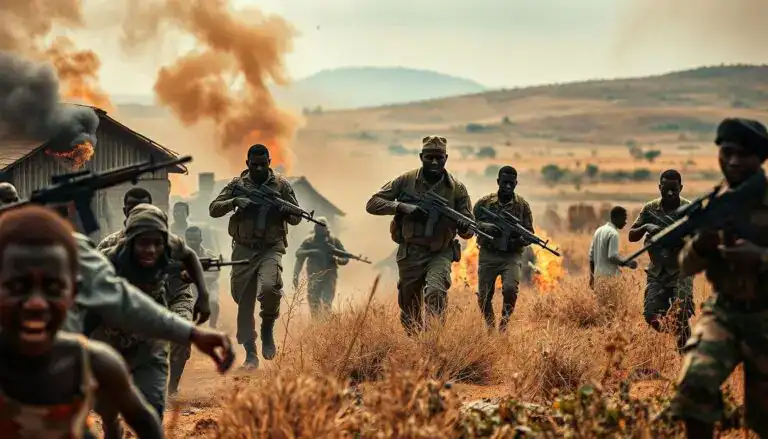
The threat of terrorism is growing in Nigeria. Groups like Boko Haram are causing violence and instability.
Studies show that AI can help significantly in fighting terrorism. It improves the gathering of intelligence, surveillance, and predictive analytics. This boosts Nigeria’s security.
AI is being used in counterinsurgency strategies. It shows promise in fighting terrorist groups. Using AI well can make counter-terrorism operations more effective and focused.
In Nigeria, AI’s role in fighting terrorism is getting more important. It’s key to understand how AI works in real situations. This knowledge helps create strong countermeasures.
The Current Landscape of Terrorism in Nigeria
Terrorism is a big problem in Nigeria, with Boko Haram being a major threat. They attack civilians, causing death and making people leave their homes.
Impact of Terrorism Attacks on Nigeria’s National Security & Economy
-
Terrorism costs Nigeria around 0.82% of GDP per year, according to a 2017 African Development Bank working paper, showing a statistically significant drag on economic growth.
-
Violence more broadly (including terrorism, communal conflicts, kidnappings, etc.) has cost Nigeria US$1.34 trillion over 13 years (2007–2019), per a BusinessDay/Institute for Economics & Peace (IEP) analysis.
-
As of 2021, insecurity and violence are estimated to account for up to 8% of Nigeria’s GDP, or around US$132.6 billion.
-
According to TheCable, in 2020 alone, insecurity (including terrorism and other violence) shaved 2.6% off Nigeria’s GDP, roughly equivalent to US$10.3 billion.
-
Statista reports that the economic cost of terrorism in Nigeria is 2.4% of GDP, and the total impact is estimated at about US$142 billion.
-
Terror attacks also affect human security: Boko Haram and other extremist violence have led to large-scale displacement, school closures, and business shutdowns, disproportionately damaging local economies — especially in the northeast.
-
In Benue State, for example, one recent study showed insecurity drives a 0.21% drop in crop output and 0.31% drop in livestock output for each 1% increase in violence — showing how terrorism undermines agriculture.
-
On the fiscal front, increased terrorism has forced the government to reallocate spending: more is spent on defence, crowding out investment in other areas.
-
Security challenges are also putting upward pressure on poverty: major violence and banditry coincide with rising poverty and reduced investor confidence, making development harder.
Understanding AI Technologies in Security Applications
AI technologies have changed how we fight terrorism. Machine learning, computer vision, and natural language processing are key. They help gather intelligence, monitor areas, and predict threats.
Machine Learning and Predictive Analytics
Machine learning analyses large amounts of data to spot patterns. It can predict when and where terrorists might strike. This lets security teams act before a threat happens.
Computer Vision and Pattern Recognition
Computer vision helps monitor areas and spot unusual behaviour. It can even recognise people by their faces. This is very useful in dangerous places.

Natural Language Processing for Intelligence Gathering
Natural language processing (NLP) analyses large amounts of text. It looks at social media and news to find clues on terrorism. It flags anything that seems off for a closer look.
Together, these AI tools make security teams better at fighting terrorism.
Using AI to Combat Terrorism in Nigeria: Current Implementations
In Nigeria, AI is changing the fight against terrorism. Many initiatives use AI to boost national security.
Government-Led AI Security Initiatives
The Nigerian government is using AI in its fight against terrorism. AI systems help analyse data from different sources. This helps spot possible terrorist threats.
Collaborative International AI Security Projects
Nigeria is working with other countries to improve its AI for fighting terrorism. A key example is the Lake Chad Basin Intelligence Fusion Centre.
Case Study: The Lake Chad Basin Intelligence Fusion Centre
The Lake Chad Basin Intelligence Fusion Centre is a big team effort. It brings together Nigeria and other regional countries. This centre uses AI to combine intelligence from various sources.
The centre’s AI system improves intelligence analysis. This leads to smarter decisions and better resource use in fighting terrorism.
Surveillance and Monitoring Systems Powered by AI
AI is changing how Nigeria fights terrorism. These systems use new tech to spot and stop terrorists. This makes the country safer.
Facial Recognition Technology in High-Risk Areas
Facial recognition technology is used in high-risk areas to identify terrorists. It can check faces fast and alert security teams right away.
Social Media Monitoring for Terrorist Activities
AI also watches social media for signs of terrorism. It analyses large amounts of data to find patterns. This helps security teams act fast.
Drone Surveillance with AI Analytics in the North-East Region
In the North-East, drones with AI help track terrorists. AI makes drone data more useful to security teams. This helps them make smart plans.
These AI systems are making Nigeria safer. They help keep people safe from terrorism.
Predictive Intelligence: Forecasting Terrorist Activities
Predictive intelligence is key to detecting terrorist plots in Nigeria. It uses new tech to stop attacks early. This boosts national safety.
Behavioural Pattern Analysis and Early Warning Systems
Looking at data to find signs of terrorism is called behavioural pattern analysis. Early warning systems then alert security teams. This lets them act fast to stop threats.
Geospatial Mapping and Hotspot Identification
Geospatial mapping helps find areas at risk of terrorism. By studying this data, security teams can focus on key areas. They can then fight terrorist plans more effectively.
Success Stories and Prevented Attacks
A UNODC report shows predictive analytics stops terrorists from recruiting. It has helped stop many attacks. This demonstrates the value of predictive intelligence for Nigeria’s safety.
Challenges in Implementing AI for Counter-Terrorism in Nigeria
Several challenges make it hard to use AI in Nigeria’s fight against terrorism. The country faces many obstacles when trying to use AI for better security. These issues need to be solved to improve national safety.
Infrastructure and Technological Limitations
Nigeria’s IT infrastructure and tech skills are significant hurdles to AI adoption. The lack of robust IT systems and stable internet, particularly in rural areas, makes it challenging to use AI.
Data Quality, Bias and Availability Issues
AI needs good, varied data to work well. But in Nigeria, getting and keeping quality data is hard. This is due to poor data collection and biased data sets.
Training and Expertise Gaps in the Nigerian Security Sector
To use AI in fighting terrorism, you need skilled people. But Nigeria’s security team lacks those with AI knowledge. This gap makes it hard to use AI effectively.
Fixing these problems is key to using AI to boost Nigeria’s fight against terrorism.
Ethical and Legal Considerations in the Nigerian Context
AI in counter-terrorism in Nigeria raises significant ethical and legal issues. The country is using AI to improve security. But it’s important to keep civil liberties safe and follow the law.
Privacy Concerns and Civil Liberties
AI in surveillance raises privacy worries and could harm civil liberties. It’s key to use AI wisely and openly to keep trust.
Regulatory Frameworks for AI in Security Operations
A strong set of rules is needed for AI in security. These rules should cover data protection, AI bias, and how AI makes decisions.
Public Perception and Acceptance of AI Security Measures
How the public sees AI security is very important. Teaching people about AI’s strengths and weaknesses can help build trust and cooperation.
The UNODC symposium report says using AI with human rights in mind is key. This way, AI helps keep us safe while respecting our rights.
Rounding up – The Future of AI in Nigeria’s Counter-Terrorism Efforts
AI is set to change Nigeria’s fight against terrorism. AI tools like machine learning and computer vision can improve how we gather intelligence and watch over areas. They also help predict threats better.
To make AI work well for security, careful planning is needed. Nigeria needs to invest in its tech and consider the ethics and laws of AI use. The government and its international allies must establish robust rules and train experts to use AI for security.
AI could be a game-changer in Nigeria’s fight against terrorism. It can make the country safer and help keep its people safe. But it’s important to use AI wisely, balancing security needs with protecting people’s rights. This way, AI can help without causing harm.

Senior AI Writer
Bio: Okikiola is a writer and AI enthusiast with a background in Office Technology and Management from the Federal Polytechnic Offa. She went further to study an MSc in International Business at De Montfort University (DMU). With extensive work experience across administrative and business roles, she now focuses on exploring how artificial intelligence can transform work, innovation, and everyday life.