


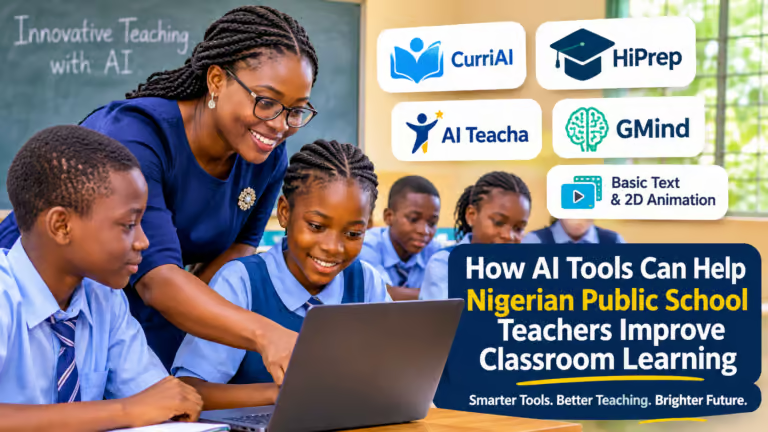
Artificial intelligence and digital learning tools are creating new opportunities for Nigerian teachers to improve lesson preparation, develop classroom materials and support pupils with different learning needs. Platforms such as CurriAI, HiPrep, AI Teacha and GMind offer practical applications that could help public school educators manage some of the demands of teaching while making lessons more interactive.
For many teachers in Nigeria’s public schools, preparing lesson notes, developing assessments, marking exercises, and supporting pupils with different levels of understanding can be demanding. In classrooms with large numbers of learners and limited teaching resources, these responsibilities can leave educators with less time to provide individual attention.
AI-powered educational platforms are designed to assist with some of these tasks. When used appropriately, they can help teachers prepare instructional materials, generate questions, explain difficult concepts and provide additional learning resources.
However, their value depends on how teachers apply them to their subjects, curricula and classroom conditions.
CurriAI: Supporting lesson preparation and assessment
CurriAI, developed by Nigerian education technology company Schoola, is designed to help teachers create lesson plans, class notes and assessments using artificial intelligence.
The platform allows educators to generate teaching materials based on subjects, topics, age groups and learning objectives. Rather than preparing every document from the beginning, a teacher can use the system to produce an initial lesson structure and adapt it to the needs of the class.
For example, a primary school teacher preparing a lesson on the water cycle could use CurriAI to develop learning objectives, explanatory notes, classroom activities and assessment questions. A secondary school teacher could use it to prepare questions on algebra, biology or government.
The platform can also support the preparation of multiple-choice questions and other assessment materials. This may reduce the time teachers spend creating exercises and allow them to devote more attention to explaining topics and monitoring pupils’ progress.
Educators have used Schoola’s tools in different Nigerian learning environments. Teachers interviewed by Guardian Nigeria described using CurriAI to reduce the time spent preparing lesson materials and assessments. One teacher working with out-of-school children in Maiduguri also described how technology-assisted learning activities helped pupils engage with classroom work.
CurriAI therefore offers a practical example of how locally developed educational technology can support teachers working with Nigerian curricula and classroom realities.
HiPrep: Extending learning support beyond the classroom
HiPrep is a Nigerian education technology platform focused on personalised learning support for primary and secondary school pupils.
One of its AI-powered features is Lumi, an AI study companion designed to help children continue learning outside scheduled tutoring sessions. It allows learners to ask academic questions, revise topics, practise exercises and receive guided explanations when they need additional support.
For public school teachers, this type of technology could provide another way to support pupils who struggle to understand particular subjects during classroom lessons.
For instance, after teaching fractions in mathematics, a teacher could encourage pupils to revisit the topic through guided practice and explanations outside school hours. A pupil who needs more time to understand the concept could use an AI study companion to review examples and practise additional questions.
HiPrep’s approach also highlights the potential of combining AI with human teaching support. Its platform uses personalised learning pathways and tutoring support rather than relying exclusively on automated responses.
However, access remains an important consideration. Public school pupils would need suitable devices and connectivity to benefit from online learning services. Teachers and parents would also need to ensure that pupils use AI-generated explanations appropriately.
AI Teacha: Bringing teaching tasks into one platform
AI Teacha is an AI-powered educational platform developed in Nigeria to support teachers with lesson preparation, assessment creation and other classroom responsibilities.
Its tools can generate structured lesson plans, class notes, quizzes, tests and examination questions. The platform also provides features for classroom activities, feedback and student reporting.
For a public school teacher handling several classes, these functions could help reduce the time spent preparing instructional documents and assessment materials.
For example, a Basic Science teacher could use AI Teacha to prepare a lesson on the human digestive system, generate questions to assess pupils’ understanding and develop classroom activities around the topic.
Teachers can also use its content-generation capabilities to prepare presentations and adapt explanations for learners with different levels of understanding.
The platform’s wider range of educational tools could be useful to teachers who want to manage several aspects of their instructional work through a single digital environment.
Nevertheless, generated lesson plans and questions should be reviewed before classroom use. Teachers must ensure that the materials reflect the appropriate curriculum, learning objectives and level of their pupils.
GMind: Developing Nigerian-contextualised teaching resources
GMind AI is associated with efforts to develop AI-powered educational resources for Nigerian teachers. Through its collaboration with the Teachers Registration Council of Nigeria (TRCN), the organisation has been involved in plans to provide educators with contextualised and simulated lesson materials.
The proposed TRCN-GMind platform is designed to incorporate Nigerian history, culture and local realities into teaching resources. Its intended functions include generating lesson plans, providing classroom simulations and differentiating learning materials for pupils with varying abilities.
This is particularly relevant to Nigerian public schools, where teachers may need to explain concepts using examples that pupils can easily relate to.
For example, a teacher explaining agricultural production could use locally relevant examples involving crops, farming practices and food supply in Nigeria. Similarly, lessons on history and civic education could incorporate Nigerian communities, institutions and historical experiences.
The platform’s proposed differentiated resources could also help teachers prepare activities for pupils who require additional support, those working at the expected level and learners who need more challenging exercises.
GMind’s wider teacher-development initiative also seeks to improve educators’ ability to use AI responsibly. Its collaboration with TRCN reflects an effort to make AI adoption part of professional development rather than simply introducing technology without adequate training.
Basic text and 2D animation: Making lessons easier to understand
Beyond AI-powered platforms, basic text production and two-dimensional animation are useful digital skills for teachers.
Basic text tools allow educators to prepare and format lesson notes, worksheets, presentations, classroom instructions and revision materials. Teachers can use these resources to organise information more clearly and provide pupils with materials they can read and revisit.
Two-dimensional animation adds a visual dimension to teaching. Instead of relying entirely on verbal explanations or static diagrams, teachers can create simple animated sequences to demonstrate how processes work.
For example, an animation can show the movement of water through evaporation, condensation and precipitation when teaching the water cycle. In Biology, a teacher could use animated illustrations to explain how blood circulates through the human body. In Mathematics, simple animations can demonstrate how shapes move, how fractions are divided or how geometric transformations work.
These materials can be particularly useful for younger learners and pupils who find abstract concepts difficult to understand through text alone.
One example of software used for educational animation is Plotagon, which enables users to create animated scenes and characters. It has been introduced in educator training contexts as a way to produce lessons without requiring advanced animation skills.
However, animation does not automatically make a lesson effective. Teachers still need to ensure that the visuals are accurate, age-appropriate and connected to the subject being taught.
Other digital tools: Supporting classroom organisation and learning
Other digital tools can complement AI platforms by helping teachers organise their work, present information and assess pupils.
Presentation software can be used to prepare visual lessons, while digital quiz platforms allow teachers to test pupils’ understanding through interactive questions. Audio and video tools can help educators develop supplementary learning materials, and digital document tools can simplify the preparation and distribution of worksheets and notes.
Teachers can also use online learning platforms to share resources, communicate assignments and organise learning activities where internet access and school infrastructure permit.
Not all of these tools use artificial intelligence. Their importance lies in how they complement AI-powered applications and help teachers build a more organised digital learning environment.
The importance of responsible use in public schools
Although AI tools offer practical benefits, their use in Nigerian public schools must account for challenges such as unreliable internet access, limited access to computers and smartphones, electricity supply, and the cost of subscriptions.
Teachers should therefore prioritise tools that are affordable, easy to use and appropriate for the resources available in their schools. Where internet access is limited, downloadable materials and offline teaching resources may provide more practical alternatives.
Accuracy is another important consideration. AI systems can generate incorrect information, misleading explanations or assessment questions that do not reflect the prescribed curriculum. Teachers must check generated materials before sharing them with pupils.
Children’s privacy must also be protected. Teachers should avoid entering pupils’ sensitive personal information into AI platforms unless the necessary safeguards and permissions are in place.
Most importantly, AI should support rather than replace the teacher. Educators remain responsible for understanding their pupils, explaining difficult subjects, encouraging curiosity and providing the human guidance that technology cannot fully reproduce.
For Nigeria’s public education system, the opportunity is not simply to introduce more digital applications into classrooms. It is to equip teachers with the knowledge and resources to use technology in ways that address real educational challenges.
CurriAI, HiPrep, AI Teacha, GMind, basic text production and 2D animation demonstrate different ways technology can contribute to lesson preparation, personalised learning, assessment and classroom engagement. Their long-term value will depend on whether teachers can use them consistently, responsibly and within the realities of the schools where they work.
