


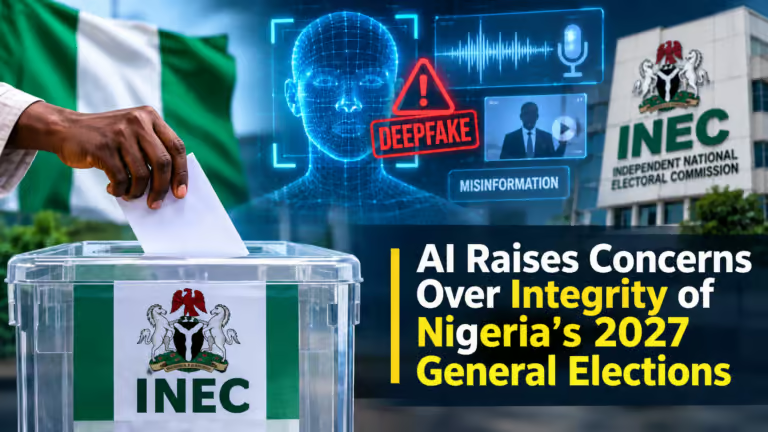
The growing use of artificial intelligence (AI) in political campaigns has raised concerns about the potential spread of disinformation and its implications for the integrity of Nigeria’s 2027 general elections.
At a National Summit on Electoral Information Strategy in Abuja, stakeholders warned that AI tools capable of producing fabricated audio recordings, realistic videos and coordinated online misinformation could be exploited to manipulate public opinion, suppress voters and undermine confidence in democratic institutions.
The summit was held with financial support from the European Union and organised by the International Press Centre, the Centre for Media and Society, the International Institute for Democracy and Electoral Assistance, and Development Alternatives Incorporated.
Among the participants were the Chairman of the Independent National Electoral Commission (INEC), Professor Joash Amupitan; former INEC chairman Professor Attahiru Jega, who chaired the two-day event; the European Union Ambassador to Nigeria and ECOWAS; a representative of the Minister of Information; representatives of the National Assembly and political parties; as well as non-governmental organisations, academics, fact-checkers, media practitioners and members of the public.
The discussions followed remarks by Bayo Onanuga, Special Adviser to the President on Information and Strategy, at the 7th World Media Summit in China, where he spoke about AI’s growing influence on Nigeria’s electoral environment.
Onanuga observed that AI had become a powerful tool in political contests ahead of the 2027 general elections, with political actors and their supporters using it for different purposes. He noted that some use the technology to spread false information, while others employ it for satire or to highlight candidates’ achievements.
At the Abuja summit, Professor Amupitan warned that the growing use of AI tools capable of generating fabricated audio recordings, realistic videos, and coordinated online misinformation threatens the integrity of the approaching elections.
Professor Abigail Ogwezzy-Ndisika of the University of Lagos Faculty of Communication and Media Studies delivered a keynote address titled *Beyond the Ballot: Architectural Resilience & Generative AI*.
She argued that AI had made it increasingly difficult to distinguish authentic electoral information from fabricated content, creating opportunities for political actors and foreign news networks to manipulate public opinion, suppress voters and undermine democratic institutions.
Ogwezzy-Ndisika identified several potential threats ahead of the 2027 elections, including false announcements about election postponements and candidate withdrawals, altered polling unit locations, manipulated videos of political candidates, voice cloning and coordinated cyber-enabled voter suppression.
To address these risks, she proposed a five-fold framework incorporating intelligence monitoring of harmful AI use, incident response and risk assessment, emergency verification, strategic coordination, rapid counter-information campaigns, and post-election documentation and evaluation.
She also cautioned that efforts to combat disinformation must not involve unlawful surveillance, intimidation or censorship, or violate constitutional rights, freedom of expression and data privacy.
The summit’s communiqué acknowledged that AI could also benefit electoral administration. It identified opportunities to improve voter registration, electoral logistics, data management, information accessibility and administrative efficiency.
However, it warned that generative AI had made it easier to produce convincing deepfakes, cloned voices, fabricated documents and manipulated electoral information capable of misleading citizens and discrediting electoral institutions.
- Related:
- INEC Collaborates with Google on AI and Election Integrity Ahead of 2027
- Stakeholders Call for Safeguards Against AI Election Manipulation
- INEC Warns AI Disinformation Could Undermine Credibility of Nigeria’s 2027 General Election
- Assessing the Threat of AI Misuse to Nigeria’s Electoral Integrity
The communiqué stressed that election integrity depended not only on credible voting and result-management processes but also on the accuracy and reliability of information available to citizens before, during and after elections. It noted that false information could undermine electoral legitimacy even when the physical voting process remained unaffected.
It also identified the increasing circulation of false political claims, fabricated announcements, manipulated photographs and videos, and unofficial election results as significant challenges to voter confidence, public participation and institutional credibility.
Drawing on the experience of the 2023 general elections, the communiqué highlighted how quickly fabricated information could spread across digital platforms.
Among its recommendations were strengthening INEC’s information management and verification systems, establishing rapid-response mechanisms to verify and communicate electoral information, and improving the regulation and accountability of the commission’s digital platforms.
It also called for collaboration among government institutions, telecommunications companies and security agencies to strengthen critical telecommunications infrastructure. Social media influencers and content creators were urged to exercise caution and restraint when sharing information.
The communiqué further emphasised the responsibility of the Presidency, INEC, political actors and the media to avoid the reckless use of digital technology in ways that could disrupt the electoral process and intensify political tensions. It also called on members of the public, particularly young people, to refrain from malicious uses of AI.
As Nigeria approaches the 2027 general elections, the discussions highlight the importance of reliable electoral information alongside the credibility of the voting process. The ability of electoral institutions, media organisations and citizens to identify and respond to fabricated content will be an important part of addressing the challenges posed by AI in the country’s democratic process.
