

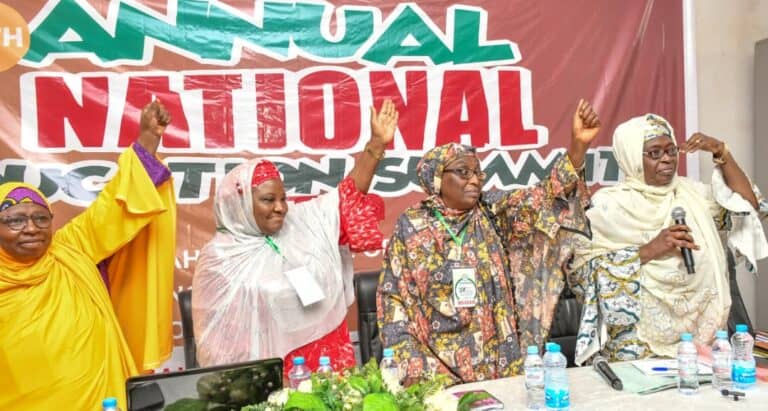
The Kwara State chapter of the Federation of Muslim Women’s Associations in Nigeria (FOMWAN) has intensified efforts to promote artificial intelligence (AI) literacy among educators, traders, and community leaders following the organisation’s 24th Annual National Education Summit, which focused on the theme, “The Ummah in the Age of Artificial Intelligence (AI): Challenges, Opportunities and Responsibilities.”
To extend the summit’s resolutions to local communities, FOMWAN Kwara organised a step-down workshop in Ilorin, bringing practical AI training directly to teachers, traders, women leaders, and other stakeholders. The initiative aimed to equip participants with basic knowledge of AI tools and their potential applications in education, business, communication, and everyday life.
The workshop was delivered in partnership with the Brain Builders Youth Development Initiative (BBYDI), which provided technical support and hands-on training using accessible AI platforms, including Meta AI.
The event reflects growing awareness of the need to prepare communities for a future increasingly shaped by artificial intelligence. Across sectors, AI is transforming how people work, learn, communicate, and access information, creating both opportunities and challenges.
In its post-summit communiqué, FOMWAN’s national leadership highlighted the importance of ensuring that Muslim communities are not left behind in the ongoing digital transformation.
“While AI offers significant opportunities for education, entrepreneurship and Islamic propagation (Da’wah), many Muslims, particularly in rural areas, lack the infrastructure and digital skills to benefit from it, a gap that could deepen without urgent intervention,” the communiqué stated.
Related:
- Nigeria Police Embraces AI at Landmark Leadership Workshop
- Kwara AI Summit 2025 Delivers High-Level Talks on Nigeria’s AI Future
The organisation called for increased investment in digital literacy, infrastructure, and ethical frameworks to support responsible AI adoption while ensuring broader access to emerging technologies.
At the Ilorin workshop, facilitators emphasised that while AI can be a powerful tool for productivity and learning, users must understand its limitations and verify information obtained through AI systems.
“AI will answer a question with full confidence, whether it is right or wrong. It is a useful tool, not the last word, and anything that matters should be checked against a source you trust,” a facilitator told participants.
Participants were trained on how AI can assist with research, lesson planning, content creation, communication, business operations, and problem-solving. Organisers said the training was designed to demystify artificial intelligence and make it accessible to people who may have limited exposure to digital technologies.
The initiative aligns with broader efforts by the Kwara State Government to strengthen digital literacy and promote AI adoption within the education sector.
Speaking during a recent AI training programme for teachers, the Commissioner for Education and Human Capital Development, Dr Adetola Olohungbebe, urged educators to embrace innovation and rethink traditional approaches to teaching and learning.
“Let today be the beginning of a new chapter, one where Kwara classrooms become hubs of innovation, inclusion and inspiration. AI integration goes beyond technical skills and involves re-imagining knowledge delivery,” Olohungbebe said.
The state government has increasingly supported programmes aimed at preparing teachers and students for a technology-driven future through digital skills development and emerging technology training.
Governor AbdulRahman AbdulRazaq has also advocated greater collaboration among governments, researchers, investors, and innovators to accelerate the responsible deployment of AI solutions across critical sectors.
Represented by his Special Adviser, Saadu Salau, at a recent technology forum, the governor said: “We invite researchers, investors, and innovators to work with governments in piloting and scaling AI and digital solutions in agriculture, health, education, and governance.”
Stakeholders at the FOMWAN workshop noted that AI presents significant opportunities for improving access to education, supporting entrepreneurship, and driving economic development. However, they stressed that digital literacy and ethical awareness must accompany technological adoption to prevent misinformation, misuse, and exclusion.
For FOMWAN, the conversation around AI extends beyond technology itself. The organisation believes communities must be equipped with the skills and knowledge needed to navigate emerging technologies while upholding ethical values and social responsibility.
The summit and subsequent community training underscore a growing consensus that AI literacy is becoming an essential skill in the modern world. Through initiatives such as the Ilorin workshop, FOMWAN hopes to ensure that more Nigerians, particularly women, educators, and grassroots communities, are prepared to benefit from the opportunities created by artificial intelligence rather than being left behind.

Senior Reporter/Editor
Bio: Ugochukwu is a freelance journalist and Editor at AIbase.ng, with a strong professional focus on investigative reporting. He holds a degree in Mass Communication and brings extensive experience in news gathering, reporting, and editorial writing. With over a decade of active engagement across diverse news outlets, he contributes in-depth analytical, practical, and expository articles exploring artificial intelligence and its real-world impact. His seasoned newsroom experience and well-established information networks provide AIbase.ng with credible, timely, and high-quality coverage of emerging AI developments.