


What Is Artificial Intelligence? From Expert Systems to Generative AI
Artificial intelligence refers to computer systems designed to perform tasks that normally require human intelligence – perceiving images, understanding speech, learning from experience, and making decisions. Rather than replicating the human brain cell by cell, AI is defined by functional capability: if the task requires intelligence when done by a person, and a machine can do it, that’s AI.
Several core technologies sit under the AI umbrella. Machine learning uses algorithms that learn patterns from data rather than following hard-coded rules. Deep learning, a subset of machine learning, layers artificial neural networks to handle unstructured data like images, audio, and text. Natural language processing enables machines to understand, generate, and translate human language. Computer vision allows systems to interpret visual inputs such as photos, video feeds, and medical scans. AI can analyse large datasets to recognise patterns with unmatched speed, and it can rapidly process massive amounts of unstructured data to uncover hidden patterns and trends.
The field’s history stretches back to 1950, when Alan Turing published “Computing Machinery and Intelligence.” Expert systems emerged in the 1980s as rule-based tools encoding specialist knowledge for narrow AI tasks. Deep learning breakthroughs around 2012 – notably the AlexNet model for image classification – reignited interest, and by 2022–2023, large language models brought generative AI into mainstream awareness. Modern AI systems learn from big data instead of being explicitly programmed step by step: they ingest vast amounts of labelled or semi-labelled information, detect patterns, adjust internal parameters, and generalise to new inputs. This is the computer science foundation on which every advantage discussed below is built.
Why the Advantages of Artificial Intelligence Matter in 2026
Between 2016 and 2026, artificial intelligence moved from academic research labs into the tools billions of people use daily. Voice-powered virtual assistants, ChatGPT-style generative AI tools, recommendation engines on streaming platforms, and semi-autonomous features in cars all became mainstream within a single decade. That shift wasn’t gradual – it accelerated sharply after 2022 when large language models brought AI into everyday life for consumers and professionals alike.
This article focuses primarily on the advantages of artificial intelligence, while acknowledging that advantages and disadvantages must be balanced for responsible adoption. You already interact with AI technology more often than you might realise: spam filters scanning your inbox, Google Translate converting languages in real time, Netflix and YouTube surfacing content you’re likely to enjoy, and fraud alerts from your bank catching suspicious charges before you do. Artificial intelligence drives innovation across industries by delivering massive gains in speed, accuracy, and efficiency. AI enhances productivity, driving economic growth across industries – and according to PwC estimates, AI could contribute $15.7 trillion to the global economy by 2030.
In the sections that follow, we’ll define what AI actually is, break down the key advantages for organisations and consumers, walk through sector-specific use cases, and briefly address the risks worth watching.

Core Benefits of Artificial Intelligence for Organisations
Most measurable benefits of artificial intelligence in companies fall into four clusters: productivity gains through process automation, cost reduction via resource optimisation, better decision making through data analysis, and improved risk management, including quality control. AI enhances efficiency, enables personalisation, and accelerates innovation in business operations. Let’s look at each.
Productivity and process automation. AI can automate routine tasks, increasing productivity across departments. Think invoice processing, email routing, report generation, scheduling, and data entry – AI algorithms handle these repetitive tasks faster and with fewer mistakes than manual workflows. AI can process information faster than humans, enhancing productivity, which means organisations can increase throughput without proportional headcount growth. Automating repetitive tasks frees human workers to focus on creative tasks and more complex tasks that require human emotion, judgment, or relationship-building.
Cost reduction and resource optimisation. AI can reduce operational costs by streamlining processes in logistics, energy management, and maintenance. AI drives smart automation through robotics, optimises inventory management, and predicts maintenance needs. AI can help optimise supply chains and manage inventory effectively – a critical advantage in manufacturing and retail. One documented case showed a mid-size manufacturer reducing unplanned downtime by 67% and saving roughly $4.1 million in the first year after deploying predictive maintenance powered by machine learning algorithms.
Data analysis and decision support. AI models scan millions of records – transactions, sensor logs, customer interactions – in seconds, surfacing patterns human analysts would miss. AI can analyse vast data to uncover patterns for efficiency across existing processes and internal processes.
Risk reduction and quality control. AI minimises the risk of human error, fatigue, or emotional distraction, particularly in precision-based fields. In manufacturing, computer vision inspects products on the line for defects. In cybersecurity, anomaly detection flags threats in real time. Many AI applications in quality control drive error rates from double digits into single digits during pilot deployments.
It’s worth noting that AI integration yields operational benefits but presents challenges like high implementation costs and data privacy risks – a point we’ll return to later.
Advantages of Artificial Intelligence in Decision Making and Data Analysis
One of the biggest benefits of artificial intelligence is turning big data into actionable insights at a speed no human team can match. Machine learning models can scan millions of transactions, sensor readings, or customer interactions in seconds, delivering the kind of data analysis that used to take analysts weeks.
AI identifies hidden correlations in data for better decisions – combinations of variables that predict churn, flag fraud, or signal demand shifts. AI provides informed recommendations to enhance decision-making, and it can predict potential outcomes based on historical data, giving business leaders a forward-looking view rather than a rearview mirror. For example, a retailer might use AI tools to combine historical data on sales with weather forecasts, holiday calendars, and local events to optimise stock levels ahead of Black Friday or Ramadan, avoiding both stockouts and excess inventory. AI enables faster decision-making in business environments where timing is a competitive advantage.
Decision support systems can go further – recommending dynamic pricing adjustments, targeted promotions for micro-segments, or alerts when KPIs deviate from plan – while leaving final judgment to human managers. This is where human intervention remains critical: good data governance, regular retraining of training data pipelines, bias evaluation, and clear feedback loops keep AI-driven decision-making accurate and fair over time.
Productivity, Automation, and Cost Reduction Through AI Systems
AI systems automate both simple and complex workflows, boosting operational efficiency and enabling meaningful cost reduction across industries. The range of task automation is broad – from document classification and data entry to invoice matching, scheduling, and handling basic customer inquiries. These are often the first places organisations see ROI because the work is well-defined and high-volume.
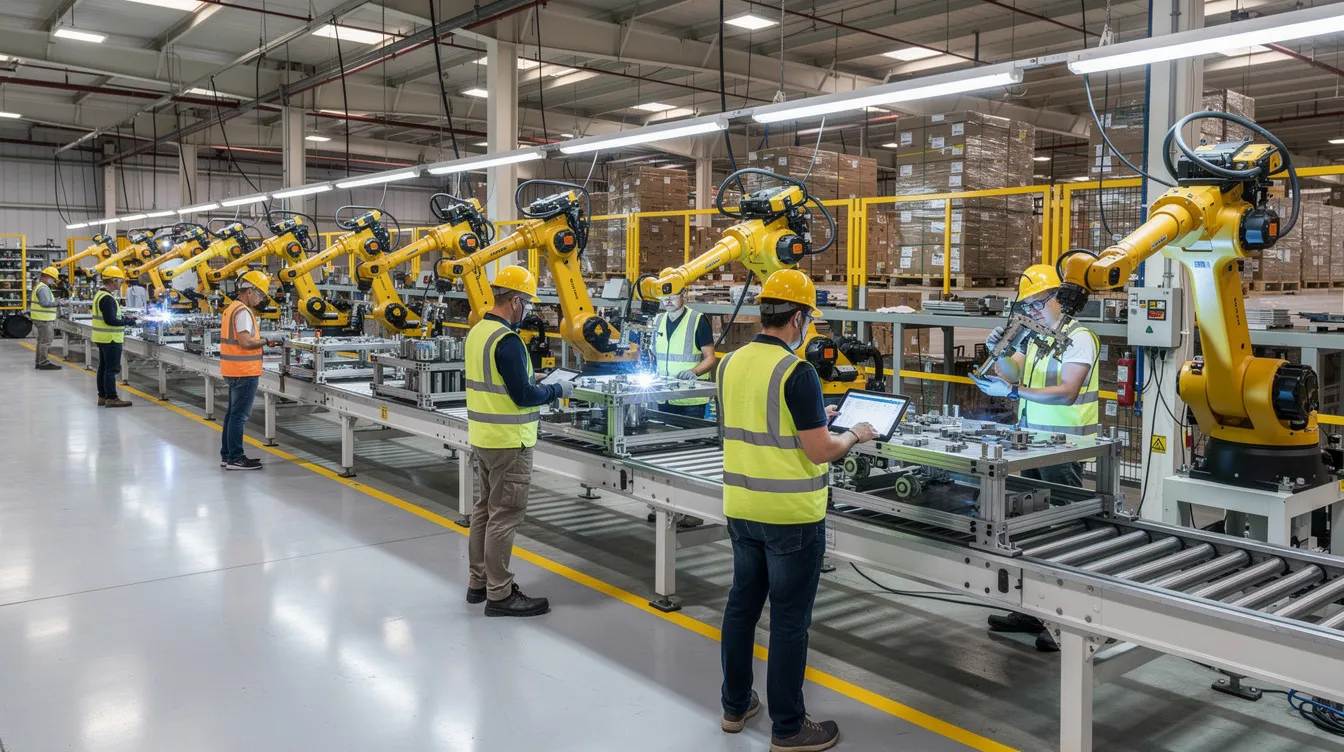
In manufacturing, warehousing, and logistics, AI-powered robots and cobots (collaborative robots) handle picking, packing, sorting, and inspection. Automated picking systems have been standard in large warehouses since around 2018, and their accuracy and speed continue to improve. AI tools can also reduce research and development time and costs, and AI can assist in designing new materials and discovering drugs – expanding automation’s reach well beyond the factory floor into labs and R&D centres.
The cost savings from predictive maintenance alone are dramatic. Consider a concrete scenario: a mid-sized manufacturer deploys IoT sensors on critical equipment and uses machine learning to predict failure 24–48 hours in advance. One case study documented a 70% reduction in equipment failures, a 45% drop in maintenance costs, and $4.2 million in annual savings across 2,500 machines. A separate case at an FMCG beverage company achieved 45% reductions in unplanned downtime and $15 million in annual savings across eight facilities.
- Read also: Reasons Why AI Benefits Nigeria
Importantly, automation doesn’t only replace tedious tasks and repetitive jobs. It frees employees to focus on strategic, creative, or relationship-driven work – the kind of work that requires human intelligence and human emotion. When AI programs handle the routine tasks, human resources can be redirected toward innovation, customer relationships, and process improvement. This rebalancing of effort is one of the most underappreciated advantages of artificial intelligence in practice.
Enhancing Customer Experience: Personalisation and 24/7 Service
Since about 2020, customer expectations have shifted sharply: people expect speed, personalisation, and constant access. AI applications have reshaped how companies meet these expectations, making customer experience a key advantage area for utilising AI.
Recommendation engines – the kind powering streaming platforms, e-commerce stores, and music services – analyse customer behaviour to suggest relevant content or products. AI enhances customer service by personalising interactions, and AI can personalise products to enhance customer experience at scale. In e-commerce, personalisation can go as far as dynamically rearranging a homepage based on previous browsing history, purchase patterns, location, or device type. Companies use AI to segment customers into micro-groups, predict churn using customer data, and send tailored offers that improve loyalty and lifetime value. AI can identify trends in customer behaviour that would be invisible in manual analysis.
AI chatbots provide instant feedback to customer queries, and ai systems can operate 24/7 for customer support without fatigue or breaks. AI can automate repetitive customer service tasks – order tracking, FAQ responses, appointment scheduling – reserving human agents for complex, high-value interactions. AI improves customer service efficiency and reduces wait times, which directly lifts satisfaction scores. McKinsey estimates that AI in customer care functions can reduce costs and raise productivity by 30–45% of current function costs.
Transparency matters here. Giving customers control over how their customer data is used in personalisation – clear disclosures, opt-outs, and privacy settings – is becoming essential for maintaining trust.

Sector-Specific Benefits of Artificial Intelligence: Real-World Use Cases
While AI technology is cross-cutting, the benefits of artificial intelligence look different depending on the industry. Here’s how artificial intelligence solutions play out in practice across major sectors.
Healthcare: AI accelerates disease detection, personalises patient treatment plans, and speeds up pharmaceutical discovery. Regulators in several jurisdictions approved image-analysis tools around 2018–2020 for tasks like detecting tumours in radiology scans and diabetic retinopathy in ophthalmology. AI can analyse medical data to improve diagnostic accuracy, support reducing human error in surgical procedures, and personalise treatment plans based on patient data. AI can assist in developing cures for diseases and can help manage healthcare resources effectively – predicting admissions, optimising bed allocation, and smoothing staffing schedules. These capabilities make healthcare a sector that can benefit significantly from AI.
Finance: Financial institutions use AI for automated fraud detection by flagging anomalous transactions in real-time. Credit scoring models incorporate alternative data sources, algorithmic trading operates at speeds impossible for human workers, and AI chatbots handle customer inquiries around the clock. These applications reduce losses, speed up decisions, and strengthen compliance with anti-money laundering rules.
Manufacturing and logistics: Quality inspection powered by computer vision catches defects that human eyes miss. Predictive maintenance – as discussed earlier – slashes downtime and costs. Route optimisation for delivery fleets reduces fuel consumption and emissions while improving on-time performance. AI can automate processes end-to-end across supply chains.
Transportation: Self-driving cars and driver-assist features are reducing accidents and improving traffic flow. An estimated 33 million self-driving cars are expected on the road by 2040, reshaping the job market and urban planning. AI also optimises fleet logistics and fuel management for commercial operators – a category where dangerous tasks can be shifted away from human workers.
Education: AI can provide personalised learning paths for students, adapting content difficulty and pace to individual performance. AI can automate administrative tasks for teachers, freeing time for mentorship. AI can assist students with special needs through assistive tools, and AI enhances educational accessibility for diverse learning groups – making quality instruction available at scale regardless of geography or ability.

Balancing the Advantages and Disadvantages of Artificial Intelligence
While this article focuses on benefits, responsible adoption requires acknowledging the disadvantages of artificial intelligence. The main concerns include job displacement in routine roles and repetitive jobs, algorithmic bias when training data reflects historical inequities, security risks around data privacy, and the high upfront cost of infrastructure and talent. Ethical concerns and ethical considerations around how AI handles sensitive decisions – credit scoring, hiring, medical triage – deserve serious attention from business leaders.
Many of these risks stem from how AI systems are designed and governed rather than from the technology itself. Poor data quality produces inaccurate outcomes. Lack of human oversight leads to overreliance. Insufficient transparency erodes trust. Notably, AI is expected to create new jobs in various fields even as it transforms existing ones – the net effect on the job market depends on how organisations and policymakers manage the transition. Human intervention remains essential for high-stakes decisions.
Balancing advantages and disadvantages starts with clear business goals, quality data, and testing for bias before deployment. Emerging regulations – including the EU AI Act discussions from 2023–2025 – are pushing requirements around safety, fairness, and transparency. Governance is evolving, and organisations that build ethical frameworks now will be better positioned as rules solidify.
Implementing AI in Your Organisation to Capture These Benefits
Realising the benefits of artificial intelligence requires a structured implementation plan, not ad hoc experimentation. Start by identifying use cases with clear ROI – areas where current inefficiencies, costs, or risks are visible and measurable. Then assess data readiness: is data available, clean, integrated, and sufficient in volume? Without quality data, even the best AI models underperform. Pilot artificial intelligence solutions in lower-risk, high-impact environments. Customer service chatbots, internal data analysis dashboards, and predictive analytics for non-critical operations are common starting points. Use pilot results to learn, iterate, and build organisational confidence before scaling to mission-critical automation.
Cross-functional teams are essential. Combining business stakeholders who understand the use case, IT and engineering for technical implementation, data science for modelling, and operations for workflow integration produces better outcomes than siloed efforts. Employee training matters equally – staff need skills to work effectively with AI tools and understand their outputs rather than viewing them as threats. Business leaders who invest in change management and upskilling will develop innovative products and services faster than those who treat AI as a purely technical initiative.
Future Outlook: How AI Technology Will Shape the Next Decade
By 2030, AI is expected to be deeply embedded in business operations, public services, and consumer products. AI could contribute $15.7 trillion to the global economy by 2030, and the global AI market is projected to be worth $200 billion by 2028. These numbers reflect not just hype but measurable shifts already underway. Trends likely to accelerate include more powerful generative AI models capable of multimodal understanding, autonomous systems in transport and logistics, and wider use of AI in climate and sustainability projects like energy grid optimisation and carbon tracking.
The advantages of artificial intelligence will increasingly come from integrating multiple AI applications across the value chain – combining demand forecasting, supplier risk analysis, dynamic pricing, and customer personalisation into coherent systems rather than isolated tools. AI represents a powerful tool for the global economy, but its impact depends on how thoughtfully organisations deploy it. Organisations investing now in AI skills, data infrastructure, and governance will be competitively positioned by 2028–2030.
Human judgment, ethics, and strategy will remain essential even as AI capabilities grow. The companies that thrive will be those that pair powerful AI development with strong governance, clear strategy, and human-centric design. Narrow AI solving specific problems will continue to deliver the bulk of near-term value, while broader capabilities emerge gradually. The key takeaways AI offers aren’t just about speed or cost – they’re about building organisations that learn, adapt, and serve people better.
Advantages of Artificial Intelligence: How AI Systems Transform Business and Everyday Life
Introduction: Why the Advantages of Artificial Intelligence Matter in 2026
Between 2016 and 2026, artificial intelligence moved from academic research labs into the tools billions of people use daily. Voice-powered virtual assistants, ChatGPT-style generative AI tools, recommendation engines on streaming platforms, and semi-autonomous features in cars all became mainstream within a single decade. That shift wasn’t gradual – it accelerated sharply after 2022 when large language models brought AI into everyday life for consumers and professionals alike.
This article focuses primarily on the advantages of artificial intelligence, while acknowledging that advantages and disadvantages must be balanced for responsible adoption. You already interact with AI technology more often than you might realise: spam filters scanning your inbox, Google Translate converting languages in real time, Netflix and YouTube surfacing content you’re likely to enjoy, and fraud alerts from your bank catching suspicious charges before you do. Artificial intelligence drives innovation across industries by delivering massive gains in speed, accuracy, and efficiency. AI enhances productivity, driving economic growth across industries – and according to PwC estimates, AI could contribute $15.7 trillion to the global economy by 2030.
In the sections that follow, we’ll define what AI actually is, break down the key advantages for organisations and consumers, walk through sector-specific use cases, and briefly address the risks worth watching.
What Is Artificial Intelligence? From Expert Systems to Generative AI
Artificial intelligence refers to computer systems designed to perform tasks that normally require human intelligence – perceiving images, understanding speech, learning from experience, and making decisions. Rather than replicating the human brain cell by cell, AI is defined by functional capability: if the task requires intelligence when done by a person, and a machine can do it, that’s AI.
Several core technologies sit under the AI umbrella. Machine learning uses algorithms that learn patterns from data rather than following hard-coded rules. Deep learning, a subset of machine learning, layers artificial neural networks to handle unstructured data like images, audio, and text. Natural language processing enables machines to understand, generate, and translate human language. Computer vision allows systems to interpret visual inputs such as photos, video feeds, and medical scans. AI can analyse large datasets to recognise patterns with unmatched speed, and it can rapidly process massive amounts of unstructured data to uncover hidden patterns and trends.
The field’s history stretches back to 1950, when Alan Turing published “Computing Machinery and Intelligence.” Expert systems emerged in the 1980s as rule-based tools encoding specialist knowledge for narrow AI tasks. Deep learning breakthroughs around 2012 – notably the AlexNet model for image classification – reignited interest, and by 2022–2023, large language models brought generative AI into mainstream awareness. Modern AI systems learn from big data instead of being explicitly programmed step by step: they ingest vast amounts of labelled or semi-labelled information, detect patterns, adjust internal parameters, and generalise to new inputs. This is the computer science foundation on which every advantage discussed below is built.
Core Benefits of Artificial Intelligence for Organisations
Most measurable benefits of artificial intelligence in companies fall into four clusters: productivity gains through process automation, cost reduction via resource optimisation, better decision making through data analysis, and improved risk management, including quality control. AI enhances efficiency, enables personalisation, and accelerates innovation in business operations. Let’s look at each.
Productivity and process automation. AI can automate routine tasks, increasing productivity across departments. Think invoice processing, email routing, report generation, scheduling, and data entry – AI algorithms handle these repetitive tasks faster and with fewer mistakes than manual workflows. AI can process information faster than humans, enhancing productivity, which means organisations can increase throughput without proportional headcount growth. Automating repetitive tasks frees human workers to focus on creative tasks and more complex tasks that require human emotion, judgment, or relationship-building.
Cost reduction and resource optimisation. AI can reduce operational costs by streamlining processes in logistics, energy management, and maintenance. AI drives smart automation through robotics, optimises inventory management, and predicts maintenance needs. AI can help optimise supply chains and manage inventory effectively – a critical advantage in manufacturing and retail. One documented case showed a mid-size manufacturer reducing unplanned downtime by 67% and saving roughly $4.1 million in the first year after deploying predictive maintenance powered by machine learning algorithms.
Data analysis and decision support. AI models scan millions of records – transactions, sensor logs, customer interactions – in seconds, surfacing patterns human analysts would miss. AI can analyse vast data to uncover patterns for efficiency across existing processes and internal processes.
Risk reduction and quality control. AI minimises the risk of human error, fatigue, or emotional distraction, particularly in precision-based fields. In manufacturing, computer vision inspects products on the line for defects. In cybersecurity, anomaly detection flags threats in real time. Many AI applications in quality control drive error rates from double digits into single digits during pilot deployments.
It’s worth noting that AI integration yields operational benefits but presents challenges like high implementation costs and data privacy risks – a point we’ll return to later.
Advantages of Artificial Intelligence in Decision Making and Data Analysis
One of the biggest benefits of artificial intelligence is turning big data into actionable insights at a speed no human team can match. Machine learning models can scan millions of transactions, sensor readings, or customer interactions in seconds, delivering the kind of data analysis that used to take analysts weeks.
AI identifies hidden correlations in data for better decisions – combinations of variables that predict churn, flag fraud, or signal demand shifts. AI provides informed recommendations to enhance decision-making, and it can predict potential outcomes based on historical data, giving business leaders a forward-looking view rather than a rearview mirror. For example, a retailer might use AI tools to combine historical data on sales with weather forecasts, holiday calendars, and local events to optimise stock levels ahead of Black Friday or Ramadan, avoiding both stockouts and excess inventory. AI enables faster decision-making in business environments where timing is a competitive advantage.
Decision support systems can go further – recommending dynamic pricing adjustments, targeted promotions for micro-segments, or alerts when KPIs deviate from plan – while leaving final judgment to human managers. This is where human intervention remains critical: good data governance, regular retraining of training data pipelines, bias evaluation, and clear feedback loops keep AI-driven decision-making accurate and fair over time.
Productivity, Automation, and Cost Reduction Through AI Systems
AI systems automate both simple and complex workflows, boosting operational efficiency and enabling meaningful cost reduction across industries. The range of task automation is broad – from document classification and data entry to invoice matching, scheduling, and handling basic customer inquiries. These are often the first places organisations see ROI because the work is well-defined and high-volume.
In manufacturing, warehousing, and logistics, AI-powered robots and cobots (collaborative robots) handle picking, packing, sorting, and inspection. Automated picking systems have been standard in large warehouses since around 2018, and their accuracy and speed continue to improve. AI tools can also reduce research and development time and costs, and AI can assist in designing new materials and discovering drugs – expanding automation’s reach well beyond the factory floor into labs and R&D centres.
The cost savings from predictive maintenance alone are dramatic. Consider a concrete scenario: a mid-sized manufacturer deploys IoT sensors on critical equipment and uses machine learning to predict failure 24–48 hours in advance. One case study documented a 70% reduction in equipment failures, a 45% drop in maintenance costs, and $4.2 million in annual savings across 2,500 machines. A separate case at an FMCG beverage company achieved 45% reductions in unplanned downtime and $15 million in annual savings across eight facilities.
Importantly, automation doesn’t only replace tedious tasks and repetitive jobs. It frees employees to focus on strategic, creative, or relationship-driven work – the kind of work that requires human intelligence and human emotion. When AI programs handle the routine tasks, human resources can be redirected toward innovation, customer relationships, and process improvement. This rebalancing of effort is one of the most underappreciated advantages of artificial intelligence in practice.
Enhancing Customer Experience: Personalisation and 24/7 Service
Since about 2020, customer expectations have shifted sharply: people expect speed, personalisation, and constant access. AI applications have reshaped how companies meet these expectations, making customer experience a key advantage area for utilising AI.
Recommendation engines – the kind powering streaming platforms, e-commerce stores, and music services – analyse customer behaviour to suggest relevant content or products. AI enhances customer service by personalising interactions, and AI can personalise products to enhance customer experience at scale. In e-commerce, personalisation can go as far as dynamically rearranging a homepage based on previous browsing history, purchase patterns, location, or device type. Companies use AI to segment customers into micro-groups, predict churn using customer data, and send tailored offers that improve loyalty and lifetime value. AI can identify trends in customer behaviour that would be invisible in manual analysis.
AI chatbots provide instant feedback to customer queries, and AI systems can operate 24/7 for customer support without fatigue or breaks. AI can automate repetitive customer service tasks – order tracking, FAQ responses, appointment scheduling – reserving human agents for complex, high-value interactions. AI improves customer service efficiency and reduces wait times, which directly lifts satisfaction scores. McKinsey estimates that AI in customer care functions can reduce costs and raise productivity by 30–45% of current function costs.
Transparency matters here. Giving customers control over how their customer data is used in personalisation – clear disclosures, opt-outs, and privacy settings – is becoming essential for maintaining trust.
Sector-Specific Benefits of Artificial Intelligence: Real-World Use Cases
While AI technology is cross-cutting, the benefits of artificial intelligence look different depending on the industry. Here’s how artificial intelligence solutions play out in practice across major sectors.
Healthcare: AI accelerates disease detection, personalises patient treatment plans, and speeds up pharmaceutical discovery. Regulators in several jurisdictions approved image-analysis tools around 2018–2020 for tasks like detecting tumours in radiology scans and diabetic retinopathy in ophthalmology. AI can analyse medical data to improve diagnostic accuracy, helping surgeons by reducing human error in surgical procedures, and can personalise treatment plans based on patient data, as seen in emerging AI applications in Nigeria’s health sector. AI can assist in developing cures for diseases and can help manage healthcare resources effectively – predicting admissions, optimising bed allocation, and smoothing staffing schedules. These capabilities make healthcare a sector that can benefit significantly from AI.
Finance: Financial institutions use AI for automated fraud detection by flagging anomalous transactions in real-time. Credit scoring models incorporate alternative data sources, algorithmic trading operates at speeds impossible for human workers, and AI chatbots handle customer inquiries around the clock. These applications reduce losses, speed up decisions, and strengthen compliance with anti-money laundering rules.
Manufacturing and logistics: Quality inspection powered by computer vision catches defects that human eyes miss. Predictive maintenance – as discussed earlier – slashes downtime and costs. Route optimisation for delivery fleets reduces fuel consumption and emissions while improving on-time performance. AI can automate processes end-to-end across supply chains.
Transportation: Self-driving cars and driver-assist features are reducing accidents and improving traffic flow. An estimated 33 million self-driving cars are expected on the road by 2040, reshaping the job market and urban planning. AI also optimises fleet logistics and fuel management for commercial operators – a category where dangerous tasks can be shifted away from human workers.
Education: AI can provide personalised learning paths for students, adapting content difficulty and pace to individual performance. AI can automate administrative tasks for teachers, freeing time for mentorship. AI can assist students with special needs through assistive tools, and AI enhances educational accessibility for diverse learning groups – making quality instruction available at scale regardless of geography or ability.
Balancing the Advantages and Disadvantages of Artificial Intelligence
While this article focuses on benefits, responsible adoption requires acknowledging the disadvantages of artificial intelligence. The main concerns include job displacement in routine roles and repetitive jobs, algorithmic bias when training data reflects historical inequities, security risks around data privacy, and the high upfront cost of infrastructure and talent. Ethical concerns and ethical considerations around how AI handles sensitive decisions – credit scoring, hiring, medical triage – deserve serious attention from business leaders.
Many of these risks stem from how AI systems are designed and governed rather than from the technology itself. Poor data quality produces inaccurate outcomes. Lack of human oversight leads to overreliance. Insufficient transparency erodes trust. Notably, AI is expected to create new jobs in various fields even as it transforms existing ones – the net effect on the job market depends on how organisations and policymakers manage the transition. Human intervention remains essential for high-stakes decisions.
Balancing advantages and disadvantages starts with clear business goals, quality data, and testing for bias before deployment. Emerging regulations – including the EU AI Act discussions from 2023–2025 – are pushing requirements around safety, fairness, and transparency. Governance is evolving, and organisations that build ethical frameworks now will be better positioned as rules solidify.
Implementing AI in Your Organisation to Capture These Benefits
Realising the benefits of artificial intelligence requires a structured implementation plan, not ad hoc experimentation. Start by identifying use cases with clear ROI – areas where current inefficiencies, costs, or risks are visible and measurable. Then assess data readiness: is data available, clean, integrated, and sufficient in volume? Without quality data, even the best AI models underperform. Pilot artificial intelligence solutions in lower-risk, high-impact environments. Customer service chatbots, internal data analysis dashboards, and predictive analytics for non-critical operations are common starting points. Use pilot results to learn, iterate, and build organisational confidence before scaling to mission-critical automation.
Cross-functional teams are essential. Combining business stakeholders who understand the use case, IT and engineering for technical implementation, data science for modelling, and operations for workflow integration produces better outcomes than siloed efforts. Employee training matters equally – staff need skills to work effectively with AI tools and understand their outputs rather than viewing them as threats. Business leaders who invest in change management and upskilling will develop innovative products and services faster than those who treat AI as a purely technical initiative.
Future Outlook: How AI Technology Will Shape the Next Decade
By 2030, AI is expected to be deeply embedded in business operations, public services, and consumer products. AI could contribute $15.7 trillion to the global economy by 2030, and the global AI market is projected to be worth $200 billion by 2028. These numbers reflect not just hype but measurable shifts already underway. Trends likely to accelerate include more powerful generative AI models capable of multimodal understanding, autonomous systems in transport and logistics, and wider use of AI in climate and sustainability projects like energy grid optimisation and carbon tracking.
The advantages of artificial intelligence will increasingly come from integrating multiple AI applications across the value chain – combining demand forecasting, supplier risk analysis, dynamic pricing, and customer personalisation into coherent systems rather than isolated tools. AI represents a powerful tool for the global economy, but its impact depends on how thoughtfully organisations deploy it. Organisations investing now in AI skills, data infrastructure, and governance will be competitively positioned by 2028–2030.
Human judgment, ethics, and strategy will remain essential even as AI capabilities grow. The companies that thrive will be those that pair powerful AI development with strong governance, clear strategy, and human-centric design. Narrow AI solving specific problems will continue to deliver the bulk of near-term value, while broader capabilities emerge gradually. The key takeaways AI offers aren’t just about speed or cost – they’re about building organisations that learn, adapt, and serve people better.
The numerous advantages covered in this article are real and growing, but they reward deliberate strategy over blind adoption. If you’re exploring AI for your organisation, start by identifying one high-impact, low-risk use case this quarter, assemble a cross-functional team, and build from there. The best time to begin was yesterday. The second-best time is now.

Contributor
Joy is an accounting graduate with a diverse professional background in multimedia and catering, experiences that have strengthened her adaptability and creative problem-solving skills.
Now transitioning into artificial intelligence and technology writing, Joy blends analytical thinking with engaging storytelling to explore and communicate emerging technology trends. Her drive to join aibase.ng is rooted in a passion for bridging the gap between complex AI innovations and practical, real-world understanding for individuals and businesses.