

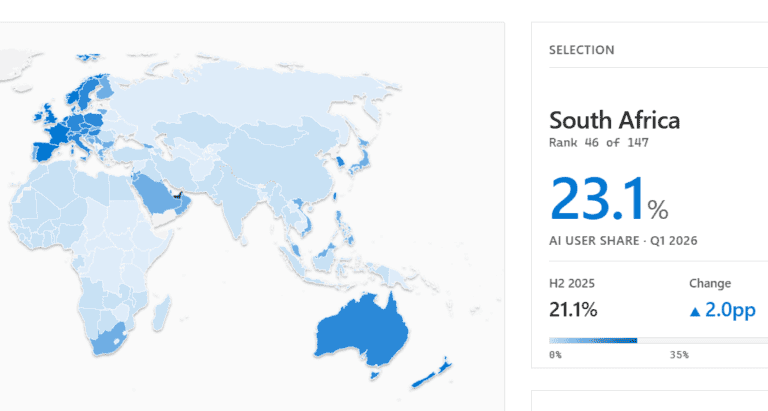
A stark digital divide is opening up across the African continent. New data published by Microsoft reveals that South Africa has surged significantly ahead of regional economic heavyweights Nigeria and Kenya in artificial intelligence adoption.
According to the latest figures released in the Microsoft Global AI Diffusion in Q1 2026 Report, South Africa has secured its spot as the continental frontrunner.
It recorded a 23.1% generative AI adoption rate among its working-age population. By contrast, Nigeria tracks much further behind at 10.1%, while Kenya registers at just 7.8%.
The Continental Leaderboard
The metrics, compiled by Microsoft’s specialised AI Economy Institute, demonstrate that South Africa is the only nation on the continent to break past the 20% adoption threshold.
The data highlights an uneven pace of technological integration that separates the continent’s top markets:
| Rank | African Nation | AI Adoption Rate (Q1 2026) |
|---|---|---|
| 1 | South Africa | 23.1% |
| 2 | Namibia | 15.1% |
| 3 | Libya | 15.0% |
| — | Nigeria | 10.1% |
| — | Kenya | 7.8% |
Infrastructure and Readiness Dictate the Gap
The widening gulf between South Africa and its peers is not a reflection of local tech-savviness, but rather a direct consequence of fundamental infrastructure disparities.
Microsoft’s findings indicate that AI transformation scales rapidly only where core foundational pillars, specifically reliable electricity, stable broadband connectivity, and localised cloud data centres, are already established.
- The Local Cloud Advantage: South Africa benefits directly from well-established hyperscale cloud data centres based in Johannesburg and Cape Town. This allows local enterprises and developers to leverage low-latency computing power.
- The Connectivity Bottleneck: Sub-Saharan Africa as a whole continues to battle the widest mobile broadband usage and coverage gaps globally. For many small businesses and workers in Nigeria and Kenya, the sheer cost and inconsistency of everyday internet access restrict active interaction with data-heavy generative AI models.
A Widening Global North-South Divide
On a macroeconomic scale, the report cautions that the broader AI adoption gap between the Global North and Global South is actively expanding.
Related
-
South Africa Tops Africa in Generative AI Adoption Despite Global Gap
-
Africa Rises in Global Rankings
Nigeria Calls for Continental AI Framework to Drive Africa’s Digital Future
- During the first quarter of 2026, global AI usage among the working-age population climbed to 17.8%. However, adoption in advanced economies rose to 27.5%, while developing nations averaged just 15.4%.
- Microsoft researchers noted that until basic barriers to infrastructure, data accessibility, and digital skills are systematically resolved, the economic advantages of artificial intelligence risk aggravating existing international inequalities.

Senior AI Writer
Bio: Okikiola is a writer and AI enthusiast with a background in Office Technology and Management from the Federal Polytechnic Offa. She went further to study an MSc in International Business at De Montfort University (DMU). With extensive work experience across administrative and business roles, she now focuses on exploring how artificial intelligence can transform work, innovation, and everyday life.