
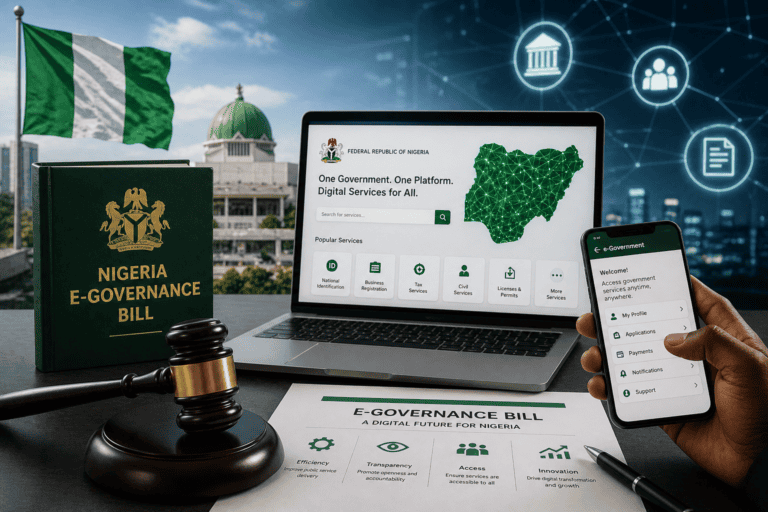
Nigeria has quietly taken a significant step toward governing artificial intelligence. Buried inside the Electronic Governance Bill 2025 – a broad digital infrastructure law currently before the National Assembly – are seventeen provisions that could determine how AI is built, deployed, and held accountable in this country for years to come. Most Nigerians have never heard of them. They should.
What the Bill Actually Says
Part XI of the Bill, titled Ethical Governance of Artificial Intelligence, sets out the rules that anyone who builds, deploys, or uses an AI system in Nigeria must follow. This is not restricted to big tech companies. It applies to hospitals using AI diagnostic tools, banks using credit-scoring algorithms, government agencies using automated decision systems, and startups building AI products for Nigerian markets.
The Bill lays down seven foundational principles that all AI systems must meet. Systems must be fair and non-discriminatory, ensuring they do not reinforce existing biases. They must be transparent and explainable, meaning users should be able to understand how a decision was made. They must be safe, secure, and robust. Crucially, the Bill demands accountability; a named individual or entity must be responsible for every AI system and human oversight, ensuring that no AI system operates entirely outside human control.
“Responsibility for the system’s operation and outcomes is assigned to a specific individual or entity, who can be held accountable.” – Section 63(1)(d), E-Governance Bill 2025
The Bill also creates a framework for regulatory sandboxes, controlled testing environments where AI innovators can develop and test new products under relaxed regulatory conditions before full public deployment. Startups, small businesses, and Nigerian-registered ventures with local ownership are explicitly prioritised. This is a meaningful gesture toward homegrown innovation.
What to Praise? Nigeria Is Showing Up
- Let us acknowledge this clearly: Nigeria is one of the very few African countries with legislation specifically addressing AI governance moving through its legislature. The EU AI Act took years to produce. Most African nations have not started. Nigeria is in the conversation, and that matters.
- WHAT THE BILL GETS RIGHT
- Citizens can contest AI decisions: The Bill requires AI systems to include mechanisms for due process and access to remedies. If an algorithm denies you a loan or flags you as a fraud risk, you have a legal right to challenge that decision.
- Bias is explicitly addressed: Developers must actively adopt safeguards to detect and reduce discriminatory outcomes, including indirect bias. This is not boilerplate; it is a legal obligation.
- Vulnerable groups are named: The Bill explicitly mentions women, youth, persons with disabilities, and rural communities as groups that must be considered in AI risk classification and sandbox prioritisation.
- Public accountability is built in: An annual AI impact assessment report must be published by the Minister, evaluating compliance and making policy recommendations, creating a formal public accountability mechanism.
- Nigerian innovators are prioritised: The sandbox framework gives preference to Nigerian-registered startups and enterprises targeting underserved populations, which is a direct investment in local AI capacity.
What to Question: The Gaps We Cannot Ignore
Praise without scrutiny is not accountability; it is flattery. The Bill has real strengths, but civil society must be honest about what is missing and what remains dangerously vague.
WHAT THE BILL LEAVES UNANSWERED
- “The Regulatory Agency” – which one? The Bill repeatedly refers to a Regulatory Agency but never clearly defines which institution this is. Is it NITDA? NCC? A new body? Without clarity, enforcement becomes a bureaucratic football.
- No timeline for implementation: The Bill states what must happen, but not when. Regulations can be issued at the Agency’s discretion, meaning the protections it promises could remain theoretical for years.
- Penalties are too low: The maximum financial penalty for violating the AI provisions is ₦10,000,000 (approximately $6,250 at current rates) or 2% of annual Nigerian revenue. For a large multinational, this is negligible & not a deterrent.
- Civil society is absent from governance: The Bill grants the Regulatory Agency broad powers but creates no formal mechanism for citizens, civil society organisations, or affected communities to participate in regulatory decisions or oversight processes.
- Enforcement capacity is assumed, not built: The Bill mandates inspections, audits, and investigations — but Nigeria’s existing regulatory bodies are already under-resourced. Passing a law does not create the institutional capacity to enforce it.
A law is only as strong as the institutions enforcing it. Nigeria does not need more legislation; it needs funded, capable regulators and an informed public that demands accountability.
What This Means for You
If this Bill passes in its current form, every Nigerian who interacts with an AI system, whether applying for a bank loan, using a government service, accessing healthcare, or consuming content online, gains legal rights they do not currently have. The right to know an AI made a decision about you. The right to challenge that decision. The right to seek compensation if it caused you harm.
But rights on paper are not rights in practice. Whether these protections mean anything depends on whether the Regulatory Agency is properly established and funded, whether enforcement is taken seriously, and whether Nigerians are aware enough of their rights to exercise them.
That is precisely why organisations like AI Safety Nigeria exist. We are not waiting for the law to be passed to start building an informed, empowered public. We are building the literacy, the research capacity, and the advocacy infrastructure that will hold these institutions accountable when the law arrives.
The Bottom Line
Nigeria’s E-Governance Bill 2025 is the most serious attempt this country has made to govern AI. It is imperfect; the penalties are weak; the regulator is undefined; and civil society has no formal seat at the table. But the foundations are there. What happens next depends on whether Nigerians, citizens, researchers, journalists, and advocates engage with this process before the ink is dry.
The people shaping AI in Nigeria are not only in Abuja or Lagos. They are in every community affected by an algorithm they cannot see, a decision they cannot contest, and a system they were never asked to design. This Bill is for them. They deserve to know it exists.

He is the Founder and Executive Director of AI Safety Nigeria, driving Nigeria’s most comprehensive AI literacy and safety movement. He is the convener of the first AI Safety Summit in Nigeria and the African Cybersecurity Convention, serves on the Advisory Council of Blacks in AI Safety and Ethics (BASE) USA, and brings over 15 years of cybersecurity expertise to the AI governance space.